

If a Civil Service job advert has asked for a statement of suitability instead of a CV and a covering letter, you are being assessed on something quite specific. The panel wants to see, in your own words, that you meet the essential criteria for the role. It is one of the most common stumbling blocks in the Civil Service application process. Most candidates treat it like a cover letter, when it actually needs to work like structured, evidence-led proof.
This guide walks through what a statement of suitability actually is and how it differs from a personal statement or a covering letter. It also covers how long it should be, how to structure it, and includes a full worked example you can adapt.
What is a statement of suitability?
A statement of suitability is a short, focused piece of writing submitted as part of a Civil Service job application. Its only job is to show the sift panel that you meet the essential criteria listed in the job advert and person specification. You do this using specific evidence from your own experience, not general claims.
It usually replaces, rather than sits alongside, a traditional CV and cover letter. Some campaigns ask for a Civil Service CV plus a short suitability statement. Others ask for the statement alone. Always check the exact wording on the job advert and the “how to apply” section, since requirements vary by department and role.
Unlike a general personal statement for a university application, a Civil Service statement of suitability is criteria-driven. You are not writing freely about your career story. You are proving, point by point, that you can do the job as advertised.
How is it different from a cover letter or personal statement?
The three documents sound similar, but they serve different purposes. Mixing them up is one of the most common mistakes candidates make.
A covering letter is usually a narrative pitch: why you want the job, why you want the organisation, and a broad summary of your fit. A personal statement, in a university or general job-search context, often blends career story with motivation. It is less rigidly tied to named criteria. A statement of suitability is different again. It exists specifically to prove each essential criterion, using the panel’s own language, either criterion by criterion or through a structured narrative that clearly covers all of them.
Imagine you submit a generic cover letter where a statement of suitability was asked for. A sift panel marking strictly against the essential criteria will struggle to find your evidence, even if it is technically present somewhere in the text. Structure and signposting matter as much as content here.

How long should a Civil Service statement of suitability be?
Word limits vary by campaign, but 250 to 500 words is a common range. Many campaigns set a strict limit, enforced by the application system itself. Check the advert carefully. Some senior or specialist roles allow up to 750 or 1,000 words, while high-volume graduate schemes often cap it much lower.
Treat the stated limit as a hard rule, not a guideline. Sift panels read a high volume of applications. Anything that runs over the limit may be cut off automatically, or marked down for not following instructions. That is itself an unspoken test of attention to detail.
Within that limit, the most common failure is trying to cover too much ground too thinly. It is far better to evidence three or four essential criteria properly, with specific examples, than to gesture vaguely at every line of the person specification in the same word count.
What should you include?
Before writing anything, go through the job advert and person specification. List every essential criterion named. These are usually phrased as skills, experience types or behaviours. Examples include “experience of managing stakeholder relationships” or “ability to analyse complex information and present clear recommendations.” Essential criteria are non-negotiable. Miss one entirely, and you risk being sifted out regardless of how strong the rest of your statement is.
For each criterion, find one concrete example from your work, education, voluntary activity or other relevant experience that proves you have it. A good example names the situation, what you specifically did, and the measurable or observable outcome. Numbers, outcomes and specific tools carry far more weight than general claims. Saying “I am a strong communicator” proves nothing on its own.
If the campaign also references Success Profiles behaviours, weave the relevant behaviour language in naturally rather than bolting it on as a separate section. Only split it out separately if the advert specifically asks for behaviours to be addressed that way. See our companion guide on the Success Profiles framework for more on this.
Step-by-step: how to write your statement
Plan before you write
Start by highlighting every essential criterion in the job advert and person specification. Then match at least one real example to each one. Draft this as a simple table before you write a single sentence of prose: criterion in one column, your evidence in the other. This single step prevents the most common failure, which is writing a fluent statement that never actually proves the criteria.
Check the exact word limit and any formatting instructions (font, headings, whether bullet points are allowed) stated on the application portal. These vary between campaigns, and some are enforced automatically.
Reread the job advert’s own wording, and note the specific phrases it uses for each criterion. Where accurate, mirror that language in your statement. This is not padding. Sift panels often score against a checklist built directly from the advert’s wording. Matching phrasing makes it far easier for an assessor to tick your evidence against their checklist quickly.
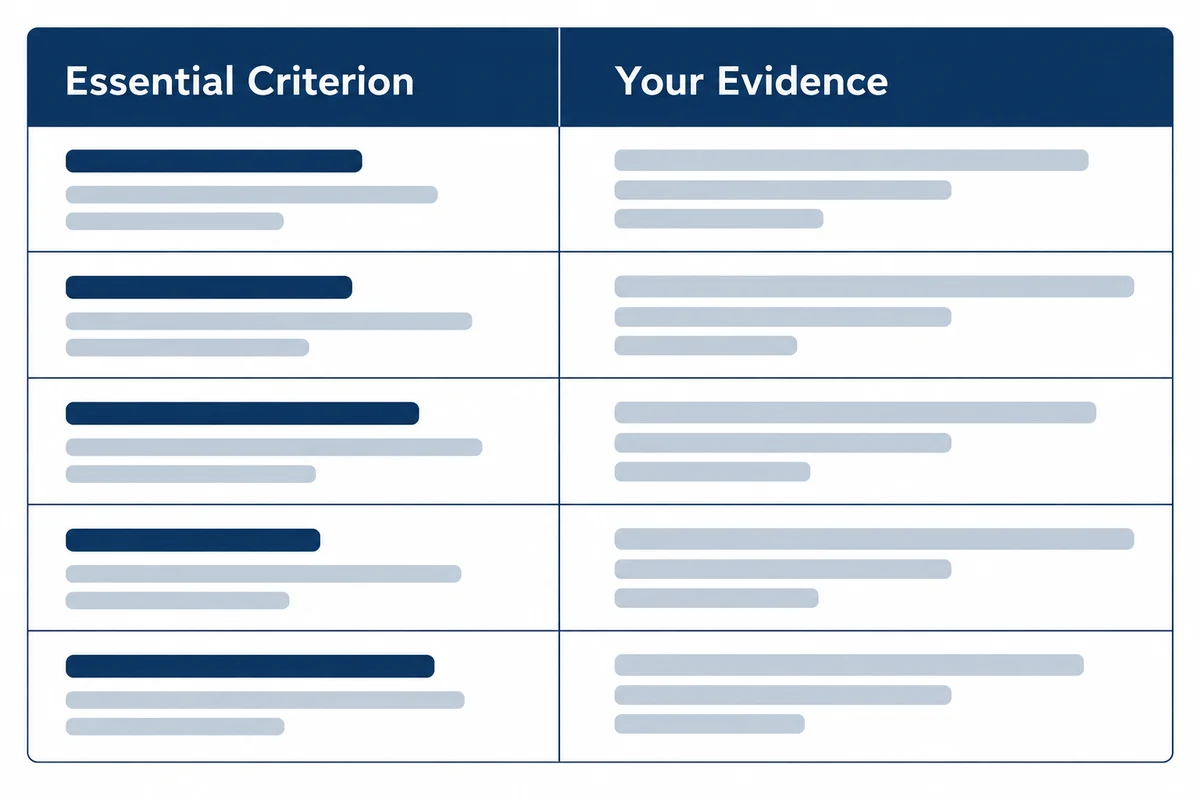
Structure the statement
Open with one or two sentences that state your interest in the role and briefly signal your overall fit, without repeating your CV. Avoid generic opening lines such as “I am writing to apply for the position of…” The panel already knows this from the application system, so use the space for something that earns its place.
For the body, address each essential criterion in turn. Use short subheadings matching the advert’s own wording, or clearly signposted paragraphs. Within each one, state the criterion, give your specific example, and name the outcome. A workable one-sentence formula is: situation, action, result, in that order, kept tight enough to fit the word count.
Close with a short final line connecting your overall profile back to the role. Do not introduce new, unevidenced claims here. One sentence is usually enough.
Polish and check
Read the statement back against your criteria table from the planning stage. Confirm every essential criterion has a clear, specific piece of evidence attached, not just a passing mention.
Cut anything that describes a responsibility without an outcome. “Responsible for managing a small team” tells the panel what your job title covered. “Managed a team of six, restructuring workloads to cut missed deadlines by a third over two quarters” tells them what you actually achieved.
Check the word count against the limit stated on the advert. Then check spelling, grammar and formatting one final time. A statement that is strong on content but careless on basics undermines the very attention-to-detail impression you are trying to create.
Civil Service statement of suitability: worked example
Below is a condensed example for a fictional Executive Officer role. The essential criteria here are stakeholder management, written communication, and working under pressure to deadlines. Adjust the specifics to your own real evidence and the real criteria in the advert you are applying to.
I am applying for the Executive Officer, Operations Policy role because it combines the stakeholder management and analytical writing I have developed over four years in a fast-paced operational environment with a chance to contribute directly to public-facing service improvements.
In my current role, I manage relationships across five internal teams and two external suppliers to coordinate monthly service reporting. When a reporting process was causing repeated delays, I redesigned the data-collection template and agreed a shared deadline structure with each stakeholder. This cut late submissions from a third of cases to under five percent within two reporting cycles. The work required adapting my communication style across technical and non-technical audiences, and I regularly brief senior non-expert stakeholders on complex operational data in plain, accessible language.
I am used to producing clear written analysis under time pressure. During a recent service review, I was asked to draft a ten-page briefing summarising findings from six workstreams within two working days, for presentation to senior leadership. I structured the brief around three clear recommendations, supported by concise evidence. It was adopted without amendment and used directly in the subsequent decision meeting.
I regularly manage conflicting deadlines by prioritising against business impact, rather than simply working through tasks in the order they arrive. I proactively flag risks to deadlines early, rather than waiting until they become a problem for stakeholders further down the line.
Notice that each paragraph maps to one criterion. Each one opens by signalling what is being evidenced, then closes on a specific, measurable outcome rather than a general claim.
Common mistakes to avoid
The single most common mistake is writing a general career summary instead of directly evidencing the named essential criteria. This leaves the panel unable to tick you off against their scoring sheet, even when relevant experience exists somewhere in your background.
A close second is ignoring the word limit. Some candidates run well over it; others pad a short limit with filler to look thorough. Both signal the same thing to a panel: an inability to follow a specific instruction. That rarely reflects well in a Civil Service context built around process and accuracy.
Vague claims without evidence are another frequent problem. Saying you are “highly organised” or “an excellent communicator” without a concrete example carries almost no weight on its own. The example is the proof, not the adjective.
Finally, reusing the same generic statement across multiple applications is easy for an experienced sift panel to spot. Adapting it to each advert’s specific wording and criteria also gives you the chance to mirror the exact language the role is being scored against.
Frequently asked questions
How long should a Civil Service statement of suitability be?
Check the specific job advert, since word limits vary by campaign, but 250 to 500 words is a common range. Some senior or specialist roles allow more. High-volume schemes often set a lower limit, enforced by the application portal.
Is a statement of suitability the same as a personal statement?
Not quite. A personal statement is often a broader narrative about your career and motivation. A Civil Service statement of suitability is specifically structured to evidence the essential criteria named in the job advert and person specification.
Do I need to address every essential criterion?
Yes. Essential criteria are the minimum requirements for the role. Failing to evidence one risks being sifted out, regardless of how strong your other evidence is. Desirable criteria are worth including if space allows, but essential criteria come first.
Can I use bullet points in a statement of suitability?
Check the application instructions first. Some campaigns specify prose only, while others accept clear headings or bullet points. When in doubt, short paragraphs with clear signposting are a safe, widely accepted format.
What’s the best structure if the advert doesn’t specify one?
A short opening, one paragraph per essential criterion addressed in the advert’s own order, and a brief closing line connecting your profile to the role is a reliable, panel-friendly default structure.
Should I mention Success Profiles behaviours in my statement?
Only if the job advert asks for them here specifically. Many campaigns assess Success Profiles behaviours separately, for example at interview. Check the advert’s assessment stage breakdown before folding behaviour language into your suitability statement.
Recent Comments