
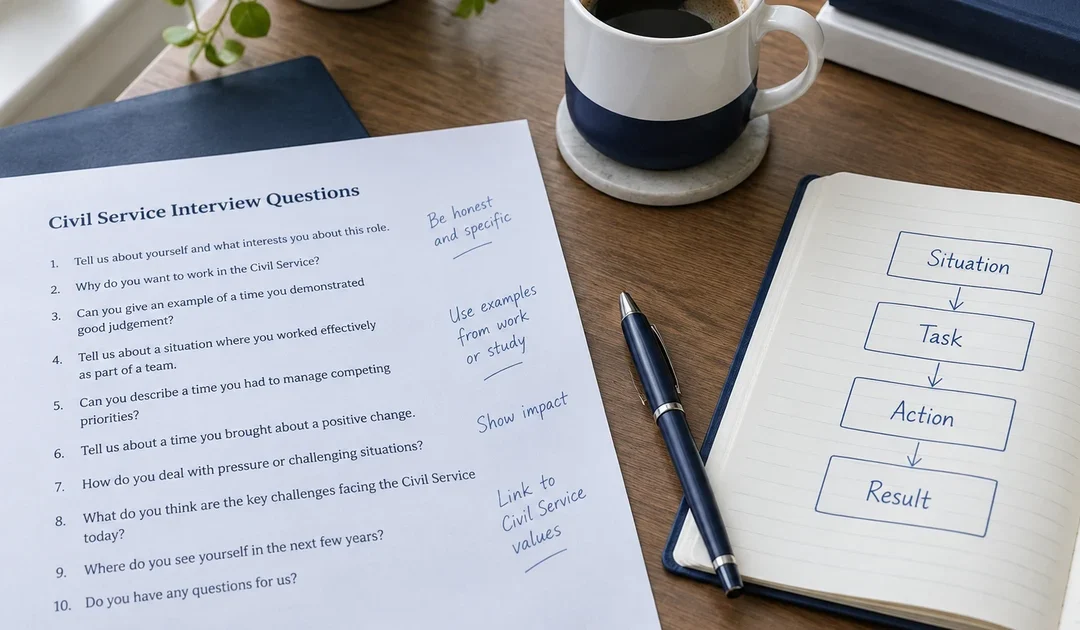
Getting invited to a Civil Service interview is a genuine achievement. The application process is competitive, and a lot of candidates never get past the written stage. But the interview itself catches many people out, because it follows a different structure to most private-sector interviews. It is built around the Success Profiles framework, and the Behaviours in particular, and it rewards candidates who prepare specific, structured examples in advance.
This guide walks through how Civil Service interviews are structured. It gives real example questions for the most commonly assessed Behaviours, shows how to answer them using the STAR method, and covers the mistakes that cost candidates marks.
How a Civil Service interview is structured
Most Civil Service interviews are built around the Success Profiles framework, the official assessment model used across Civil Service recruitment. Depending on the role, you may be assessed on some combination of Behaviours, Strengths, Experience and Technical ability. Behaviours are the part almost every interview includes, and the part candidates find hardest to prepare for.
A panel (usually two or three people) will ask you to describe a specific situation where you demonstrated a named Behaviour, such as Communicating and Influencing or Working Together. They are not asking what you would do in theory. They want a real example from your own experience, told in enough detail that they can score it against set criteria.

Each Behaviour question is usually followed by probing or “drill-down” questions, where the panel asks you to clarify or expand on a detail in your answer. These are not trick questions. They exist to check that your example is genuine and that you actually did what you are describing, so do not panic if you get a follow-up question. Treat it as a chance to add more useful detail.
If the role includes Strengths-based questions, these are different again. They ask what you enjoy doing or what comes naturally to you, not what you have done before, so there is less preparation possible and more value in answering honestly and quickly.
The STAR method, applied properly
Every Civil Service Behaviour answer should follow the STAR structure:
- Situation: a short, specific setup. One or two sentences on the context, not a long history.
- Task: what you needed to achieve and why it mattered.
- Action: what you personally did, step by step. This is the longest part of the answer and should use “I”, not “we”.
- Result: what happened, ideally with a measurable or observable outcome, plus a short reflection on what you learned.
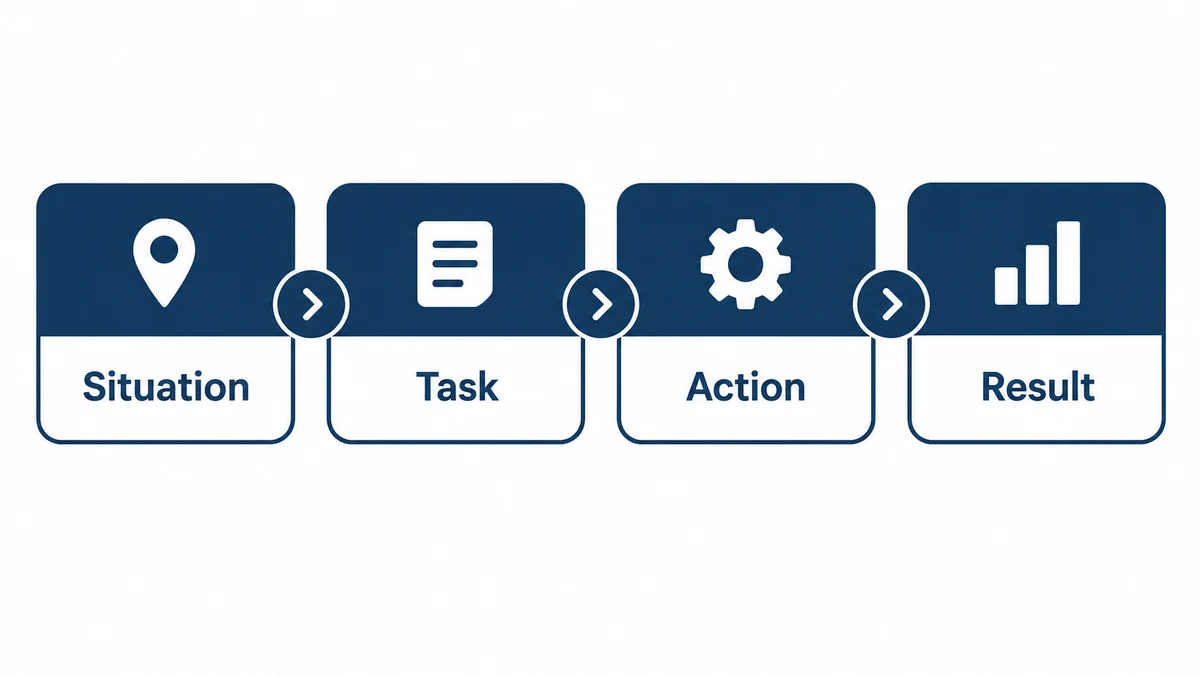
A common mistake is spending too long on Situation and Task and rushing the Action and Result, which is exactly where the marks are. Aim for roughly 10 to 15 percent of your answer on Situation and Task combined, and the rest split between Action and Result.
Example questions and answers by Behaviour
Below are worked examples for the Behaviours most frequently assessed at interview. Use these as a model for structure and level of detail, not as a script to copy. Panels can tell when an answer is memorised rather than genuinely the candidate’s own.
Communicating and Influencing
Question: “Tell me about a time you had to explain something complicated to someone who did not have the same background knowledge as you.”
Example answer:
- Situation: “In my previous role I needed to explain a change to our internal reporting process. The team had used the old system for several years.”
- Task: “Several people were confused by the change. A few were resistant to it. I needed everyone using the new process correctly within two weeks.”
- Action: “I ran two short drop-in sessions rather than one long meeting. I used a one-page visual comparing old and new steps side by side. I followed up individually with the two people who seemed least confident.”
- Result: “By the deadline, the whole team was using the new process correctly. Two colleagues later told me the one-page comparison was what made it click for them. I now use the same approach whenever I introduce a process change.”
Working Together
Question: “Give an example of a time you worked with a team or colleague you found challenging.”
Example answer:
- Situation: “I was paired with a colleague on a joint project. We had very different working styles. I preferred to plan everything up front and they preferred to adapt as we went, which caused some early friction.”
- Task: “We had a shared deadline. We needed to agree one approach rather than working against each other.”
- Action: “I suggested we each write down our top three priorities for the project. We compared them and found we actually agreed on the outcome, even though our process was different. I then built a simple shared plan that left room for the flexibility they wanted.”
- Result: “We delivered on time. The working relationship was good enough that we chose to work together again on a later project.”
Delivering at Pace
Question: “Tell me about a time you had to deliver something to a tight deadline.”
Example answer:
- Situation: “I was given a report to complete with two days’ notice instead of the usual two weeks, due to an unexpected change in a senior stakeholder’s schedule.”
- Task: “I needed to produce something accurate and useful in that time, without compromising on quality.”
- Action: “I identified the three sections that mattered most to the audience and drafted those first. I used a template from a previous report to save time on formatting, rather than starting from scratch.”
- Result: “The report was delivered on time and the stakeholder used it as the basis for their decision. I later turned the shortened structure into a template I still use for urgent requests.”
Managing a Quality Service
Question: “Describe a time you had to balance competing demands while still meeting a required standard.”
Example answer:
- Situation: “I was handling two requests at once, one from a senior manager and one from an external contact, both marked urgent.”
- Task: “I needed to meet both deadlines without letting quality slip on either.”
- Action: “I checked the actual deadline on each, rather than assuming both were equally urgent. I found one had a day’s flexibility and reprioritised accordingly, while keeping both requesters informed of my plan.”
- Result: “Both pieces of work were delivered to the standard required. The senior manager specifically commented on being kept updated throughout.”
Strength-based questions
If your interview includes Strengths, expect quick, instinctive questions such as “what part of your current job do you enjoy least?” or “tell me about a time you felt really motivated at work.” There is no STAR structure here and very limited preparation value, because the panel is listening for genuine, immediate reactions rather than a rehearsed answer. The best preparation is simply reflecting honestly, before the interview, on what energises you and what drains you, so you are not caught off guard trying to invent an answer on the spot.
Common mistakes to avoid
- Vague examples. “I’m good at communicating” is not an answer. The panel needs a specific situation with a beginning, middle and end.
- Talking about the team instead of yourself. Panels are scoring you, not your team, so make sure your Action section is about what you personally did.
- No measurable result. Even a soft result (“my manager asked me to run the same approach again”) is better than no result at all.
- Reusing one example for every question. Prepare at least one distinct example per Behaviour being assessed, so you are not stretching the same story to fit a question it does not really answer.
- Memorised, word-for-word answers. These come across as rehearsed and fall apart under follow-up questions. Know your examples well enough to adapt them, rather than reciting them.
- Not reading the job advert’s Behaviours list. Different roles weight different Behaviours differently. Prepare examples matched to the specific Behaviours listed for the role you applied for, not a generic set.
For the written stage of the application, see our guides on the Civil Service statement of suitability and the Civil Service CV. For interview advice beyond the Civil Service, see our general guide on how to prepare for a job interview.
Frequently asked questions
How many examples should I prepare for a Civil Service interview?
Prepare at least one strong, distinct example for each Behaviour listed in the job advert, plus one or two spares in case a follow-up question needs a different angle.
Can I reuse an example from my Statement of Suitability at interview?
Yes, but expand it with more detail than you had space for in writing, and be ready for probing questions that ask you to go deeper than your original written version.
What if the panel asks a follow-up question I have not prepared for?
Answer honestly from the same example rather than inventing new detail. Panels ask follow-up questions to check your example is genuine, not to catch you out.
Do I need a different example for every Behaviour, or can one story cover two?
One well-chosen example can sometimes demonstrate two Behaviours, but only use this if the fit is genuine. Forcing one story to cover a Behaviour it does not really show will weaken your score on that Behaviour.
How long should a Behaviour answer be at interview?
Roughly two to three minutes is a good guide. Long enough to cover STAR properly, short enough that you are not losing the panel’s attention or repeating yourself.
What is the difference between a Civil Service interview and a private-sector interview?
A Civil Service interview is scored formally against the specific Behaviours (and Strengths or Experience, where relevant) listed for the role, using set criteria the panel applies consistently across every candidate. A private-sector interview is often more conversational and less structured.
Recent Comments