
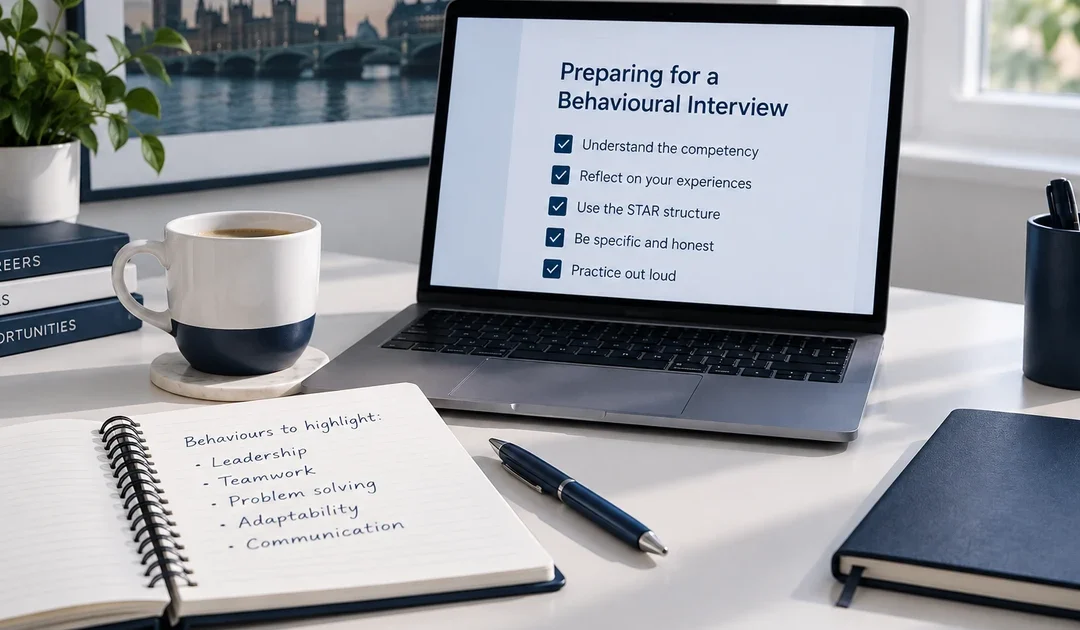
Every Civil Service job advert lists a set of behaviours. You might see “Delivering at Pace” or “Communicating and Influencing” and wonder exactly what the panel wants from you. These behaviours sit at the centre of the Success Profiles recruitment framework. Getting them right is often the single biggest factor in whether your application passes the sift.
My complete guide to applying for the Civil Service covers the whole application process, from reading the advert through to the STAR method. This guide goes one level deeper. It works through all 9 official Civil Service Behaviours one at a time. For each one, you get a plain-English definition, what panels look for, and a short worked example.
What the Behaviours framework is
Behaviours are one of five elements inside Success Profiles. The other four are strengths, ability, experience and technical skills. The Cabinet Office defines behaviours as the actions and activities that result in effective performance in a job. In practice, they describe how you work, not just what you have done.
A few things to know before you start matching examples to behaviours:
- Not every advert uses every behaviour. A role will usually ask for 2 to 4 of the 9, chosen to fit that job.
- Behaviours are graded. What “good” looks like at Administrative Officer level is different from Grade 7 or Senior Civil Service level. Check the advert or the linked grade profile for the right level.
- The same behaviour can be assessed in different ways. It might show up in a written example at application stage, or in a behaviour-based question at interview, or both.
Always check the exact wording and grade level in the advert itself. Official definitions and grade-level indicators live on GOV.UK’s Success Profiles: Civil Service behaviours page. Read the exact descriptor for your grade before you write.

The 9 Civil Service Behaviours
1. Seeing the Big Picture
What it means: Understand how your role supports your team’s objectives and your department’s priorities. Keep the wider national interest in view, not just your own task list.
What panels look for: Evidence that you understood why a piece of work mattered beyond your immediate job. Show that this understanding changed how you approached it.
Short example: “I noticed our local process was creating extra work for a partner team upstream. I flagged this to my manager with a proposed fix. The wider directorate later adopted it as standard practice.”
2. Changing and Improving
What it means: Look for ways to work more efficiently and suggest new ideas. Be open to feedback rather than defaulting to “the way we’ve always done it.”
What panels look for: A specific improvement you identified or helped deliver, plus the measurable difference it made.
Short example: “I redesigned our weekly reporting spreadsheet after noticing colleagues duplicating the same manual checks. The new version cut preparation time from two hours to twenty minutes.”
3. Making Effective Decisions
What it means: Use evidence, data and sound judgement to reach decisions. Weigh up risks and alternatives rather than guessing.
What panels look for: A real decision you made or strongly influenced. Show what evidence you used and why you chose that option over the alternatives.
Short example: “Two suppliers quoted similar prices. I compared their delivery records and compliance history before recommending one of them. The project board approved my recommendation.”
4. Leadership
What it means: Show pride in public service and help create a shared sense of purpose. Value fairness, diversity and inclusion, whether or not you manage people formally.
What panels look for: How you motivated or involved others, even informally. Show that you made sure different views were heard.
Short example: “Our team took on a new process with no formal training. I volunteered to write a simple guide and ran two short walkthrough sessions. Nobody was left behind.”
5. Communicating and Influencing
What it means: Explain things clearly and honestly, and adapt your style to your audience. Listen to other people’s views rather than just pushing your own.
What panels look for: A time you had to explain something complex in simple terms, or persuade someone who did not initially agree with you.
Short example: “I needed a non-technical director to approve a system change. I replaced the usual jargon-heavy briefing with a one-page summary and a short demo. It got sign-off at the first meeting.”
6. Working Together
What it means: Build positive, professional relationships across your team and with other people. Value different perspectives and resolve conflict constructively.
What panels look for: Evidence of collaborating with people outside your immediate team, or handling a disagreement in a way that kept the relationship working.
Short example: “Two colleagues disagreed over how to split a shared task. I suggested we each list our priorities and found a split that covered both. We used that split as our template going forward.”
7. Delivering at Pace
What it means: Take responsibility for achieving results. Work with energy and focus under pressure, and keep quality up even against a deadline.
What panels look for: A real deadline or workload pressure, the practical steps you took, and a measurable outcome.
Short example: “A colleague left the team two days before a report was due. I reprioritised my own workload and delegated two smaller tasks. I delivered the report on time with no drop in quality.”
8. Managing a Quality Service
What it means: Deliver a service that is efficient and effective. Focus on what the end user actually needs, and stay consistent with relevant policy and legislation.
What panels look for: A time you identified or fixed a gap between what a service was delivering and what users actually needed.
Short example: “I noticed repeat phone queries about the same form field. I rewrote the guidance notes in plain English. That specific query type fell by around a third the following month.”
9. Developing Self and Others
What it means: Invest time in your own learning, and support the growth of people around you. Ask for feedback, and act on it.
What panels look for: What you did to close a skill or knowledge gap, or how you helped a colleague develop theirs.
Short example: “I asked my line manager for feedback after a difficult meeting. I used it to change how I prepare for similar sessions. I later passed on the same approach to a newer colleague.”
How to choose which examples to write
- List every behaviour named in the advert, along with its grade level if stated.
- Brainstorm two or three possible examples per behaviour before you commit to one. Pick the example where your own action, not the team’s, drove the outcome.
- Check the result is specific. A number, a timeframe or a clear change in outcome carries far more weight than “it went well.”
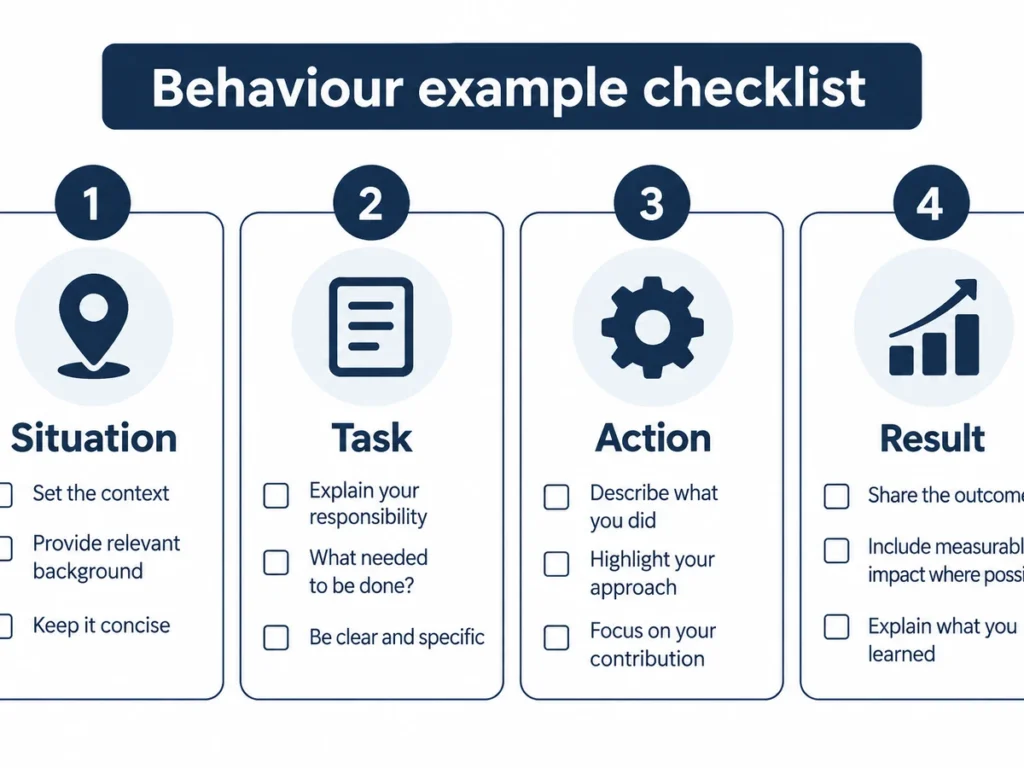
- Build each example with STAR (Situation, Task, Action, Result). My complete Civil Service application guide walks through a full worked STAR example in detail, including how much of your word count each part should take.
- Match your example to the right section. Behaviour evidence usually belongs in your personal statement or a dedicated text box. Keep it separate from your statement of suitability if the advert asks for both.
Common mistakes to avoid
- Describing the team’s achievement instead of your own. Panels score your personal contribution, not “we.”
- Picking an example that technically fits but is not your strongest one. A smaller example with a clear result beats a big project where your role was unclear.
- Ignoring the grade level. An example that works for an Administrative Officer role may read as too junior, or too senior, for the grade you are applying at.
- Reusing one example for every behaviour. It is fine to reuse a strong story across a CV and a personal statement. But each behaviour needs evidence that genuinely matches its own definition.
FAQ
How many Civil Service behaviours are there?
There are 9: Seeing the Big Picture, Changing and Improving, Making Effective Decisions, Leadership, Communicating and Influencing, Working Together, Delivering at Pace, Managing a Quality Service, and Developing Self and Others.
Do I need to write examples for all 9 behaviours?
No. Each advert names the specific behaviours being assessed for that role, usually two to four of them. Check the advert and person specification carefully.
Are the behaviours the same at every grade?
No. Each behaviour has grade-specific descriptors, from Administrative Officer through to Senior Civil Service. The advert or the GOV.UK grade profile tells you which level applies.
What is the difference between a behaviour and a strength?
Behaviours are the actions you take, assessed through examples and evidence. Strengths are what you naturally enjoy and do well. These are usually assessed through short, instinctive answers at interview, not written examples.
Which method should I use to write behaviour examples?
STAR (Situation, Task, Action, Result) is the standard approach. It is the one Civil Service panels expect to see.
Where can I find the official definitions?
GOV.UK publishes the full Success Profiles: Civil Service behaviours document. It includes grade-level descriptors for each behaviour.
Recent Comments