More UK employers, and every Civil Service application, now ask candidates to submit an anonymised CV, sometimes called a blind CV, as part of “blind recruitment.” The idea is simple: strip out anything that could reveal your identity, so your application is judged on substance rather than your name, age or background. In practice, though, most candidates aren’t sure exactly what to remove or keep. Fewer still know how to make a strong impression once the usual personal details are gone. This guide covers what an anonymised CV actually is, why employers use one, and exactly what to take out and leave in. You’ll also find a full before/after example and how it fits into processes like Civil Service recruitment.
What is an anonymised CV?
An anonymised CV, also called a blind CV or name-blind CV, is a version of your CV with personally identifying details removed. The person reviewing it can’t tell your name, gender, age, ethnicity or background from the document alone. It’s the CV equivalent of a “blind audition”: the panel scores your skills, experience and achievements, not who you are.
You’ll usually encounter one of two approaches:
- The employer anonymises it for you. Some large employers and public-sector recruiters, many Civil Service departments included, strip out identifying fields before your CV reaches the hiring panel. This might be an automated system or a member of the HR team. You submit a normal CV; the anonymisation happens on their end.
- You’re asked to submit an already-anonymised CV. Increasingly, some employers explicitly ask candidates to remove identifying details themselves before submitting. This is the version most people are searching for help with, and the focus of this guide.
If a job advert or application portal doesn’t say either way, it’s worth checking directly with the recruiter. Submitting a fully anonymised CV when a normal one was expected can occasionally look like a formatting mistake rather than a deliberate choice. Always follow the specific instructions given.

Why do employers use blind recruitment?
Blind or anonymised recruitment exists to reduce unconscious bias at the shortlisting stage. A name, a school or even a hobby can unintentionally sway a reviewer before they’ve properly read the evidence. Employers use it to:
- Widen the pool of candidates who get to interview stage, including those from under-represented or non-traditional backgrounds.
- Meet diversity and inclusion commitments, particularly in the public sector, and support compliance with the Equality Act 2010. The Civil Service has used name-blind recruitment as standard practice for several years.
- Demonstrate fair hiring practice for compliance, audit or employer-brand reasons.
- Focus panels on demonstrable skills and achievements rather than assumptions drawn from a name, address or educational background.
It isn’t about hiding your capability. It’s about making sure your capability is what gets you through the door.
What to remove from an anonymised CV
If you’re asked to anonymise your own CV before sending it, work through this checklist. The goal is to keep every piece of evidence about what you can do, while removing anything that signals who you are.
Remove:
- Your full name (use “Candidate” or a candidate/reference number if one’s been provided)
- Photo, if you’d normally include one
- Date of birth or age
- Gender, marital status or nationality
- Home address (a general region, e.g. “Greater Manchester,” is usually fine if location relevance matters)
- Email address and phone number containing your name (create a neutral email such as candidate123@email.com for the application if asked to fully anonymise contact details, unless the employer tells you contact details can stay for logistics)
- Names of employers, if the process asks for full anonymisation (some processes only ask you to remove personal identifiers, not company names, so check the instructions)
- University or school names, if the process specifically flags educational background as a bias risk (again, follow the specific brief; not every anonymised process asks for this)
- Personal interests or memberships that could hint at background, gender or age (e.g. a specific society, club or hobby with a strong demographic association)
- Any photo, logo or personal branding in the CV design
Keep:
- Job titles, responsibilities and achievements
- Dates of employment (durations matter for evidencing experience, even if the birth date doesn’t)
- Skills, qualifications and certifications relevant to the role
- Quantified results and impact (“increased regional sales by 18%”)
- Reference to sector or industry experience
The test for every line: does this tell the panel what I can do, or does it tell them who I am? Keep the former, cut the latter.
How to write an anonymised CV, step by step
Strip identifiers and rewrite
- Start from your normal, strongest CV. Anonymising isn’t about writing a weaker document. It’s an editing pass on your best existing CV, not a new document built from scratch.
- Replace your name in the header with “Candidate” or the reference number given by the employer, and remove any photo or personal branding from the template.
- Strip demographic and contact identifiers using the checklist above, based on exactly what the employer’s instructions ask for. If the instructions are vague, err on the side of removing more rather than less, then adjust if the employer clarifies.
- Re-read every bullet point for indirect identifiers. Watch for details that unintentionally reveal age (e.g. “25 years’ experience since 1989”), gender, or background even after the obvious fields are removed. Phrases like “as a mother of two” or “captain of the ladies’ hockey team” are easy to miss on a first pass.
- Check your referencing style and sign-off too. A covering note or email that still says “Kind regards, Sarah” defeats the purpose if the CV itself is anonymised. Keep the whole submission consistent, not just the document.
Polish and proofread
- Keep achievements evidence-led. With identity removed, your bullet points are doing all the work. Make sure each one states a clear, specific, measurable result rather than a vague responsibility.
- Check the formatting still reads cleanly. Removing a photo or contact block can leave awkward white space. Adjust the layout so the CV still looks intentional, not stripped-down.
- Check the document’s metadata, not just the visible text. Word and PDF properties often store the file’s original author name even after the visible CV has been fully anonymised.
- Save it as a new, clearly labelled file (e.g. “Anonymised-CV-CandidateRef123.pdf”) so you don’t accidentally send the wrong version to the wrong process.
- Proofread once more as “Candidate.” It’s easy to miss a stray mention of your name in a project title, a cover letter reference, or a file name you forgot to rename.
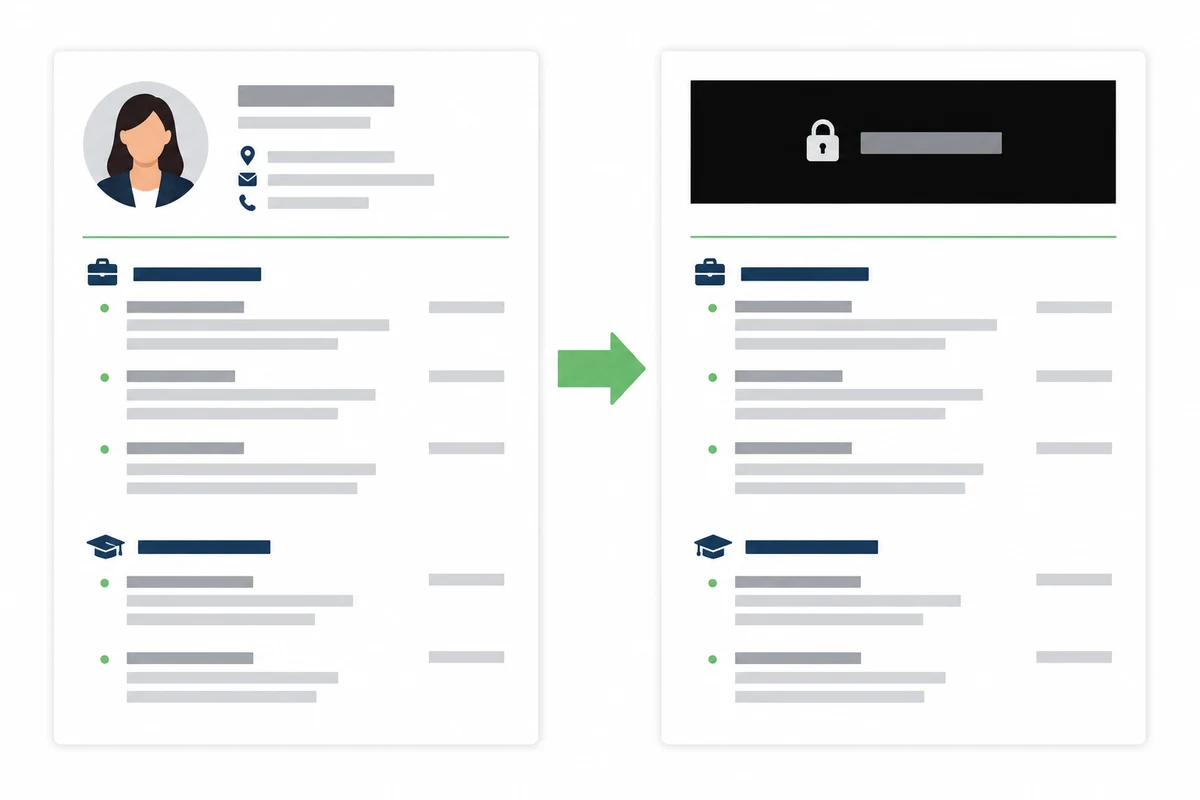
Anonymised CV example: before and after
Before (standard CV header and bullet):
Sarah Whitfield
07123 456789 | sarah.whitfield32@email.com | Manchester
Marketing Manager, Acme Retail Group (2019 to present)
Led a team of 6 to deliver our Christmas 2023 campaign, drawing on 12 years in retail marketing since graduating from the University of Leeds in 2011.
After (anonymised for a blind-recruitment process that asks for full identifier removal):
Candidate Reference: 4471
Location: North West England
Marketing Manager, Retail Sector (2019 to present)
Led a team of 6 to deliver a national Christmas campaign that increased seasonal revenue by 22% year-on-year, drawing on over a decade of retail marketing experience.
Notice what changed: name, contact details, employer name and the graduation year (an age indicator) are gone. What stayed, and what actually matters to a hiring panel, is the scope of the role, the team size, the sector and a quantified result.
Anonymised CVs and Civil Service applications
Civil Service recruitment is one of the most common places UK candidates encounter anonymised CVs and name-blind sifting, alongside the Civil Service’s standard application format. If you’re applying through the Civil Service specifically, the process, evidence structure and Statement of Suitability requirements differ from a standard CV. Our full guide, how to write a winning Civil Service CV, covers name-blind sifting in that context in more detail, including a downloadable template.
Common mistakes to avoid
- Removing too little. Leaving in a personal email address, a distinctive hobby or a graduation year defeats the purpose of anonymising the document.
- Removing too much. Stripping out employer names or dates when the process didn’t ask for it can make your experience harder to evidence and verify.
- Forgetting the file name and document properties. Word and PDF files can carry your name in the file name or “Author” metadata even after you’ve edited the visible text. Check both before submitting.
- Sending the wrong version. Keep your anonymised CV clearly labelled and separate from your standard CV so you never send the wrong one to the wrong process.
- Treating anonymisation as a downgrade. An anonymised CV should read as confidently and specifically as your normal one. It just removes the “who,” not the “how good.”
- Leaving identifying details in attachments or covering emails. A separate cover letter or email thread signed with your full name alongside an anonymised CV undermines the whole process.
- Assuming one template fits every process. Some employers ask for name and contact removal only; others ask for institution and employer names to go too. Always re-check the specific brief rather than reusing a previous anonymised CV unchanged.
- Ignoring instructions on candidate numbering. If an employer provides a reference number format, use it exactly as given. An inconsistent or self-invented reference can cause your application to be mismatched or delayed during sifting.
Anonymised CV FAQs
How do I anonymise my CV?
Remove your name, contact details, date of birth, photo and any other personal identifiers. Replace your name with a candidate reference if one has been provided. Keep job titles, dates, skills and quantified achievements, since these are what the panel actually assesses.
What is a blind CV?
A blind CV, also called a name-blind or anonymised CV, is a CV with personal identifying details removed. This lets a hiring panel assess your skills and experience without knowing your name, age, gender or background.
Do I need to remove my university name from an anonymised CV?
Only if the employer’s instructions specifically ask for it. Some anonymised processes only ask you to remove personal identifiers like your name and date of birth. Others also treat educational institution as a potential bias signal, so always follow the specific brief you’ve been given.
Is Civil Service recruitment always anonymised?
Many Civil Service application processes use name-blind sifting at the shortlisting stage, but the exact process varies by department and role. Check the specific job advert and application guidance for confirmation.
Should I use a candidate number instead of my name?
Yes, if one has been provided or requested. If not, “Candidate” is a safe, neutral replacement for your name in the header.
Will an anonymised CV hurt my chances?
No, it’s designed to be fairer, not weaker. As long as your achievements are specific and quantified, an anonymised CV should represent your capability just as strongly as a standard one.
If you’d like a second pair of eyes on your CV, anonymised or otherwise, I offer a free CV review before you submit it. You can also work with me 1-to-1 on a bespoke CV tailored to the role and process you’re applying for. See the CV writing service for details.
Recent Comments