Introduction
Applying for a UK Civil Service job in 2025 can feel confusing, even for experienced professionals. The terminology is different, the Success Profiles framework is unfamiliar, and the application form asks for sections that don’t exist in most private-sector recruitment, Employment History, Previous Skills and Experience, behaviour-based examples, and a Statement of Suitability, often with strict word limits and anonymous sifts.
If you’ve ever looked at a Civil Service job advert and thought, “I’m not even sure where to start”, you’re not alone. Every week I work with capable professionals, existing Civil Servants and external applicants alike, who know they can do the job, yet struggle to express their experience in the structured, evidence-based way that panels are trained to score.
This guide will walk you through every part of the Civil Service application process, fully updated for 2025, grounded in the latest Success Profiles guidance, and written from the perspective of a specialist Civil Service CV writer who has supported applicants across AO to G7.
You’ll learn:
- How the Civil Service actually assesses applications in 2025
- How to interpret job adverts and identify what panels really want
- How to write high-scoring examples using STAR (and avoid common traps)
- How to structure Employment History, Previous Skills & Experience and Statements of Suitability
- What happens at test, sift, interview and reserve-list stages
- The biggest mistakes that quietly cost good candidates marks
Most importantly, you’ll feel clear and confident about how to present your experience, whether you’re applying to the Civil Service for the first time or aiming for promotion.
If at any stage you feel you’d benefit from professional help, whether with your STAR examples, your CV or your Statement of Suitability, you’re welcome to book a bespoke Civil Service CV and application review. I work with applicants across all major departments and grades.
Quick Start Cheat Sheet: Civil Service Job Applications (2025)
If you’re short on time or feeling overwhelmed, start with this page and then dive into the detailed sections that follow.
What you’ll usually need before you apply
Have these to hand before you log into the Civil Service Jobs portal:
- An up-to-date CV (even if the role doesn’t ask for one explicitly)
- A copy of the job advert and person specification (download or screenshot it)
- A list of your last 10 years of employment history (or since you started work)
- 4–8 strong examples from your experience that show:
- Decision-making
- Communication
- Teamwork / collaboration
- Delivering work to deadlines
- Improving a process or service
These will become the raw material for your STAR answers.
What panels actually score
Most Civil Service panels in 2025 score your application against Success Profiles, not just job titles. In practice, that means:
- Specific behaviours listed in the advert (e.g. Delivering at Pace, Making Effective Decisions)
- Evidence of experience at the right level
- Occasionally strengths or technical criteria
The sections that are most often scored at sift are:
- Previous Skills and Experience
- Statement of Suitability / personal statement
- Any behaviour-specific text boxes (e.g. “Give an example of Working Together”)
Employment History is usually checked for context and continuity but is not normally the main scored area.
The core writing formula (STAR)
For any section where you’re clearly being asked for evidence (not just a list), you will almost always be safe using STAR:
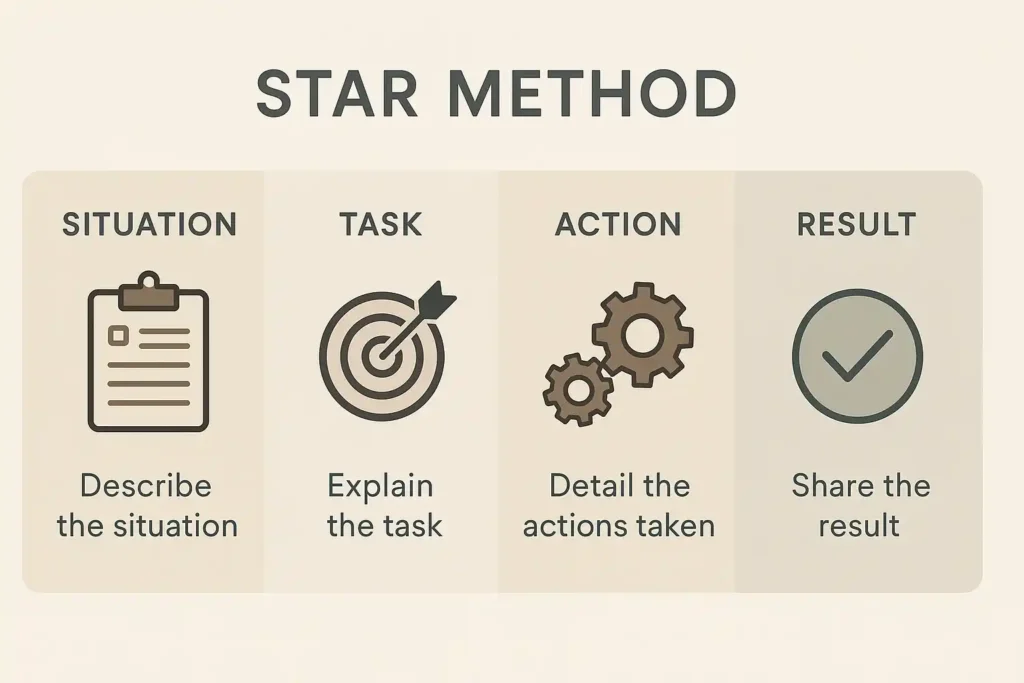
- Situation – Brief context: where/when and what was happening
- Task – The problem or objective you were responsible for
- Action – What you did (this should be the longest part)
- Result – What changed because of your actions, with evidence
Aim for:
- 250–300 words for shorter examples (often Previous Skills and Experience)
- 300–750 words total for Statements of Suitability (check the advert, some allow up to 1000+ words)
Key word-count rules (that quietly fail candidates)
- Always draft in Word/Google Docs first and check the word count
- Stay 5–10 words under the stated maximum
- If the advert says “up to 500 words”, don’t submit 250 unless your example is genuinely complete and strong
- If the system cuts you off mid-sentence, panels will only see what made it into the box
Top 5 mistakes to avoid (quick view)
| Mistake | Why it hurts |
|---|---|
| Treating “Previous Skills and Experience” as mini-CV | Panels want evidence, not another role list |
| Writing duties, not results | You look busy but not impactful |
| Ignoring behaviours in the advert | You may give great examples… of the wrong things |
| Over-explaining the Situation, under-explaining Action | Panels can’t see what you actually did |
| Copy-pasting old answers without tailoring | Feels generic; often undershoots the grade level |
If you only do three things before you hit ‘Submit’
- Re-read the “How you will be assessed” section of the advert and check your examples match the behaviours and criteria listed.
- Scan each answer for STAR, especially the R (Result) – every example should show a clear outcome.
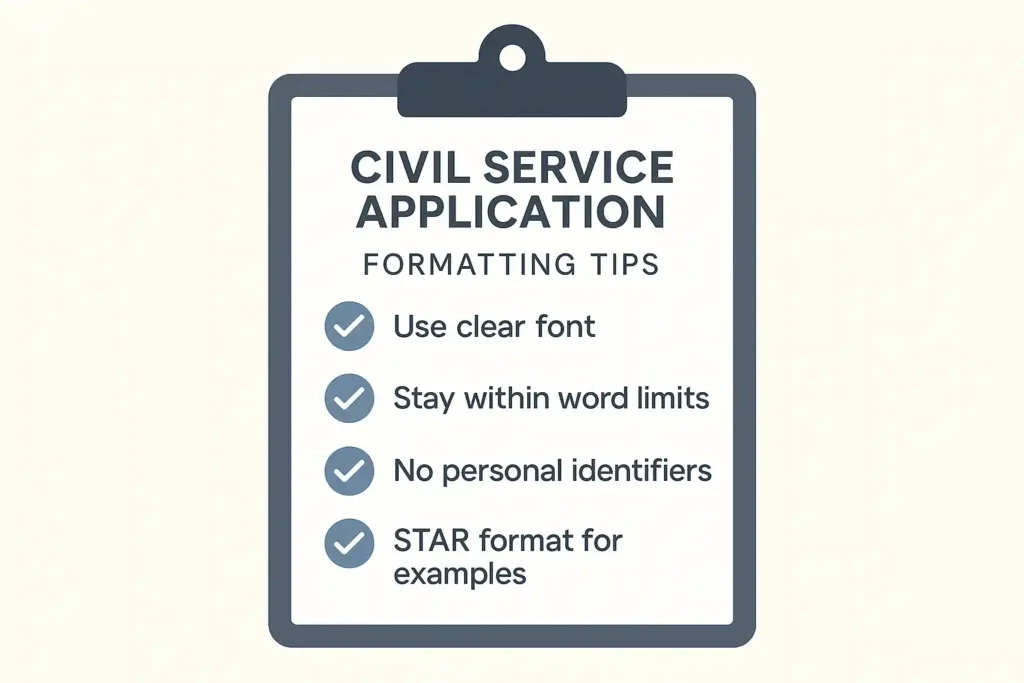
- Check formatting and anonymity – clear paragraphs, within word limits, and no personal identifiers if the sift is anonymous.
💬 If you’d like someone who lives and breathes Civil Service applications to sanity-check your examples or statement before you submit, you’re welcome to book a bespoke CV and application review. A short, focused review can often unlock a lot of extra marks.
The Civil Service Application Funnel (2025)

Before you get lost in form fields and word counts, it helps to see the whole journey your application goes through. Think of the Civil Service recruitment process as a funnel: lots of candidates at the top, fewer at each stage as the assessment becomes more detailed.
Here’s how it typically works in 2025.
Stage 1 – Find the vacancy
Most roles are advertised on the Civil Service Jobs website. You’ll usually:
- Search by department, location, grade (e.g. AO, EO, HEO, SEO) or profession (e.g. Policy, HR, Digital).
- Read the job advert, person specification, and How you will be assessed section carefully before deciding to apply.
This is where you decide whether:
- The grade is realistic, given your experience.
- The behaviours and criteria match what you can evidence.
Stage 2 – Submit your application
You complete the online form, which often includes:
- Personal details and eligibility
- Employment History
- Previous Skills and Experience
- Statement of Suitability / personal statement
- Sometimes behaviour-specific text boxes
- Occasionally an uploaded CV or supporting documents
This is where your written evidence becomes crucial. Panels will later score:
- Behaviour examples
- Experience at the right level
- How clearly you’ve aligned your skills with the role
Stage 3 – Online tests (if used)
For many roles, especially at AO/EO and some HEO levels, you may be invited to sit online tests soon after applying. These might include:
- Judgement tests
- Work Strengths tests
- Verbal or numerical tests
Your performance here can determine whether your application is progressed to sift or stopped at this stage.
Stage 4 – Sift (shortlisting)
At sift, trained panel members review and score your application against the Success Profiles elements listed in the advert (typically behaviours and experience).
They will:
- Read your Previous Skills and Experience, Statement of Suitability and any behaviour examples
- Score each behaviour / criterion on a defined scale
- Rank candidates based on total score and minimum pass marks
Only those who meet or exceed the standard move forward.
Stage 5 – Interview and assessments
If you pass sift, you’re invited to interview and, sometimes, additional exercises such as:
- Presentations
- Written tasks
- Role plays or job-related simulations
Interviews are usually:
- Behaviour-based, strength-based, or a mix of both, still aligned with Success Profiles.
Your earlier written examples often form the basis of interview questions, so good preparation at application stage pays off here.
Stage 6 – Outcome and reserve list
After interviews:
- The panel decides who to appoint immediately.
- Candidates who meet the required standard but aren’t appointed may go on a reserve list for a set period (often 6–12 months).
- If a similar role becomes available, departments can call candidates from the reserve list without re-running a full campaign.
Stage 7 – Pre-employment checks and starting in post
If you’re offered a job, you’ll go through:
- Reference checks
- Security vetting (level depends on role/department)
- Any other pre-employment checks required
Only after these are cleared will you receive a confirmed start date.
Why the funnel matters for how you write
Seeing the process as a funnel helps you make better decisions:
- Application & examples → determine whether you ever reach interview.
- Tests → can filter out candidates before anyone reads your full application.
- Interview → relies heavily on the same examples you wrote at sift stage.
So the time you spend interpreting the advert and crafting strong written examples is not a box-ticking exercise; it’s the foundation for everything that follows.
Throughout, the constant is Success Profiles.
Understanding Success Profiles in the Civil Service (2025)
If you only remember one thing about Civil Service recruitment, make it this:
Success Profiles are the lens through which every part of your application is judged.
Instead of only asking “Have you done this job before?”, the Civil Service looks at how you work, what you’ve achieved, and what you’re likely to do in future.
Success Profiles are made up of five elements:
- Behaviours – what you do and how you act in specific situations
- Strengths – what you naturally enjoy and are energised by
- Ability – what you can do now, often measured through tests
- Experience – what you’ve learned and done in previous roles
- Technical – specialist knowledge or qualifications (where relevant)
Not every element is used in every campaign. The job advert and especially the “How you will be assessed” section tells you which will be assessed for that vacancy.
You can read the official overview here:
Let’s briefly break down each element in plain English.
Behaviours: how you act
Behaviours describe the actions and decisions that lead to good performance. Examples include: GOV.UK
- Seeing the Big Picture
- Making Effective Decisions
- Communicating and Influencing
- Working Together
- Delivering at Pace
In your application, behaviours are usually assessed through:
- Your Statement of Suitability
- Your Previous Skills and Experience section
- Any behaviour-specific text boxes
- Your interview answers
This is where STAR is critical: each behaviour needs clear, specific examples that show you’ve demonstrated it at the right grade level.
Strengths: what energises you
Strengths are about what you naturally enjoy and feel motivated by. In practice, strengths might be assessed through:
- Online strengths tests
- Strength-based interview questions, such as:
- “What types of tasks do you enjoy most at work?”
- “How do you feel when you’re working to tight deadlines?”
You don’t usually write lengthy strengths sections on the form, but your written examples should still feel consistent with the strengths the role values (for instance, enjoying problem-solving, or working collaboratively).
Ability: what you can do now
Ability is often assessed through online tests, such as:
- Verbal reasoning
- Numerical reasoning
- Judgement tests
These aren’t about your past job titles; they’re about how you process information and make decisions in realistic scenarios.
Experience: what you’ve done and learned
Experience is not just a list of jobs. Under Success Profiles, it’s about:
- The depth and relevance of your experience
- What you’ve actually delivered or improved
- What you’ve learned from your work
In the application form, experience is usually assessed through:
- Previous Skills and Experience
- Statements of Suitability
- Sometimes Employment History (for context)
This is where you link what you’ve done to what the job requires.
Technical: specialist knowledge or qualifications
Technical elements apply when a role needs a particular:
- Professional qualification (e.g. accountant, solicitor)
- Technical skill set (e.g. digital, data, engineering)
- Knowledge base (e.g. specific legislation, policy area)
Technical requirements are normally listed under “Essential criteria” or in a separate Technical Skills section of the advert. They might be assessed through:
- Your CV
- Your statement
- A technical interview or exercise
Why Success Profiles matter when you write your application
Understanding Success Profiles helps you:
- Choose the right examples – ones that clearly show the behaviours and experience the panel must score
- Pitch at the right level – AO/EO vs HEO/SEO and above
- Avoid filler – you stop writing things that are nice but not scored
- Stay consistent – your CV, form and interview answers all tell the same story
Before you start typing into the Civil Service Jobs form, take 5–10 minutes to:
- Highlight every behaviour, strength, and essential criterion in the advert.
- Note which Success Profiles elements will be assessed at sift vs interview.
- Match each element to one or more examples from your experience.
💬 If you’d like help decoding the Success Profiles for a specific role and mapping them to your strongest examples, that’s something I regularly do in my one-to-one CV and application reviews.
Civil Service Behaviours: What They Are and How to Show Them

Civil Service behaviours describe how effective performance looks in different roles and at different grades. They are one of the core elements of Success Profiles and are almost always assessed at sift and interview.
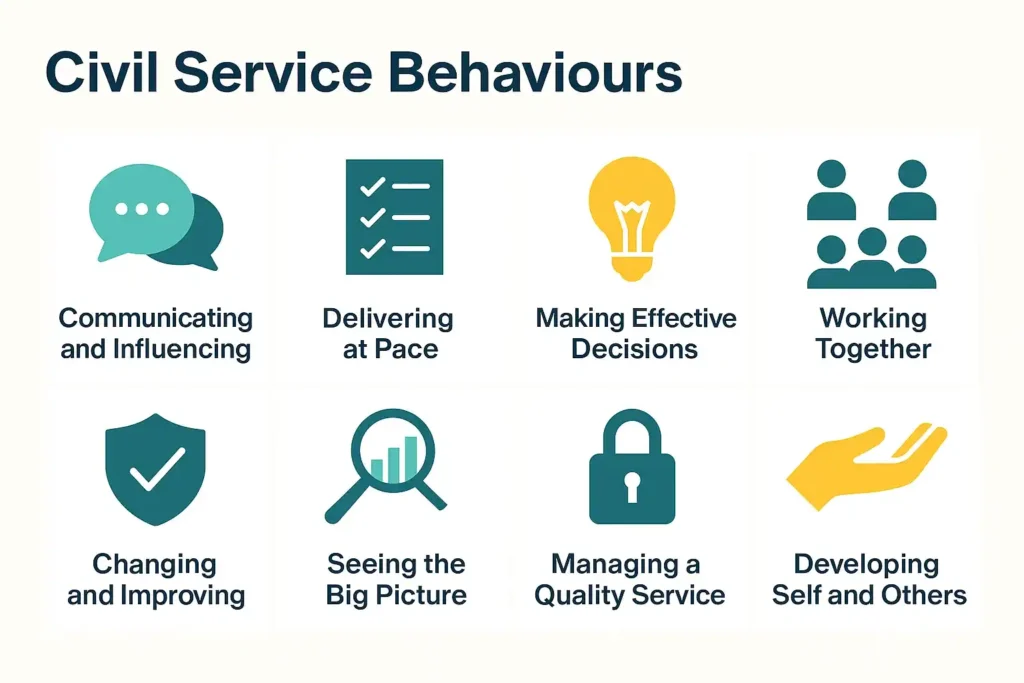
Common behaviours include:
- Seeing the Big Picture
- Changing and Improving
- Making Effective Decisions
- Communicating and Influencing
- Working Together
- Developing Self and Others
- Managing a Quality Service
- Delivering at Pace
You will not be asked to evidence all of these for one job. The advert will list the handful that matter for that role, and often tell you which are assessed at sift, which at interview, and sometimes both.
The official behaviour definitions are here:
Behaviour levels: AO/EO vs HEO/SEO and above
The same behaviour (for example, “Delivering at Pace”) looks different at different grades.
A simplified way to think about it:
| Behaviour example | AO / EO level (junior) | HEO / SEO level (middle management) |
|---|---|---|
| Delivering at Pace | Managing your own workload efficiently; meeting deadlines; escalating issues in time. | Planning and prioritising work for yourself and others; managing risks and trade-offs; ensuring delivery across a team or project. |
| Making Effective Decisions | Gathering relevant information; following guidance; seeking advice when unsure; documenting decisions. | Balancing evidence, risks and stakeholder views; making clear recommendations; owning decisions and learning from outcomes. |
| Communicating and Influencing | Explaining information clearly to customers or colleagues; tailoring tone to the audience; listening and checking understanding. | Persuading a range of stakeholders; presenting complex information clearly; challenging constructively; influencing outcomes. |
| Working Together | Being a reliable team member; supporting colleagues; sharing information; contributing to a positive environment. | Building relationships across teams or organisations; resolving conflict; creating conditions for others to work well together. |
When you choose examples, imagine the panel asking:
“Does this sound like someone operating at this grade, given the behaviour definition?”
If your example would be impressive for an AO but you are applying for HEO, you may not score as highly as you could, even if the story is good.
How to choose behaviour examples strategically
For each behaviour listed in the advert:
- Read the official behaviour description at the right level
- Use the GOV.UK document to check what “good” looks like for that grade.
- List 2–3 potential examples from your experience
- Aim for recent (last 2–3 years, if possible).
- Prioritise examples where you had clear responsibility and impact.
- Check scope and complexity
Ask yourself:- Who was affected by this work? (Customers, team, department, wider organisation?)
- Did I influence others, manage stakeholders or lead anything?
- Did the work involve ambiguity, change, competing priorities?
- Pick the example that feels most “on-grade”
- For AO/EO, it’s fine if your examples are closer to individual tasks and direct service delivery.
- For HEO/SEO, try to show breadth, influence or leadership as well as delivery.
- Map each chosen example to multiple behaviours where possible
- One strong story can sometimes evidence more than one behaviour, depending how you frame it.
Common behaviour pitfalls
I see similar issues again and again when reviewing Civil Service applications:
- Describing duties, not behaviours
- “I am responsible for…” doesn’t tell the panel how you actually behave under pressure, handle complexity, or influence others.
- No clear result
- Lots of background, activity and meetings… then no tangible outcome. Panels need to see what changed because of your actions.
- Grade mismatch
- Using an AO-level example (e.g. following instructions) for an HEO application where they expect to see ownership and judgement.
- Over-reliance on one behaviour
- Some candidates use all their examples to show they can “Deliver at Pace” but neglect “Working Together” or “Making Effective Decisions”. You need a rounded picture that matches the advert.
Practical example: Delivering at Pace (AO/EO vs HEO/SEO)
AO/EO-style example (cut down):
In my role as an Administrative Officer in 2023, I handled incoming correspondence for a busy team mailbox, often receiving over 80 emails per day. I created a simple triage spreadsheet to log new messages, introduced colour-coding for priority cases and set up daily 15-minute catch-ups with the team to agree allocations. As a result, we reduced average response times from 5 working days to under 3, and consistently met our service standard for three consecutive quarters.
Here the emphasis is on managing your own workload, improving a local process and meeting service standards.
HEO/SEO-style example (cut down):
As an HEO Project Manager in 2024, I was responsible for coordinating a cross-departmental working group delivering a new reporting process to tight ministerial deadlines. I agreed a realistic delivery plan with senior stakeholders, set up fortnightly progress meetings and introduced a simple RAG status report so risks were visible early. When a key dependency slipped, I renegotiated scope with the policy lead, re-prioritised tasks and secured temporary resources from another team. We delivered the revised process on time, and directors later adopted the RAG approach for other programmes.
Here the focus is on coordinating others, managing risk and negotiating scope — appropriate for a more senior grade.
💬 If you’re not sure whether your behaviour examples are at the right level for the grade you’re targeting, I can help you assess and refine them as part of a bespoke Civil Service CV and application review.
How to Read a Civil Service Job Advert Properly
A Civil Service job advert isn’t just a description of the role; it’s effectively a marking scheme in disguise. If you can read it the way a panel member does, it becomes much easier to decide whether to apply and how to pitch your examples.
Think of the advert as having four key zones:
- What the job is about
- What you must be able to do
- Which Success Profiles elements are being assessed
- Where they’ll be assessed: at sift, interview, or both
Let’s break that down.
Zone 1 – The job description / “About the role”
This is usually the first substantial block of text.
Here you’ll find:
- The purpose of the role (“You will be responsible for…”)
- The context (team, department, policy area, customers)
- Any major projects or priorities
When you read this, ask:
- “What problem is this role here to solve?”
- “Who are the main customers or stakeholders?”
- “Is this mostly frontline delivery, back-office operations, or policy/strategy?”
This shapes the type of examples you choose.
For instance, a contact-centre-heavy AO role will value service and accuracy; a policy HEO will care more about analysis, influencing and drafting.
Zone 2 – Person specification / essential criteria
This is where the advert tells you what you must demonstrate to be considered appointable.
Look for headings like:
- Person specification
- Essential criteria
- What we are looking for
You’ll typically see:
- Experience requirements (e.g. “Experience of managing competing priorities”)
- Skills (e.g. “Strong written communication skills”)
- Occasionally knowledge/technical points (e.g. “Understanding of X legislation”)
Your task is to:
- Highlight every essential criterion
- Map at least one example to each one
- Avoid applying if you genuinely can’t evidence multiple essentials (or go in knowing your chances are low)
Zone 3 – Success Profiles / “What we are assessing”
Somewhere in the advert – or sometimes in an attached candidate pack – you’ll find a section called:
- Success Profiles
- How you will be assessed
- Selection process
This is the most important part for your application strategy. It usually tells you:
- Which behaviours will be assessed
- Whether Experience, Strengths or Technical elements will be used
- Which elements are assessed at sift (application), which at interview, and sometimes both
Typical wording might be along the lines of:
- “We will assess you against these behaviours at sift and interview…”
- “At sift, we will assess your Experience through your Statement of Suitability.”
- “Strengths will be assessed at interview.”
Once you know this, you can decide:
- Which sections of the form really matter at sift
- Where to place your strongest STAR examples
- How much time to spend on each part
Zone 4 – Instructions for the application form
Finally, look for practical instructions on:
- Word limits: “In no more than 750 words…”
- Where to include information: “Please use the Statement of Suitability to demonstrate…”
- File uploads: “Please also upload a CV of no more than two pages…”
Write these down somewhere visible while you draft. Common traps include:
- Putting your best evidence in the wrong box (for example, in Employment History instead of the Statement of Suitability)
- Ignoring a word limit or attaching a CV when they didn’t want one
- Failing to address something they explicitly said would be assessed at sift
Turning the advert into your personal marking guide
Once you’ve read the advert end-to-end, do this on paper or in a separate document:
- List each behaviour being assessed at sift
- List each essential criterion
- Note any experience / technical requirements separately
- Decide which section of the form each will be evidenced in (PSE, Statement, behaviour text box, etc.)
- Assign one or two strong examples to each item
You should end up with a mini grid that looks something like:
| Behaviour / Criterion | Where it’s assessed | Example you’ll use |
|---|---|---|
| Delivering at Pace (HEO level) | Statement of Suitability (sift) | Project delivery example from 2024 |
| Communicating and Influencing (HEO) | Interview | Stakeholder negotiation example from 2023 |
| Managing a Quality Service | Previous Skills and Experience | Service improvement example from local gov |
| Essential: Experience managing caseload | Previous Skills and Experience | Current role caseload example |
When you do this first, writing the application stops feeling like guesswork and starts to feel more like answering an open-book exam.
💬 If you’re looking at a specific Civil Service advert and struggling to work out what to emphasise or which stories to use, I can help you decode the Success Profiles and build that “marking guide” with you as part of a bespoke CV and application review.
Before You Start Writing: Setting Yourself Up to Succeed
Most people make Civil Service applications much harder than they need to be because they jump straight into the form. The strongest applications usually come from candidates who spend a bit of time getting organised before they write a single sentence.
Here’s the pre-work I recommend.
Step 1 – Build a bank of examples
Rather than inventing examples on the spot for each behaviour, pull together a small “portfolio” you can draw from.
Aim for 6–10 solid examples that cover themes like:
- Delivering work under pressure or to tight deadlines
- Improving a process, service or system
- Handling difficult or sensitive situations
- Working with others to solve a problem
- Analysing information and making decisions
- Influencing or persuading people
- Learning something new and applying it quickly
For each example, jot down:
- The role and year
- A one-line summary of what happened
- Which behaviours it might evidence (e.g. Delivering at Pace + Working Together)
Don’t worry about writing full STAR stories yet – you’re just gathering raw material.
Step 2 – Match your examples to the advert
With your bank of examples and the advert in front of you:
- Look at the behaviours and essential criteria being assessed at sift.
- For each one, ask:
- “Which story best shows this behaviour at the right level?”
- “Is it recent enough to feel relevant?”
- Assign at least one example to each behaviour / criterion.
You might notice that:
- Some examples can cover more than one behaviour (for instance, a project story might show Delivering at Pace, Working Together and Communicating and Influencing).
- Some criteria are “nice to have” rather than “must have” – but if they’re marked as essential, they still need evidence somewhere.
If you can’t find any example at all for a genuinely essential requirement, you have two options:
- Accept that this might not be the right role right now, or
- Apply anyway, but go in with realistic expectations and focus applications on roles that are a closer match.
Step 3 – Check grade fit and complexity
Now sense-check whether your chosen examples feel right for the grade.
Ask yourself:
- For AO/EO roles –
- Does this show me handling my own workload, following guidance, and delivering good service?
- For HEO/SEO roles and above –
- Does this show me coordinating or leading work?
- Am I managing stakeholders, risks or competing priorities?
- Are the decisions and impacts at the right scale (e.g. team, department, wider organisation)?
If all your examples are very task-focused and narrowly scoped, but you’re applying for a more senior role, you may need to:
- Choose different examples, or
- Reframe existing ones to emphasise your influence and ownership, not just your activity.
Step 4 – Decide where each example will live
Before you open the application form, decide:
- Which examples will go into Previous Skills and Experience (if it’s being used as an “example” section)
- Which will go into your Statement of Suitability
- Which will be saved for the interview or for specific behaviour text boxes
A common mistake is to use your very best story in a short “Previous Skills and Experience” example, then have very little left for a 750-word Statement of Suitability that’s actually scored for multiple behaviours.
Instead, think strategically:
- Use Previous Skills and Experience to show overall relevance and one or two strong points.
- Use your Statement of Suitability to deploy your strongest, most on-grade STAR examples where you know they’re going to be scored.
Step 5 – Choose your “anchor” message
Great applications often have a subtle, consistent message that runs through them, for example:
- “I’m an AO/EO who can be trusted to handle high-volume, sensitive work reliably and professionally.”
- “I’m an HEO/SEO who takes ownership for delivery, manages stakeholders effectively and improves services.”
- “I’m an external candidate who brings transferable experience from another sector and has taken time to understand how the Civil Service works.”
This isn’t something you state explicitly, but it influences:
- Which examples you pick
- The way you frame your actions and results
- The language you use in your Statement of Suitability
It should align with what the advert is really asking for.
Step 6 – Decide your writing order
Most people open the application form and fill it out top to bottom. That’s rarely the best way.
Instead, consider this writing order:
- Statement of Suitability (or behaviour text boxes if they’re the main scored area)
- Previous Skills and Experience
- Employment History
- Any additional questions
- Final polishing pass across all sections
Why this order works:
- You tackle the most important, most scored sections when your energy is highest.
- Once you’ve written your main examples, it’s much easier to keep Employment History clear and concise without repeating everything.
💬 If you’d like help choosing and structuring the right set of examples before you start writing, I can work with you to build a tailored “example map” for your target role as part of a bespoke Civil Service CV and application review. advert – that is the definitive statement of what is scored at sift.
Key Sections of the Civil Service Application Form

Most UK Civil Service roles are applied for through the Civil Service Jobs portal. The layout can vary slightly between departments, but the core building blocks are very similar. Understanding what each section is really for helps you avoid duplication and put your best evidence where it will actually be scored.
Broadly, you’ll encounter some version of the sections below.
Overview of the main sections
| Section | What it’s for | Usually scored at sift?* |
|---|---|---|
| Personal details & eligibility | Who you are, right to work, declarations, diversity monitoring, reasonable adjustments | ❌ No – for admin/eligibility only |
| Employment History | Factual record of where you’ve worked and what you did | 🔍 Sometimes viewed for context, rarely main focus |
| Previous Skills and Experience | Short section summarising relevant background and/or a focused example | ✅ Often scored |
| Statement of Suitability / personal statement | Longer statement explaining how you meet the role’s requirements and behaviours | ✅ Usually scored |
| Behaviour-specific text boxes (if present) | Individual evidence for behaviours such as Delivering at Pace, Making Effective Decisions, etc. | ✅ Scored |
| Uploaded CV / supporting documents | Extra information: CV, qualifications, portfolios, sometimes used at sift or interview | 🔍 Depends on advert |
*Always check the “How you will be assessed” section of the advert – that is the definitive statement of which elements are scored at sift and where.
Let’s look at what’s really expected from each part.
Personal details, eligibility and adjustments
This top part of the form is mostly administrative. It covers:
- Contact details
- Nationality and right-to-work questions
- Security/vetting-related questions
- Disability / access requirements and reasonable adjustments
- Diversity monitoring (optional)
Panels who sift applications typically don’t see this information, especially where anonymous sift is in use. It’s handled separately by HR/Recruitment.
What you should do here:
- Answer accurately and honestly
- Request any reasonable adjustments you need for online tests or interviews
- Complete diversity questions if you’re comfortable – they’re usually anonymised and used for monitoring, not selection
There’s no need to “sell yourself” in this section.
Employment History
You’ve already seen how important this is for context. In the form, it usually appears as:
- A series of fields per role (job title, organisation, dates), plus
- A free-text box for a short description of duties
Key points:
- Use reverse chronological order – most recent first
- Keep descriptions to 2–4 concise lines
- Focus on what the role involved, not detailed STAR examples
- Cover all relevant work, including temp contracts and significant voluntary roles
Panel members may glance at this during sift to understand your background – but they typically score your behaviours and evidence from other sections.
Previous Skills and Experience
This section is often misunderstood and misused.
On the form, you might see a label like:
- “Previous Skills and Experience”
- “Relevant skills and experience”
- “Tell us how your skills and experience make you suitable for this role”
It usually appears as one text box with a word limit (commonly 250–300 words). The advert or candidate pack will tell you how it’s used, but in practice it’s one of two things:
- A short summary of your relevant background (like a targeted profile); or
- A single evidence example (STAR-style) when the wording explicitly asks you to “provide an example”.
Either way, this section is often scored against the Experience element of Success Profiles and sometimes against specific behaviours.
You’ll get a dedicated section of this guide on how to approach it, the key point here is: don’t treat it as a second Employment History.
Statement of Suitability / personal statement
This is one of the biggest scoring opportunities in your application.
On the form it might be labelled as:
- “Statement of Suitability”
- “Personal Statement”
- Occasionally “Statement of interest”
You’ll usually see a clear word limit or range, such as:
- “Up to 750 words”
- “750–1000 words”
- “In no more than 500 words…”
This is where you should:
- Address the essential criteria
- Evidence the behaviours being assessed at sift
- Show you understand the purpose and context of the role
Panels frequently use this section to score multiple behaviours and experience criteria together, especially at HEO/SEO and above.
We’ll cover how to structure it later (including example structures). For now, treat this as your main written advocacy piece.
Behaviour-specific boxes (if included)
Some adverts include separate text boxes for individual behaviours, for example:
- “Give an example of when you have demonstrated Delivering at Pace.”
- “Please provide an example of Working Together at [grade] level.”
These are almost always scored directly against that behaviour, often with a 1–7 scale and detailed descriptors.
If behaviour boxes are present:
- Follow the word limit carefully – they’re often tight (250–300 words).
- Use STAR for each one.
- Avoid repeating the same example across multiple behaviours unless the advert allows it and you can genuinely frame different aspects of the story.
Where behaviour boxes exist, your Statement of Suitability might focus more on experience, motivation and fit; where they don’t, your Statement usually has to carry more of the behavioural evidence.
Uploaded CV and supporting documents
Not all campaigns ask for a CV, but where they do, you’ll be prompted to upload:
- A CV (usually limited to 2 pages)
- Sometimes additional documents (e.g. qualification certificates, portfolios, short cover letter, or a separate statement file)
The way CVs are used varies by department:
- In some campaigns, the CV is used only for eligibility (e.g. checking length of experience or qualifications).
- In others, the CV may be read alongside your statement at sift to provide context.
- Occasionally, the advert might say the CV will be used to assess technical skills or experience directly.
Always follow the instructions in the advert; if it says your Statement of Suitability will be used to assess experience, don’t rely on your CV to do that job.
To keep your CV Civil Service-friendly:
- Focus on achievements and impact, not just duties
- Use clear, behaviour-friendly bullet points
- Avoid graphics, tables and complex layouts that might not export cleanly
🔗 For more on this, see my full guide to writing a Civil Service CV and, if helpful, download my free Civil Service CV template (Word).
Other possible sections
Depending on the department or grade, you might also see:
- Eligibility questions for internal-only campaigns (e.g. “Are you a substantive Civil Servant?”)
- Location preferences
- Working pattern preferences (full time, part time, job share)
- Additional motivation questions (e.g. “Why do you want to join [Department]?”)
These aren’t always scored at sift, but any free-text box should still be treated as an opportunity to show professionalism, clarity and fit.
Employment History: Building a Clear, Credible Timeline
The Employment History section looks straightforward, but it does more work than people realise. While panels usually score you on your behaviours and examples, your employment history provides the context: it shows your career trajectory, level of responsibility and how your experience hangs together.
It also has to be compatible with name-blind, fair recruitment practices and the way applications are exported for sift on the Civil Service Jobs system.
You can see the Civil Service’s own overview of the process on the Civil Service Careers: How to apply page.
What the Employment History section is really for
When a panel or HR professional looks at your Employment History, they’re typically asking themselves:
- Have they done work at a similar level of responsibility?
- Is there a coherent story to their background, even if it’s non-linear?
- Are there any gaps that might need explanation?
- Does their experience broadly align with the scope of the role?
They’re not expecting detailed STAR examples here; this section is about who you’ve worked for, what your role was and broadly what you did.
What to include for each role
For each job, aim for:
- Job title
- Employer / organisation
- Start and end dates (month and year)
- 2–4 concise lines summarising your responsibilities
Example – external candidate (AO/EO level):
Customer Service Advisor
XYZ Energy – March 2021 to Present
Handle high-volume inbound calls and emails from domestic customers, resolving billing enquiries and complaints. Use CRM and billing systems to update records, agree payment plans and escalate complex issues appropriately. Consistently meet quality and call-handling targets.
Example – internal candidate (HEO level):
Higher Executive Officer – Policy Delivery
Department for Education – July 2022 to Present
Lead on coordinating delivery of policy initiatives within the skills portfolio. Draft briefings and submissions for senior officials, manage relationships with delivery partners and monitor progress against key milestones, escalating risks where necessary.
Keep the language neutral and professional – this is not the place for selling or superlatives (“world-class”, “exceptional”, etc.).
How much detail is enough?
As a rule of thumb:
- Recent, highly relevant roles (especially your current one) can take 3–4 lines.
- Older or less relevant roles can often be summarised in 1–2 lines.
- If the role is clearly junior and some years ago, you don’t need to list every task – just enough to explain what you were doing.
You do not need:
- Full STAR examples
- Long lists of every task or system used
- Paragraphs running to 8–10 lines
Panels have a lot to read; clarity beats volume.
Dealing with gaps and non-standard paths
Most careers are not perfectly smooth. Panels understand this, but unexplained gaps can raise questions.
Best practice:
- For gaps over 3 months, add a brief line in the relevant part of the timeline, for example:
- “Career break (Jan–Sept 2023) – caring responsibilities.”
- “Full-time study – MSc in Public Policy.”
- “Job search following redundancy.”
- For agency or temp roles, you can either:
- Group them: “Various temporary administrative roles via ABC Agency (Jun 2020–Feb 2021).”
- Or list one or two of the most relevant assignments if they’re significant.
If you’re coming from outside the Civil Service:
- Avoid internal jargon that only your current employer would understand.
- Use terms a sift panel in any department would recognise (e.g. “contact centre” instead of a branded team name, “case management system” instead of a proprietary product name).
If you’re an existing Civil Servant:
- Include the grade (e.g. AO, EO, HEO, SEO) where appropriate.
- Make progression visible if you’ve moved up grades or taken on more responsibility.
Should you show impact here?
A light touch is fine – for instance:
“…consistently meeting quality and productivity targets.”
or
“…contributing to a 15% reduction in processing times.”
But avoid writing full STAR stories. Save your detailed impact and results for:
- Previous Skills and Experience
- Statement of Suitability / personal statement
- Behaviour-specific boxes
- Interview answers
That’s where impact is fully scored.
Common Employment History mistakes
A few patterns I see often when reviewing applications:
- Huge blocks of text under each job
- Hard to read and unlikely to be scored in detail.
- Fix: 2–4 concise lines per role.
- Leaving unexplained gaps
- Panels may speculate or wonder if something’s missing.
- Fix: one honest, neutral line for each significant gap.
- Using internal jargon as job titles
- Not clear to other departments, especially if you’re an external candidate.
- Fix: use neutral, descriptive titles or add a clarifying word.
- E.g. “Band 6 – Team Leader (Contact Centre)”.
- Treating this as a second Statement of Suitability
- You end up duplicating content and wasting effort.
- Fix: keep Employment History factual; put your best arguments in the scored sections.
💬 If you’re not sure how to present a complex work history (for example, lots of temp roles, a big career change or multiple career breaks), I can help you shape a clear, credible Employment History and align it with your Civil Service CV as part of a bespoke CV and application review.
Previous Skills and Experience: From Background to Evidence
The Previous Skills and Experience section looks innocent, but it’s where a lot of otherwise strong candidates lose marks. It often sits between Employment History and your Statement of Suitability and can be used in slightly different ways depending on how the department has set up the campaign.
On the Civil Service Jobs form it might be labelled:
- Previous skills and experience
- Relevant skills and experience
- Tell us how your skills and experience make you suitable for this role
This section is usually scored against the Experience element of Success Profiles and sometimes against specific behaviours listed in the advert.
You can check how it will be used under the “How you will be assessed” section of the advert or candidate pack (see Civil Service Careers – How to apply).
Two main patterns you’ll see
Departments tend to use this section in one of two ways:
- Summary mode – “Tell us how your skills and experience are relevant”
- Example mode – “Give an example of when you have…”
The wording is your clue.
1) Summary mode
Wording looks like:
“Using the box below, please outline how your skills and experience make you suitable for this role.”
Here, the panel expects a short, structured overview of your relevant background, not a single deep-dive STAR story.
Use this structure:
- Opening line or two – who you are and your overall experience in the relevant area.
- 1–3 short paragraphs – each covering a key strand (e.g. customer service, casework, stakeholder management, analysis).
- Closing line – connect your experience to the role’s main purpose.
Example – AO/EO, summary mode (approx. 230 words)
Over the last three years I have worked in customer-facing roles within local government and a housing association, supporting vulnerable residents and handling a high volume of enquiries. This has given me strong experience of working within clear policies and procedures while providing a responsive service.
In my current role as a Housing Support Officer at Camden Council, I manage a caseload of around 60 tenants. I assess new referrals, agree support plans, coordinate with internal teams (income, repairs, antisocial behaviour) and external agencies, and keep accurate case notes on our case management system. This has developed my ability to prioritise high-risk cases, communicate clearly with people in difficult situations and escalate safeguarding concerns appropriately.
Previously, as a Customer Services Adviser at a metropolitan borough council, I handled up to 80 telephone and email enquiries each day relating to council tax, benefits and housing. I consistently met quality and call-handling targets, and often dealt with complex or distressed callers. This required me to explain detailed information in plain English, remain calm under pressure and follow data protection and verification procedures.
Together, these roles have given me relevant experience of working with the public in a policy-led environment, managing competing priorities and contributing to team performance targets.
Here you’re clearly answering the question: “Is their background relevant to this role?” without re-listing your whole job history.
2) Example mode
Wording looks more like:
“Please give an example of when you have demonstrated [behaviour X] or [done Y].”
Here, the panel wants one focused example, usually in STAR format, that directly matches the request.
Use this structure:
- 1–2 sentences for Situation
- 1–2 sentences for Task
- 2–3 short paragraphs for Action
- 1 short paragraph for Result
Example – HEO-level, example mode (approx. 260 words)
In my current role as an Executive Officer in the performance team of a large arm’s length body, I identified that monthly performance reports for senior managers were regularly delayed and contained inconsistent data. This made it difficult for them to track progress and challenge underperformance. (Situation)
I was asked to review the reporting process and recommend changes that would improve timeliness and reliability while keeping within existing resources. (Task)
I began by mapping the existing process end-to-end, from data extraction through to sign-off, and held short discussions with analysts and team leads to understand pain points. I identified that different teams were using slightly different definitions for key measures and that we were relying on manual updates to a large shared spreadsheet. To address this, I worked with two analysts to agree a single set of definitions, created a simple data dictionary and redesigned the spreadsheet with protected formula cells to reduce manual edits. I also introduced a clear timetable, with interim checkpoints and a shared action log, so slippage could be spotted early. (Action)
As a result, we reduced the average time to issue the monthly report from 10 working days after month-end to 4, and data queries from senior managers decreased significantly. The new approach was well received at the senior leadership team meeting and has since been adopted across a second directorate. (Result)
In both patterns, the key is relevance – your answer should feel like a direct response to the role and the wording of the question.
How to decide which pattern to use
Use this quick check:
- Does the wording say “outline”, “describe your skills and experience”, or “tell us how”?
→ Treat it as summary mode. - Does the wording say “give an example”, “describe a time when”, or name a specific behaviour (e.g. “Working Together”)?
→ Treat it as example mode and use STAR.
If in doubt and the question is quite broad, you can blend the two:
- A short opening sentence framing your overall experience.
- One strong STAR mini-example that shows you in action on a key requirement.
Avoiding repetition with Employment History and Statement of Suitability
A common problem is that candidates:
- Copy and paste chunks of Employment History into this section, or
- Repeat exactly the same examples word-for-word in both Previous Skills and Experience and the Statement of Suitability.
Panels don’t penalise you for using the same scenario more than once, but:
- It becomes harder for them to see new evidence.
- You may miss opportunities to showcase the range of your experience.
A better approach:
- Use Employment History to give short, factual summaries of each role.
- Use Previous Skills and Experience to:
- Pull together your most relevant themes (summary mode), or
- Showcase one strong example (example mode).
- Use your Statement of Suitability to:
- Deploy 3–5 of your strongest STAR examples, each mapped to different behaviours / criteria.
If you reuse an example, reframe it:
- Focus on different aspects of the story.
- Emphasise a different behaviour.
- Provide more depth in the Statement of Suitability than in Previous Skills and Experience.
AO/EO vs HEO/SEO: what a good answer looks like
AO/EO – focus on:
- Handling volume and priorities
- Following policies and procedures
- Dealing with customers or service users
- Being reliable and accurate
HEO/SEO – focus on:
- Coordinating or leading pieces of work
- Managing stakeholders and risks
- Analysing information to support decisions
- Improving processes, services or ways of working
When you read your answer back, ask:
“Would this impress a panel for the grade I’m applying for, or does it sound junior/senior compared to the behaviour definitions?”
Common mistakes in Previous Skills and Experience
- Treating it as a second Employment History
- You list roles again with no real evidence or structure.
- Fix: summarise themes and/or use a focused example.
- Ignoring the question wording
- The box asks for an example of “Working Together” and you write a general overview of your admin duties.
- Fix: always answer the exact question asked.
- Trying to cram in too many half-examples
- You mention three different projects but don’t properly explain your role in any of them.
- Fix: choose one or two and do them justice.
- No clear result
- Panels can’t see what changed because of your actions.
- Fix: always include a Result, even if it’s qualitative (“positive feedback”, “fewer complaints”, “more consistent reporting”).
💬 If you’re not sure whether your Previous Skills and Experience section is doing its job, especially if you’ve had “met the standard but not appointed” feedback, I can review it alongside your statement and CV as part of a bespoke Civil Service CV and application review.
Employment History vs Previous Skills and Experience: Side-by-Side
These two parts of the Civil Service application often look similar on the surface, which is why so many candidates get tangled up. They’re usually next to each other on the Civil Service Jobs form, both mention “experience”, and both involve writing about your work.
But they serve very different purposes, and are treated differently at sift.
Here’s the simplest way to think about it:
Employment History = “Where have you worked and what did you do?”
Previous Skills and Experience = “Why is that background a good fit for this job?”
Quick comparison table
| Section | Main purpose | Typical content | How panels use it |
|---|---|---|---|
| Employment History | Build a factual timeline of your work | Job titles, organisations, dates, 2–4 line duty summaries | For context, level, continuity; rarely the main scored area |
| Previous Skills and Experience | Show your relevance and evidence for this specific role | Short, tailored summary or focused STAR-style example | Often scored as Experience (and sometimes behaviours) at sift |
Official Civil Service guidance emphasises that Experience is about what you’ve done and what you’ve learned, not just job titles – which is exactly what Previous Skills and Experience is designed to show.
How to decide what goes where
When you’re drafting, ask these questions:
Does this sentence mainly answer “what did my job involve?”
👉 It usually belongs in Employment History.
Does this sentence mainly answer “why is my background a good match for this role?”
👉 It usually belongs in Previous Skills and Experience (or Statement of Suitability).
Is this a specific story showing me solving a problem or delivering a result?
👉 It probably belongs in Previous Skills and Experience, your Statement of Suitability or a behaviour example, using STAR.
Example: how the two sections work together
Imagine you’re applying for an EO-level caseworking role.
Employment History entry
Caseworker
City Advice Service – September 2022 to Present
Manage a caseload of around 50 clients with multiple support needs. Assess new referrals, agree action plans, liaise with internal and external agencies, keep accurate case notes and provide updates to referrers.
This tells the panel:
- What your job is
- The scale of your responsibility
- The type of environment you work in
But it doesn’t provide scored evidence yet.
Previous Skills and Experience – summary mode
I currently work as a Caseworker for City Advice Service, managing a caseload of around 50 clients with multiple and sometimes complex needs. I assess new referrals, prioritise cases based on risk, agree action plans and coordinate with housing, health and social care partners to address issues such as debt, homelessness risk and safeguarding.
Previously, I worked as a Contact Centre Adviser in a local authority, handling high volumes of calls and emails about council tax, benefits and housing. This developed my ability to explain complex information in plain English, remain calm under pressure and follow detailed procedures accurately.
Across these roles, I have gained relevant experience of working in a policy-led environment, managing competing priorities and maintaining accurate records while providing a professional, empathetic service to vulnerable residents.
Here, you’re:
- Highlighting relevant themes
- Showing transferable skills
- Directly answering “Why are you suitable for this role?”
The panel may score this against the Experience criteria in the advert.
Common confusion: “Can I mention the same role in both?”
Yes – in fact, you often should.
The difference is:
- In Employment History, you describe the role once, in factual terms.
- In Previous Skills and Experience, you select and emphasise the parts of that role that matter for this particular campaign.
You can absolutely talk about your current role in both places; you’re just doing different jobs:
- One builds the timeline.
- The other builds your case for suitability.
What panels want to see overall
From these two sections combined, a sift panel wants to be able to say:
- “This person has worked at a roughly appropriate level and in broadly relevant contexts” (Employment History)
- “They can clearly explain how that background gives them the skills and experience we asked for” (Previous Skills and Experience)
If your Employment History is thin in the target area, Previous Skills and Experience becomes even more important, it’s your chance to:
- Pull out transferable experience from different roles
- Show relevant projects or responsibilities that don’t fit neatly in a job title
- Demonstrate you’ve thought carefully about the match
What not to do
- Don’t paste the exact same bullet points from Employment History into Previous Skills and Experience.
- Don’t waste Previous Skills and Experience on a generic or vague paragraph like “I am hard-working, reliable and work well as part of a team.”
- Don’t ignore the wording of the question in Previous Skills and Experience – if it asks for an example, give a proper example.
💬 If you’re unsure whether you’ve drawn the line in the right place between Employment History and Previous Skills and Experience, especially if your background is non-linear or from another sector, I can help you restructure these sections as part of a bespoke Civil Service CV and application review.d at sift.
Statements of Suitability: Your Case for the Job
For many Civil Service campaigns, the Statement of Suitability (sometimes called a personal statement) is the single most important part of your written application. It’s where you pull together your behaviours, experience and motivation into a structured argument for why you should be shortlisted.
On the Civil Service Jobs form it might be labelled:
- Statement of Suitability
- Personal statement
- Why you are suitable for this role
The advert or candidate pack usually tells you:
- The word limit (e.g. “up to 750 words”)
- Which behaviours and criteria will be assessed through it
You’ll often find this under “How you will be assessed” in the advert or on the department’s careers page. For an official overview of how personal statements are used, see Civil Service Careers: How to write your personal statement.
What a Statement of Suitability is (and isn’t)
It is:
- A structured, evidence-based statement explaining how you meet the essential criteria and behaviours
- One of the main things panels score at sift
- Your chance to show you understand the purpose and context of the role
It is not:
- A generic “cover letter” about how much you’ve always wanted to work for the Civil Service
- A repeat of your Employment History in prose form
- A place to list every task you’ve ever done
Think of it as an extended, tailored STAR answer stitched together from 3–5 strong examples.
Word count: how long should it be?
Always follow the specific instructions in the advert. Common patterns:
- Junior roles (AO/EO): 250–500 words
- Many HEO/SEO roles: 500–1000 words
- Senior or specialist roles: occasionally up to 1200–1500 words
A few principles:
- Aim to use most of the allowed word count – it’s hard to show multiple behaviours in 150 words if you’ve been given 750
- Stay 5–10 words under the maximum to avoid cut-offs
- If no word limit is stated (increasingly rare), aim for 500–750 words at EO/HEO and 750–1000 at SEO+
A simple structure that works at most grades
You don’t need a fancy structure. This three-part model is robust and panel-friendly:
- Opening paragraph (2–4 sentences)
- Who you are now (role/grade/sector)
- A concise statement of fit: “why you, why this role”
- A nod to the role’s purpose (shows you’ve understood it)
- Main body – 3–5 STAR-based examples
- Each example mapped to one or more behaviours / essential criteria
- Clear topic sentence, then STAR narrative (Situation, Task, Action, Result)
- Use headings or bolded behaviour names if the portal formatting allows (e.g. “Example: Delivering at Pace”)
- Closing paragraph (2–3 sentences)
- Summarise your overall fit and motivation
- Reaffirm your interest in contributing to the team/department’s goals
Example outline – AO/EO-level Statement of Suitability (c. 400–500 words)
Opening (approx. 80–100 words)
- “I am currently an Administrative Officer in… with X years’ experience in customer-facing roles…”
- Mention experience with policies, high-volume work, accuracy, service.
Example 1 – Delivering at Pace / Managing a Quality Service (approx. 150–180 words)
- A STAR example about handling workload, prioritising, meeting service standards.
Example 2 – Communicating and Influencing / Working Together (approx. 150–180 words)
- A STAR example about explaining information to customers, handling difficult calls, supporting colleagues.
Closing (approx. 40–60 words)
- Tie together your experience and motivation to join that department / work area.
Example outline – HEO/SEO-level Statement of Suitability (c. 700–900 words)
Opening (approx. 100–130 words)
- Current role, grade and high-level responsibilities.
- Two–three sentences showing you understand the team’s remit or policy area.
Example 1 – Delivering at Pace / Managing a Quality Service
- A project or workstream you led or coordinated.
- Emphasise planning, risk management, stakeholder coordination, achieving outcomes.
Example 2 – Making Effective Decisions
- A complex decision or recommendation you made.
- Emphasise analysis, balancing evidence and risk, clear rationale, impact.
Example 3 – Communicating and Influencing / Working Together
- A situation where you influenced or brokered agreement between multiple parties.
- Emphasise persuasion, adapting communication, collaboration.
Optional Example 4 – Changing and Improving / Developing Self and Others
- A process improvement, innovation or way you’ve helped others develop.
Closing
- Short summary of how your experience and approach align with the department’s goals.
How many examples should you use?
As a rough guide:
- 250–400 words → 2 strong examples
- 400–750 words → 3–4 strong examples
- 750–1000+ words → 4–5 examples is usually enough
More examples are not always better – panels prefer fewer, well-developed examples to lots of half-told stories.
Tone and language
Aim for:
- Clear, professional, calm – like you’re explaining your work to a colleague in another department
- Mostly active voice (“I did…”, “I led…”, “I analysed…”)
- Concrete verbs (“analysed”, “negotiated”, “implemented”) rather than soft ones (“helped”, “involved in”)
Avoid:
- Overly emotional or apologetic language (“I feel I would be good at…”)
- Buzzword bingo (“I’m a dynamic, results-driven team player…”)
- Long, meandering sentences – panels are reading under time pressure
You can see the official style of advice in the Civil Service Careers – How to write your personal statement article; your job is to bring that to life with specific, well-chosen examples.
Common Statement of Suitability mistakes
- Rewriting your job description instead of showing impact
- “I am responsible for…” doesn’t prove you actually delivered anything.
- Fix: focus on what changed because you were in the role.
- No link to the behaviours or criteria in the advert
- You tell a good story, but it doesn’t clearly relate to what’s being scored.
- Fix: choose examples that clearly evidence the listed behaviours.
- Too much background, not enough action
- Half the word count is set-up; Action and Result are rushed.
- Fix: keep Situation/Task tight; spend most words on Action and Result.
- Reusing an old statement with minimal edits
- Panels can tell when content is generic.
- Fix: update examples, behaviour focus and framing for each new role.
- Ignoring the word limit
- The system may cut off your text mid-sentence; panels can only score what they see.
- Fix: draft offline, stay under by a small margin.
How this fits with Previous Skills and Experience and behaviour boxes
Think of your Statement of Suitability as the centrepiece:
- Previous Skills and Experience – shows your overall relevance and/or one focused example.
- Statement of Suitability – makes a structured case using multiple STAR examples.
- Behaviour-specific boxes – add targeted evidence where asked (if the campaign uses them).
Your strongest, most on-grade examples should be visible wherever the advert says Behaviour and Experience will be assessed at sift.
💬 If you’ve ever written a statement that felt “fine” but didn’t convert into an interview, you’re not alone. I regularly help Civil Service applicants reshape their Statements of Suitability so they clearly align with behaviours and grade expectations. You can book a bespoke CV and application review if you’d like structured, honest feedback before you submit.
Using STAR (and STARR) Properly in Civil Service Applications

The STAR method (ituation, Task, Action, Result) is the Civil Service’s standard way of assessing behaviour and experience examples, both on paper and at interview. It appears throughout Success Profiles guidance and Civil Service interview advice.
Panels are trained to look for each element, so if you skip or rush one part (especially Action and Result), you’re usually leaving marks on the table.
Sometimes you’ll also see STARR, where the final “R” stands for Reflection, what you learned and how you’d apply it next time. That’s particularly useful at interview and can subtly strengthen written examples too.
Recap: what STAR really means
- Situation – Brief context: where and when it happened; who was involved.
- Task – What you were trying to achieve; the specific problem or objective.
- Action – What you did, step by step; how you approached it.
- Result – The outcome; what changed; how you know it worked.
Optional extra:
- Reflection – What you learned and how you’ve applied that learning since.
A good STAR example reads like a short case study where the panel can clearly see:
- The challenge you faced
- The decisions you made
- The practical steps you took
- The positive impact you had
How much space should STAR take?
For most Civil Service applications:
- 250–300 words is a good length for a single STAR example in Previous Skills and Experience or a behaviour text box.
- 130–200 words can work if the word limit is tight and the example is focused.
- In a Statement of Suitability, each STAR example might be 150–250 words, depending on your total word count and how many examples you’re including.
As a rule:
- Situation + Task → 20–30% of the word count
- Action + Result → 70–80% (where the marks live)
AO/EO-level STAR example
This example would suit a junior role where you’re demonstrating Delivering at Pace and Managing a Quality Service.
Situation (S): In my role as an Administrative Officer in a local authority contact centre in 2023, I noticed that customers were frequently calling back about the same council tax queries because they were unclear on the next steps they needed to take.
Task (T): My manager asked me to review a sample of these calls and suggest practical changes that would help reduce repeat contacts while keeping call times within our target.
Action (A): I listened back to 20 recorded calls and identified common points where customers became confused, particularly around payment plans and evidence requirements. I drafted a short checklist for advisers to use at the end of calls, summarising the key points in plain English and reminding customers what documents they needed to send and how. I shared this with my manager and the team in a short team meeting, took on board their feedback and updated the checklist accordingly. I then began using it consistently on my own calls and encouraged colleagues to do the same.
Result (R): Over the next month, the proportion of repeat calls from the sample group reduced noticeably. My manager’s spot checks showed that customers were clearer on what they needed to do, and my own quality scores remained consistently above target. The checklist was later added to our team’s standard operating procedures.
Why this works:
- Clear, straightforward context
- You show initiative within your role
- Concrete actions and a realistic result
- Appropriate in scope for AO/EO level
HEO/SEO-level STAR example
This example is pitched at a middle-management level, demonstrating Making Effective Decisions, Working Together and Delivering at Pace.
Situation (S): As a Higher Executive Officer in a central policy team in 2024, I was responsible for coordinating input into a cross-government consultation with a tight deadline. Several directorates held different views on key issues, and drafts were being produced in isolation, risking duplication and inconsistent messages.
Task (T): I was asked to bring the contributions together into a single, coherent departmental response that reflected senior priorities, while ensuring the consultation was submitted on time.
Action (A): I started by mapping the key policy questions and identifying which directorates needed to feed into each one. I set up a simple template for responses, including word limits and prompts to reference existing commitments, and shared this with policy leads to ensure consistency. I then held a short virtual meeting with all contributors to clarify expectations, answer questions and agree a realistic timetable. As drafts came in, I reviewed them for overlaps, gaps and potential risks, and where there were conflicting positions, I arranged brief one-to-one discussions with the relevant leads to understand their reasoning. I summarised options and trade-offs in a short advice note for the Deputy Director, highlighting where decisions were needed and recommending a balanced position that aligned with ministerial priorities and legal constraints.
Result (R): The Deputy Director agreed my recommendations, and we submitted a single, coherent response ahead of the deadline. Feedback from Cabinet Office colleagues was positive about the clarity of our submission, and the Deputy Director noted in my performance review that my coordination had reduced the burden on senior leaders at a busy time.
Why this works:
- Shows you operating at HEO/SEO-level scope and complexity
- Demonstrates independent judgement, stakeholder management and alignment with senior priorities
- Uses STAR without getting bogged down in technical detail
Using STARR (adding Reflection)
If word count allows, especially in statements and at interview, you can add a short Reflection at the end:
“From this experience I learned the value of agreeing clear templates and timelines up front when coordinating contributions from multiple teams. I have since applied this approach to other cross-cutting pieces of work, which has helped reduce late changes and last-minute escalations.”
This signals to panels that:
- You’re self-aware
- You learn from experience
- You can transfer learning to new contexts
How panels actually “read” your STAR
Sift and interview panels are not just looking for a story; they’re subconsciously checking:
- Relevance – Does this example actually match the behaviour/criterion?
- Level – Does it sound AO/EO, HEO/SEO, or more senior?
- Clarity – Can they easily see what you did and why?
- Impact – Is there a meaningful result, not just “the task was completed”?
- Breadth – Across all your examples, do they see a balanced picture (delivery, collaboration, decision-making, improvement)?
Having this in mind when you choose and shape your examples helps you write in a way that’s easier to score well.
Common STAR mistakes (and quick fixes)
| Mistake | Why it’s a problem | Fix |
|---|---|---|
| Very long Situation, very short Action | Panel learns lots about context but little about you | Keep Situation/Task to 2–3 sentences; expand Action/Result |
| Writing about “we” instead of “I” | Panel can’t see your individual contribution | Describe the team briefly, then focus on what you did |
| Vague results (“it went well”) | No evidence of impact or performance | Add numbers, feedback or concrete outcomes |
| No link to behaviours | Story might be fine but not relevant to what’s scored | Choose examples that clearly map to the behaviours in the advert |
| Using one small example for a senior grade | Undersells you relative to expectations at that level | Pick higher-impact examples that show breadth and complexity |
💬 If you have experience but find it hard to turn it into clear, on-grade STAR examples, I can help you refine 3–6 key stories and align them with the behaviours in your target role as part of a bespoke Civil Service CV and application review.
Formatting and Technical Requirements for Civil Service Applications (2025)

Strong content can still underperform if it’s poorly formatted or doesn’t play nicely with the Civil Service Jobs system. Most departments export applications for sift, sometimes in a name-blind format, and panels are often reading under time pressure. Clean formatting makes it easier for them to see, and score, your best points.
Some roles also involve online tests, where instructions and technical requirements are strict; see Civil Service online tests guidance on GOV.UK for the official position.
Here’s how to keep your application technically sound and easy to read.
Formatting inside the Civil Service Jobs form
Within the online form, you can’t control font or size, the system does that for you. You can control:
- Paragraphs
- Avoid walls of text. Use short paragraphs (3–4 lines max on a desktop screen).
- Put a blank line between STAR sections if it helps readability.
- Plain text
- Type directly into the form or use “paste as plain text” from Word/Google Docs to avoid odd characters.
- Avoid bullet symbols inside STAR answers; some exports don’t handle them cleanly.
- Punctuation and spelling
- Panels will forgive the odd typo, but consistently careless writing can affect how your professionalism is perceived.
If you’re unsure how the system will display your text, you can preview or save and re-open to check the layout.
Word limits and cut-offs
Word limits are not suggestions – the system will simply stop accepting text after the limit is reached, sometimes cutting you off mid-sentence.
Best practice:
- Draft in Word or Google Docs and check the word count there.
- Aim to stay 5–10 words under the stated maximum for each box.
- If there is no explicit limit (rare these days), treat:
- 250–300 words as a good limit for single examples
- 500–750 words as a reasonable range for short statements
Before you submit:
- Copy your text back out of each box into Word once more and run a final word count to make sure nothing has been truncated.
File uploads: CVs and supporting documents
If the advert asks you to upload a CV or additional documents, the instructions usually appear in the candidate pack or on the Civil Service Careers – How to apply page.
General rules:
- File type
- Use .doc or .docx unless the advert explicitly says PDFs are acceptable.
- Avoid unusual formats (Pages, OpenOffice, etc.).
- Layout
- Keep things simple: no text boxes, complex tables, columns, or graphics-heavy templates. Some recruitment systems don’t export these cleanly.
- Stick to a single-column layout for CVs and statements.
- Fonts and sizes
- Use standard fonts like Arial, Calibri, Verdana or similar.
- 10.5–11pt for body text; 12–14pt for headings.
- File names
- Keep them neutral and anonymous, e.g.
EO_caseworker_application_May2025.docxHEO_policy_officer_CV_2025.docx
- Keep them neutral and anonymous, e.g.
- Images and logos
- Avoid profile photos, logos and decorative elements. They don’t add value and can conflict with the principle of fair, name-blind recruitment.
Anonymity and name-blind sift
Many departments use anonymous sift, where your personal details are removed before panels see your application.
Good practice:
- Remove your name, address, phone number and email from the body of any uploaded CV or statement, unless the advert specifically tells you otherwise.
- Don’t mention other candidates or internal shorthand that could accidentally identify people.
- If you’re an internal candidate referencing teams, use neutral descriptions (“operations team”, “policy team”) where possible rather than niche internal labels.
Your identifying information is already available to HR via the system – you don’t need it in the document text as well.
Paragraph structure for STAR examples
To make your STAR answers easy to mark:
- Use a clear opening line that sets the context (“In my role as X in 2023…”).
- Break Action and Result into 1–3 short paragraphs rather than one massive block.
- If space allows, you can lightly signpost the structure (without actually labelling the letters), e.g.
- “The situation was…”
- “I was responsible for…”
- “I took the following actions…”
- “As a result…”
Panels often skim first then go back to score – good structure makes it more likely they’ll catch the important parts on the first pass.
Accessibility and readability
Civil Service recruitment aims to be fair and accessible. While there isn’t a single public “style guide” for candidate writing, it’s wise to align with the principles of GOV.UK’s style and accessibility guidance:
- Prefer plain English over jargon.
- Avoid very long sentences (over 25 words).
- Use everyday words where possible.
- Avoid using all-caps for emphasis.
This doesn’t mean oversimplifying your work – just explaining it clearly so someone in another department could understand it quickly.
Common formatting mistakes (and fixes)
| Mistake | Why it’s a problem | Quick fix |
|---|---|---|
| Huge blocks of text in STAR answers | Hard to read and score; panels may skim past key points | Use short paragraphs; one idea per paragraph |
| Ignoring word limits | Text is cut off mid-sentence; panel only sees part | Draft offline, stay 5–10 words under the limit |
| Fancy CV templates with graphics and columns | Can break in exports and look un-Civil Service-like | Use a clean, single-column Word document |
| Leaving personal details in an anonymous sift document | Can conflict with name-blind principles | Remove name & contact details from CV/statement body |
| Using bullet lists instead of sentences in STAR | Feels disjointed; doesn’t always show clear reasoning | Use full sentences and link ideas with transitions |
💬 If you’re using a heavily designed CV template or you’re unsure whether your application format is helping or hindering you, I can help you convert it into a Civil Service-friendly version as part of a bespoke CV and application review.
Civil Service Online Tests and Strengths
For many roles, particularly at AO/EO and some HEO levels, online tests are a key gate in the recruitment funnel. You might complete them before your application is sifted, or between sift and interview, depending on how the department has designed the campaign.
The official starting point is:
Understanding what’s being measured – and how – means you can prepare calmly without letting tests derail your whole application.
Why online tests are used
Under the Success Profiles framework, tests are one way of assessing:
- Ability – for example, verbal and numerical reasoning
- Judgement – how you respond to realistic work situations
- Strengths – what energises you and feels natural to you at work
They’re designed to complement (not replace) your written application and interview. Strong test performance won’t rescue a very weak application, but failing the tests can stop your application from being seen at all.
Common Civil Service test types
Not every campaign uses all of these, but the main official tests include:
- Verbal test
- Measures your ability to understand and interpret written information.
- Official guidance and examples:
- Numerical test
- Assesses your ability to work with numbers, data and simple calculations/interpretations.
- Same guidance page as verbal (link above).
- Judgement test
- Presents workplace scenarios and asks how you’d respond.
- Designed to assess judgement and alignment with Civil Service values/behaviours.
- Guidance:
- Work Strengths test
- Looks at what you naturally enjoy and are energised by in a work context.
- There are no “right” or “wrong” answers in the same way; it’s about fit.
- Guidance:
- Other role-specific tests
- For some roles: Customer Service Skills, Casework Skills, Management Judgement, and specialist tests (e.g. digital/technical). These are all covered under the main Civil Service online tests guidance.
When in the process do tests happen?
Campaigns vary, but common patterns include:
- Immediately after you submit your application
- You receive an email invitation with a deadline (often 5–7 days).
- Your application may only be sifted if you reach a certain test score.
- Before you start the application form
- For some large campaigns, you might complete tests as a pre-screen.
- Only those who pass can continue to complete the full application.
- Between sift and interview
- Used as an extra data point in addition to your written evidence.
The advert or candidate pack should spell out when tests will be used and whether they’re pass/fail or one component of an overall score.
How to prepare effectively (without overdoing it)
A balanced approach:
- Read the official guidance first
- Start with the GOV.UK pages linked above. They explain format, timing and practice examples.
- Do practice tests in similar formats
- Use the practice materials provided on GOV.UK.
- For extra confidence on reasoning tests, you can also use reputable practice sites or the National Careers Service’s psychometric test preparation advice.
- Manage your environment
- Quiet space, stable internet connection, full battery if you’re on a laptop.
- Turn off notifications and ask others not to disturb you.
- Know the rules
- Some tests are untimed or loosely timed, others have strict time limits.
- Some allow calculators; others don’t.
- All of this will be explained in your invitation email and in the test instructions.
Reasonable adjustments
If you have a disability, health condition or specific learning difference (for example, dyslexia) that might affect how you perform in tests, you can request reasonable adjustments.
Typical adjustments might include:
- Extra time
- A different test format
- Screen reader compatibility
- Rest breaks
To do this:
- Indicate your needs at the application stage in the adjustments section.
- Provide any requested evidence in good time (if asked).
- Check the test provider’s own accessibility information when you receive the invite.
The aim is to make the test a fair measure of your ability, not to disadvantage you.
How much weight do tests carry?
Again, it depends on the campaign, but commonly:
- Tests may be pass/fail – you must reach a benchmark to progress.
- In some cases, your test score may be combined with sift scores to decide who is invited to interview.
- For others, tests are used more as a screening tool and your application is then judged on its own merits.
The important thing is:
- Treat tests as important, but not so intimidating that you neglect the rest of your application.
- A strong application with a decent test score usually beats a mediocre application with a stellar test score.
💬 If you’re nervous about balancing test preparation with writing high-quality STAR examples and a strong Statement of Suitability, I can help you prioritise and plan as part of a bespoke Civil Service CV and application review. The goal is to get you through tests and sift with confidence.
What Actually Happens at Sift in Civil Service Recruitment
The sift is where your written application is judged against the requirements in the advert. For most candidates, this is the make-or-break stage: if you don’t score well enough here, you never reach interview, no matter how strong you might be in person.
The overall process is described in outline on Civil Service Careers – How to apply and in the GOV.UK Success Profiles guidance.
Here’s what typically happens behind the scenes.
Step 1 – Export and anonymisation
After the application deadline:
- HR or the recruitment team exports applications from the Civil Service Jobs system.
- In many campaigns, applications are anonymised so that sift panel members do not see your name or personal details – this supports fair, inclusive recruitment.
What the panel usually sees:
- Your Employment History (sometimes)
- Your Previous Skills and Experience section
- Your Statement of Suitability / personal statement
- Any behaviour-specific text boxes
- Sometimes your CV, if the campaign uses it at sift
They do not usually see diversity data, adjustment requests or contact details.
Step 2 – Scoring against Success Profiles
Panel members are given:
- A scoring framework (e.g. a 1–7 scale)
- Behaviour definitions at the relevant grade (from the Civil Service Behaviours guidance)
- Instructions on which sections of your application to use to score which behaviours / criteria
They then:
- Read your responses in the relevant sections.
- Score each behaviour and/or criterion based on how well your evidence matches the definition at that grade.
- Make brief comments to justify the score, especially for borderline cases.
At this stage, panels are not looking for perfection. They’re asking:
- Is there clear, relevant evidence for each behaviour/criterion?
- Does it look on-grade (AO/EO vs HEO/SEO etc.)?
- Are there any serious concerns that would make the candidate unsuitable?
Step 3 – Total scores and minimum pass marks
Once individual scores are recorded, they’re usually combined into:
- A total sift score, and
- Scores per behaviour / criterion
Recruitment guidance typically requires:
- A minimum score per behaviour/criterion (e.g. at least “3 – acceptable evidence”)
- A minimum overall score for progression to interview
Candidates who:
- Meet or exceed the required standard are “sift successful”.
- Just miss the standard may become “sift reserve” – sometimes used later if more interviewees are needed.
- Fall short on key behaviours or overall score are sifted out.
Different campaigns set these thresholds differently, but the principle is consistent: evidence must meet the minimum standard at the grade.
Step 4 – Moderation
Where there is more than one panel member:
- Scores are often moderated to ensure consistency and fairness.
- Panel members may discuss borderline cases where there is disagreement.
- Occasionally, scores are adjusted if someone has been scored too harshly or generously compared with others.
Moderation is designed to ensure:
- Candidates are judged consistently
- No one is disadvantaged by one particularly strict or lenient scorer
Step 5 – Outcome and feedback
After moderation:
- Successful candidates are invited to interview (or the next assessment stage).
- In many campaigns, candidates who meet the standard but are not initially appointed after interview later go on a reserve list for a set period (often 6–12 months).
- Feedback varies by department:
- Sometimes you’ll get numerical scores for each behaviour.
- Sometimes a short narrative summary.
- Occasionally only a generic message.
Even limited feedback (“did not meet the required standard for X behaviour”) can be useful when planning your next application.
Why strong people sometimes fail at sift
Based on working with many Civil Service applicants, these are the biggest reasons capable people don’t get through sift:
- Misreading the advert
- They provide good evidence, but not for the behaviours or criteria actually being scored.
- Example: giving lots of customer service examples when the panel was primarily assessing policy analysis and stakeholder management.
- Too little evidence per behaviour
- Stories are vague, short on Action/Result, or lack specifics.
- Panels can’t award high scores for “I was involved in…” without clear detail.
- Examples at the wrong grade level
- An AO-level story (e.g. following instructions, no stakeholder complexity) used for an HEO/SEO application.
- Panels need to see you demonstrate the behaviour as defined for the grade.
- Overly generic statements
- “I am a great communicator and work well in a team” without concrete examples won’t score well; panels need evidence, not assertions.
- Ignoring word limits and formatting
- Text cut off mid-example; dense blocks of text that are hard to read under time pressure.
How to maximise your sift score
To give yourself the best chance:
- Align every example with a behaviour or criterion from the advert.
- Use STAR and spend most of your words on Action and Result.
- Make sure each example clearly demonstrates the behaviour at the right grade.
- Avoid repetition, use a range of examples to show breadth.
- Respect word limits and formatting so nothing important is lost.
Think of your application as a set of scoring opportunities. Everything you write should help a panel member say:
“Yes – this clearly meets or exceeds the standard for this behaviour at this grade.”
If you’re repeatedly getting “met the standard but not appointed” or “did not meet the standard for X behaviour”, it’s usually a sign your examples or structure need strengthening more than your underlying experience.
💬 If you’ve had one or more unsuccessful Civil Service applications and you’re not sure why you’re falling short at sift, I can review your past applications, identify where marks are being lost, and help you build stronger, on-grade examples for next time. You can book a bespoke CV and application review to work through this together.
Civil Service Interviews and Assessments
If you’ve made it to interview, your written application has already convinced the panel that you might be able to do the job. The interview and any additional assessments are there to test how you behave, think and communicate in real time.
The Civil Service Careers site has a good high-level overview under How to apply and related pages, but let’s turn that into practical, applicant-focused guidance.
Types of interviews you might face
Most Civil Service interviews now fall into one of three patterns, all aligned with Success Profiles:
- Behaviour-based interviews
- Questions ask for specific examples from your past:
- “Tell us about a time you had to make a difficult decision with limited information.”
- “Describe a situation where you had to work with others to deliver a challenging task.”
- You’re expected to answer using STAR (Situation, Task, Action, Result).
- Questions ask for specific examples from your past:
- Strength-based interviews
- Questions focus on what energises you:
- “What kind of tasks do you enjoy most at work?”
- “When are you at your best in a team?”
- These are quicker-fire, with shorter answers; they’re looking for authenticity and alignment with the strengths the role needs.
- Questions focus on what energises you:
- Mixed interviews
- A blend of behaviour and strength questions, sometimes with a couple of more traditional “motivation” questions (e.g. “Why this department?”).
Your interview invitation email will normally specify which of these to expect, and which behaviours and sometimes strengths will be assessed.
How interviews link back to your written application
Panels often use your application form as a starting point. That means:
- Behaviour questions may draw on topics you mentioned in your Statement of Suitability or behaviour boxes.
- They might say: “You mentioned in your application that you led on X – can you tell us more about that?”
- Or they may ask for fresh examples that still demonstrate the same behaviours.
Good news: if you’ve already done the work to build a bank of strong STAR examples for your application, you’ve done most of the prep for interview as well.
Behaviour-based interview answers in practice
The STAR structure still applies, but answers should be spoken, not read, and usually 2–4 minutes long per question.
Example – HEO-level “Working Together” answer (condensed):
“In my current role as an EO project support officer, I was part of a small team implementing a new casework tracking system. Initially, operational staff were resistant because they were used to the old spreadsheet and worried the new system would slow them down. (Situation & Task)
I arranged short, informal drop-in sessions with each team to understand their concerns and gathered specific examples of where they felt the system might cause issues. I then worked with our digital colleagues to adjust the training materials and highlight features that would actually save time, like auto-populated fields. I also identified a couple of early adopters in each team and asked if they’d be willing to act as informal champions. (Action)
As a result, when we rolled out the system, we had fewer formal complaints than expected, and usage increased steadily over the first month. Feedback from the operational teams in our post-implementation review noted that they felt listened to and involved in the change, and my manager commented that this had helped build trust between the project team and frontline staff. (Result)”
Key points:
- Short, clear Situation & Task
- Most of the time on Action and Result
- Focus on your contribution
- Realistic, not over-dramatised
Strength-based interview questions
Strengths questions are typically:
- Shorter
- Faster-paced
- Less about STAR; more about what naturally appeals to you
Examples:
- “What motivates you at work?”
- “What type of task do you tend to leave until last?”
- “How do you feel when you’re working under pressure?”
There aren’t “right” answers in the same way as behaviour questions, but panels are looking for:
- Alignment with the strengths needed for the role (e.g. “Learner”, “Team player”, “Problem solver”).
- Consistency with your application – if your examples show you thrive on analysis, but you say you hate detailed work, it may raise questions.
Official guidance on strengths and tests sits alongside the main Civil Service online tests guidance and Success Profiles information.
Other assessments you may encounter
Depending on department, profession and grade, you may also face:
- Written exercises
- Summarising information, drafting a short briefing or email, analysing a case study.
- Presentations
- You’re asked to prepare a short presentation on a given topic and deliver it to the panel.
- Role plays / simulations
- Acting out a scenario, often customer or stakeholder-related.
- Technical tests
- For specialist roles (e.g. digital, finance, legal), you may have job-specific tasks.
These are usually explained in the candidate pack or your interview invitation. The Civil Service Careers site has role-specific information under profession pages (e.g. Policy, Operational Delivery, Digital).
Preparing efficiently for interview
To prepare without burning out:
- Revisit the advert and Success Profiles
- List the behaviours and any strengths being assessed at interview.
- Check the behaviour definitions at the right grade on GOV.UK.
- Choose 6–10 strong STAR examples
- Ensure they cover the full range of behaviours (e.g. decision-making, delivering at pace, working with others).
- Be ready to adapt them to different questions.
- Practise speaking your examples out loud
- Aim for 2–4 minutes per answer.
- Don’t memorise scripts word-for-word; focus on the structure and key points.
- Prepare for strengths questions
- Reflect on when you’re at your best at work, and what drains you.
- Think about how your natural preferences align with the role.
- Plan logistics
- For online interviews, test your connection, webcam and microphone.
- For in-person interviews, allow extra time to arrive and go through security.
What interview panels are looking for
During interview, panel members are assessing:
- Whether your behaviours and strengths are consistent with your application and suitable for the role
- Whether you communicate clearly and professionally
- Whether you understand the context in which the department operates
- For promotions, whether you’re already operating at or near the next grade
They are not expecting you to be perfect or to know everything; they are looking for evidence and potential.
💬 If you’d like to rehearse behaviour and strengths-based questions with someone who understands how Civil Service panels think and score, I offer interview-focused sessions as part of my Civil Service CV and application review and coaching services.
Common mistakes and misconceptions in Civil Service applications
Even strong, experienced candidates lose marks or fail the sift entirely because of a handful of recurring mistakes. These are patterns I see repeatedly when reviewing real applications from AO/EO through to SEO and above.
Where relevant, I’ll point you to official references like Success Profiles on GOV.UK and Civil Service Careers – How to apply so you can see how this aligns with official guidance.
Mistake 1 – Treating the advert like a generic job description
Many applicants skim the advert, glance at the job description, and ignore:
- The behaviours list
- The essential criteria
- The “How you will be assessed” section
Result:
- They provide decent examples: but for the wrong things.
- Panels can’t award marks for behaviours or criteria that aren’t evidenced.
Fix
Before writing anything:
- Highlight every behaviour and essential criterion.
- Check where each is being assessed (statement, behaviours, interview).
- Map at least one example to each item before you write.
Mistake 2 – Writing duties, not achievements
Statements full of phrases like:
- “I am responsible for…”
- “My role involves…”
- “I deal with…”
…without showing what actually changed because of your work.
Result:
- You look busy, but it’s hard for panels to see effectiveness or impact.
Fix
For each key point, ask:
- “So what?”
- What improved?
- What problem was solved?
- What risk was reduced?
- What feedback did you receive?
Then rewrite to show impact:
- “I redesigned X, which reduced Y by 20%.”
- “As a result, complaints fell and we met our service standard.”
This is exactly what the Result part of STAR is for.
Mistake 3 – Examples at the wrong grade level
Common pattern:
- Applying for HEO/SEO but using examples that show you:
- Following instructions
- Doing individual tasks
- Carrying very limited responsibility
Result:
- Panels don’t see evidence that you’re already operating near the next grade.
- You might get feedback like “did not meet the required standard for [behaviour]”.
The behaviour definitions on GOV.UK (Civil Service Behaviours) spell out precisely what’s expected at each level.
Fix
- Choose examples where you initiate, coordinate or lead work, not just follow directions.
- Emphasise:
- Decision-making
- Managing stakeholders
- Handling risk or ambiguity
- Improving processes or services
For AO/EO roles, it’s fine that your examples are more about solid delivery; for HEO/SEO and above, they should show breadth, influence and judgement.
Mistake 4 – Over-long background, rushed Action and Result
Lots of applications spend:
- 60–70% of the word count on Situation and Task
- A couple of sentences on what the person actually did and the outcome
Result:
- Panels see context in detail but struggle to score the behaviour because they don’t see enough evidence.
Fix
- Keep Situation + Task to 2–3 sentences in most examples.
- Spend most of your words on Action + Result.
- If you’re tight on word count, cut background first.
Mistake 5 – Copy-pasting old examples without tailoring
You may have one “pet” example that you reuse for every application with minimal changes.
Result:
- It may not match the new behaviours or grade.
- It can feel generic and misaligned with the new advert.
- You could be underselling yourself if your experience has grown.
Fix
For each new campaign:
- Check whether the example still aligns with the behaviours, level and context.
- Rewrite to emphasise parts that match the new advert; remove irrelevant detail.
- Add newer, higher-level examples where possible.
Mistake 6 – Neglecting formatting and word limits
This includes:
- Text cut off mid-sentence
- Huge blocks of text with no breaks
- Over-designed CVs that don’t export correctly
Official guidance on tests and online processes makes clear that the systems are quite strict: see Civil Service online tests guidance.
Fix
- Draft offline; stick to the word limit minus a small buffer.
- Use short paragraphs and line breaks.
- Keep CVs as clean, accessible Word documents (no fancy graphics or columns).
Mistake 7 – Underplaying behavioural evidence as an internal candidate
Internal Civil Servants sometimes assume:
- “They know how I work”
- “They’ve seen my performance reviews”
So they:
- Write very short, informal examples
- Use internal shorthand and acronyms heavily
Result:
- External candidates with well-structured, clear examples sometimes outscore internal staff with more experience.
Fix
- Treat your application as if the panel knows nothing about you.
- Explain acronyms at first use or avoid them.
- Use STAR in full for behaviour examples, even if you know the panel personally.
Mistake 8 – Over-relying on one behaviour
Some applications over-index on one area, such as:
- Delivering at Pace
- Service delivery
- Technical detail
…but under-evidence:
- Working Together
- Communicating and Influencing
- Making Effective Decisions
Result:
- Panels see a skewed picture: strong in one dimension, weak in others.
Fix
- Ensure across your statement and behaviour examples you cover the full set of behaviours being assessed.
- Use your example bank to show balance – not 4 versions of the same situation.
💬 If you recognise some of these patterns in your own applications, especially if you’ve had “near misses” or unclear feedback,I can help you diagnose what’s going wrong and rebuild your examples in a way that matches how panels think and score. You can book a bespoke Civil Service CV and application review to work through this together.
Internal vs External Applicants: Playing to Your Strengths
The Civil Service recruitment process is designed to be fair and open, whether you’re a current Civil Servant or joining from another sector. The Success Profiles framework and Civil Service Careers guidance apply to everyone.
But internal and external candidates often trip up in different ways. Understanding your starting point helps you position yourself effectively.
If you’re already in the Civil Service (internal candidate)
Your advantages
- You already understand Civil Service culture, processes and language.
- You might have experience working with ministers, senior officials or cross-government groups.
- You can genuinely show progression through grades (e.g. AO → EO → HEO).
Typical pitfalls
- Assuming “they know me” so not writing full, robust STAR examples.
- Using lots of internal acronyms and shorthand (e.g. team names, programme codes) that aren’t clear to people from other business areas.
- Reusing the same examples you used to get your current grade, without showing growth.
How to strengthen your application
- Treat the panel as if they don’t know you at all
- Even in internal-only campaigns, panel members may come from different teams or directorates.
- Write fully, clearly and professionally; don’t rely on reputation.
- Show you’re already operating at the next grade
- Use examples that demonstrate:
- Wider scope (bigger projects, more stakeholders)
- More complex decisions
- Leadership or influence, even if informal
- Check the behaviour definitions at your target grade on GOV.UK.
- Use examples that demonstrate:
- Avoid internal jargon where possible
- Explain niche acronyms or use plain English equivalents.
- Instead of “I led the ABC123 project in XYZ team”, write “I led a cross-team project to improve [X process] in [department/area].”
- Show progression
- In Employment History, make it clear where you’ve:
- Moved up grades
- Taken on additional responsibilities
- Worked in different policy or operational areas
- In Employment History, make it clear where you’ve:
If you’re applying from outside the Civil Service (external candidate)
Your advantages
- You may bring fresh perspectives and experience from other sectors (private, charity, local government, international).
- You might have strong skills in areas the department wants more of (e.g. customer experience, digital, data, project delivery).
- You’re often more used to talking about achievements for CVs and appraisals.
Typical pitfalls
- Being too vague about how your experience transfers into a Civil Service context.
- Using sector-specific jargon that doesn’t translate well.
- Not showing that you understand (or are willing to learn) how government works.
How to strengthen your application
- Translate your experience into Civil Service-friendly language
- Clients → service users, customers, stakeholders (depending on context).
- Line manager → manager/supervisor.
- Head office → central team.
- KPIs → performance measures or targets.
- Show you can work in a policy-led, regulated environment
- Even if you haven’t worked in government, emphasise:
- Following guidelines, policies or regulations
- Working with sensitive information
- Balancing customer needs and organisational rules
- Even if you haven’t worked in government, emphasise:
- Demonstrate awareness of the Civil Service context
- Read the department’s pages on Civil Service Careers and the main GOV.UK pages relevant to the policy or service area.
- In your Statement of Suitability, show that you understand the broad purpose of the team / directorate you’re applying to.
- Use concrete, transferable examples
- Service delivery roles – show you can handle volume, complexity, difficult customers and standards.
- Policy/analysis roles – show you can interpret information, present recommendations and consider risks.
- Project roles – show you can plan, coordinate, communicate and deliver.
The Prospects Civil Service administrator profile can give you a sense of what entry-level Civil Service roles look like if you’re coming in fresh.
If your background is “non-traditional”
You might have:
- Gaps for caring responsibilities, health or travel
- A portfolio or freelance career
- Significant voluntary work
- Time spent overseas
Panels are used to seeing this. What matters is:
- Clarity – explain gaps briefly and honestly in Employment History.
- Relevance – pull out skills and responsibilities that align with the advert.
- Confidence – don’t undersell experience just because it wasn’t in a formal Civil Service post.
Examples:
- Voluntary roles can demonstrate Working Together, Delivering at Pace, Communicating and Influencing.
- Freelance or self-employed work can show Managing a Quality Service, Making Effective Decisions and resilience.
Internal vs external: what panels really care about
At sift and interview, panels must assess all candidates against the same Success Profiles criteria. They cannot simply “prefer” internals or externals.
What they’re really asking, regardless of your background, is:
- Have you shown clear, relevant evidence of the behaviours and experience we asked for?
- Does your evidence look on-grade?
- Do you seem likely to perform well and grow in this environment?
An external candidate with a well-structured, targeted application can absolutely outscore internal candidates – and vice versa.
💬 Balanced CTA
Whether you’re moving into the Civil Service for the first time or going for promotion within it, I can help you translate your background into the language of Success Profiles and grade-level behaviours. You can book a bespoke Civil Service CV and application review to work through your situation in detail.
Do You Need Professional Support with Your Civil Service Application?
You absolutely can write a strong Civil Service application by yourself. Thousands of people do every year using nothing more than official guidance like Success Profiles on GOV.UK and the Civil Service Careers website.
Professional support becomes valuable not because the process is impossible, but because:
- It’s high-stakes (promotion, change of career, relocation).
- It’s time-consuming to learn and implement everything alone.
- It can be hard to see your own experience clearly and express it at the right level.
I’m obviously biased, this is my profession, but I’ll also be honest: not everyone needs to invest in one-to-one help.
You might not need professional help if…
- You’re applying for an early-career AO/EO role with straightforward requirements.
- You have strong written communication skills and enjoy structuring examples.
- You’ve had positive feedback on previous Civil Service applications and just want to apply that learning again.
- You’re comfortable reading and using the official guidance on:
If that’s you, this guide plus the official resources may well be enough.
You probably would benefit from support if…
One or more of these resonate:
- You’ve had near misses
- Feedback like “met the standard but not appointed” or “just below the required sift score” more than once.
- You’re applying for a big step up
- Moving from AO/EO to HEO, or EO to SEO, where expectations jump.
- You’re short on time
- Balancing a demanding job, caring responsibilities or study with a tight application deadline.
- You’re not confident writing about yourself
- You struggle to see what’s genuinely impressive, or you downplay achievements.
- You’re moving from a very different sector or country
- You’re unsure how to translate your experience into Civil Service language and grade levels.
- You’ve read the official guidance but still feel stuck
- You understand Success Profiles on paper but don’t know what to actually write.
In these cases, an experienced specialist can:
- Save you a lot of time and stress
- Help you avoid subtle but critical errors
- Increase your chances of reaching interview by presenting what you already have more clearly
What working with a specialist can look like
Every provider is different, but in my own practice (Brendan Hope CV Writing), support for Civil Service applicants typically includes some or all of:
- Advert and Success Profiles decoding
- We go through the job advert together and identify exactly what’s being assessed at sift and interview.
- Example selection and mapping
- We choose the best 3–6 STAR examples from your career, matched to behaviours and grade expectations.
- Application form and statement review
- You draft, I review, and we iterate.
- I’ll flag where you’re under-selling, hitting the wrong level, or missing easy marks.
- Civil Service CV refinement
- Aligning your CV with Success Profiles and the content of your form, rather than treating it as a separate document.
- Interview preparation (if needed)
- Turning your written STAR examples into confident, concise interview answers.
This is always collaborative – I don’t invent experience for you, and I won’t encourage exaggeration or anything that would put you in a difficult position at interview.
What this is not
It’s important to be clear:
- I don’t have inside influence over recruitment decisions.
- I don’t write “magic words” that guarantee a job.
- I don’t submit applications on your behalf.
What I do is help you:
- Understand what’s being asked
- Select and shape your best evidence
- Present it in a way that panels can score confidently
A sensible way to decide
Ask yourself:
- How important is this role to me in the next 1–2 years?
- How many hours am I willing to invest in learning and drafting alone?
- Have I had clear feedback that my current approach isn’t working?
- Would I feel more confident submitting if someone expert had reviewed my material?
If the role is strategically important and your answers to 2–4 are “not much / not sure / yes”, then getting support is likely to be worthwhile.
💬 If this next application matters, whether it’s your first step into the Civil Service or a promotion into HEO/SEO and beyond, and you’d like expert, one-to-one support, you’re very welcome to book a bespoke Civil Service CV and application review.
We’ll focus on what panels actually score: your examples, your statement, your CV and your overall story, all aligned with Success Profiles and targeted to the grade you’re aiming for.
Civil Service Job Application FAQs (UK)
How long does a Civil Service recruitment process take?
It varies by department and role, but many campaigns take 6–12 weeks from advert closing date to conditional offer, and sometimes longer when security vetting is involved. After interview, successful candidates may still need to complete pre-employment and vetting checks before a start date is confirmed.
Do I need previous Civil Service experience to get a Civil Service job?
No. Many roles are open to external candidates, and Success Profiles are designed to assess what you’ve done and how you work, not just where you’ve worked. The key is translating your experience from other sectors into clear, behaviour-based evidence that fits the advert and grade.
Can I use the same application for more than one Civil Service role?
You can reuse elements (for example, STAR examples) across applications, but you should always adapt them to the specific advert and behaviours. Copy-pasting a full statement into a different campaign without tailoring it to the new criteria is a common reason strong candidates score less well than expected.
How many STAR examples should I prepare before applying?
A good rule of thumb is to prepare 6–10 strong STAR examples covering different themes: delivering at pace, working with others, making decisions, improving services, communicating and influencing. You can then map these to the behaviours and criteria listed in each advert and select the best-fit examples for your statement and behaviour boxes.
What does being placed on a “reserve list” mean?
If you meet the required standard at interview but aren’t immediately appointed, you may be placed on a reserve list for a set period (often 6–12 months). If a similar role becomes available in that time, the department can offer you a job without running a full new campaign, or may invite you to a shorter follow-up process.
Do internal candidates have an advantage over external applicants?
Panels are required to assess all candidates against the same Success Profiles criteria. Internal applicants may understand the language and context better, but an external candidate with well-chosen, clearly structured STAR examples can absolutely outscore internal candidates who rely on “they know me” rather than strong written evidence.
Can I get into the Civil Service if I’ve had career breaks or a non-traditional background?
Yes. Career breaks, caring responsibilities, self-employment and voluntary work are all common. Panels are more interested in the skills and behaviours you can evidence than a perfectly linear career. Briefly explain gaps in Employment History and focus your examples on what you delivered and learned in each context.
Is it worth applying if I don’t meet every single criterion in the advert?
If you genuinely cannot evidence multiple essential criteria, your chances are limited. If you meet most essentials and can show transferable experience for others, it can still be worth applying, especially at AO/EO level, provided you tailor your examples clearly and honestly to the behaviours and criteria listed.
Conclusion: Bringing Your Civil Service Application Together
Applying for the UK Civil Service in 2025 can feel complex, but once you understand the structure, it becomes far more manageable:
- The advert is your marking guide, it tells you which behaviours and criteria matter and where they’ll be assessed.
- Success Profiles and behaviours are the lens through which panels read everything you write.
- Your Employment History sets the scene; your Previous Skills and Experience and Statement of Suitability provide the evidence.
- STAR examples, with clear Actions and Results at the right grade, are your main currency at sift and interview.
- Clean formatting, respect for word limits, and a simple, Civil Service-friendly CV make it easier for panels to see your strengths.
If you follow the steps in this guide, building a bank of examples, decoding the advert properly, structuring your statements carefully and checking your format, you’ll already be ahead of a large proportion of applicants.
And if this next application really matters to you – whether it’s your first move into the Civil Service or a promotion into HEO/SEO and beyond – you don’t have to do it alone.
You can:
- Get bespoke feedback: Book a bespoke Civil Service CV and application review
- Refine your CV: Read my full guide to writing a Civil Service CV
- Use a clean starting point: Download my free Civil Service CV template (Word)
However you decide to approach it, focusing on clarity, evidence and alignment with Success Profiles will give you the best possible chance of turning your experience into a successful Civil Service appointment.


Recent Comments