
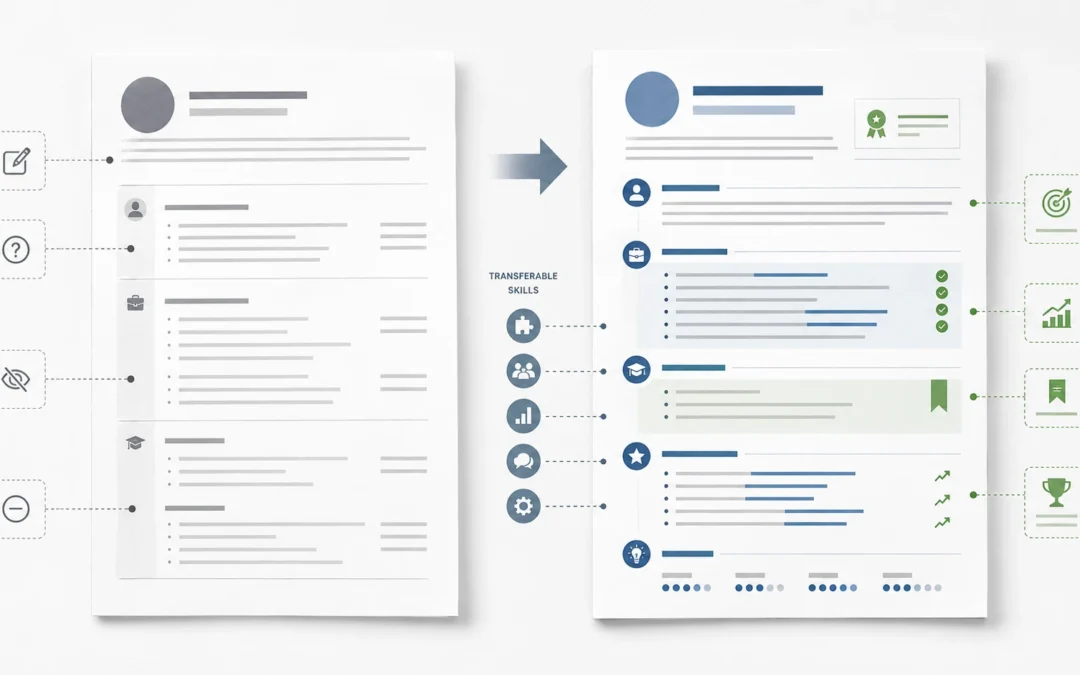
Changing career does not make your previous experience irrelevant. The challenge is helping an employer see how that experience applies to a different role, industry or level.
A career change CV must reposition your evidence around what the new employer needs. It may also need to address retraining without direct experience, an employment gap, a move into a less senior position or a long work history containing information that no longer supports your target.
The answer is rarely to erase your past. It is to retain the right evidence, translate it into recognisable language and make the connection explicit.
What is a career change CV?
A career change CV is a targeted CV that reorganises and rewrites previous experience around the requirements of a different occupation, industry or specialism. It gives greater prominence to transferable achievements, relevant skills, recent training and practical evidence while retaining a clear employment history.
A strong CV for career change should answer:
- Why is this person’s background relevant?
- What evidence shows they can perform in the new role?
- What have they done to prepare for the transition?
How is a career change CV different from a standard CV?
A standard CV usually reinforces an established direction. Recent titles, sector experience and progression already help the recruiter understand the candidate.
A changing career CV must explain relevance rather than expecting the reader to infer it. That normally means:
- translating terminology from the old sector;
- prioritising achievements that match the new role;
- making transferable evidence prominent;
- reducing irrelevant detail;
- demonstrating credible action towards the new direction.
The National Careers Service guidance on tailoring a CV recommends matching the document to the job advert, highlighting requested skills and removing outdated information.
A career transition CV applies these principles more selectively. It changes the emphasis without disguising the candidate’s history.
What is the best CV format for a career change?
For most UK career changers, a chronological-hybrid CV is the safest default. It places relevant evidence near the top while preserving a recognisable reverse-chronological employment history.
Chronological CV
A conventional chronological CV may work when the change is relatively close, such as account management to customer success.
Its weakness is emphasis: old titles and sector-specific duties may dominate before the recruiter sees the connection.
Functional or skills-based CV
A functional CV organises evidence under capability headings and minimises individual roles. This can help when direct experience is limited, but removing employment context can make achievements harder to assess or appear to obscure chronology.
A skills-based career change CV template should not therefore be treated as an automatic solution.
Chronological-hybrid CV: the recommended default
A practical structure is:
- Contact details and target-role headline
- Career-change profile
- Relevant skills or selected achievements
- Retraining, certifications or projects where important
- Reverse-chronological employment history
- Education and additional relevant information
This format lets a CV for a career switch lead with evidence without hiding its source. It also supports straightforward, ATS-friendly CV structure and keyword use, particularly with a single column, standard headings and clear dates.
How to write a CV for a career change: step by step
Do not begin by lightly editing your existing profile. First establish what the target role requires, then work backwards to find and reposition supporting evidence.
1. Analyse the target role
Review several realistic vacancies. Separate recurring requirements into:
- qualifications and knowledge;
- technical skills, systems and methods;
- responsibilities;
- expected outcomes;
- sector terminology.
Use the National Careers Service job profiles to research unfamiliar occupations.
This gives your CV for changing industry a clear target and stops it becoming a list of generic strengths.
2. Identify transferable evidence—not just skills
A skill is only persuasive when the employer can see where you used it and what happened.
Look beyond formal job descriptions. Evidence can come from projects, temporary assignments, process improvements, system implementations, volunteering, training or responsibilities undertaken during a career break.
The National Careers Service guidance on identifying skills recommends considering work, education and everyday experience.
A transferable skills CV should make the connections explicit:
| Target requirement | Transferable evidence | Target-focused wording | Proof or result |
|---|---|---|---|
| Project scheduling | Planned rotas, promotions and store refits | Coordinated schedules, resources and dependencies | Completed five refits without disrupting trading |
| Stakeholder communication | Worked with managers, suppliers and contractors | Maintained communication across project stakeholders | Resolved delivery issues before deadlines |
| Budget monitoring | Controlled staffing and maintenance expenditure | Monitored expenditure and reported variances | Reduced avoidable costs by 8% |
| Risk management | Responded to shortages and equipment failures | Identified risks and coordinated corrective action | Protected three launch dates |
These transferable skills examples show how to make unrelated experience relevant without pretending that two occupations are identical.
3. Translate evidence into the employer’s language
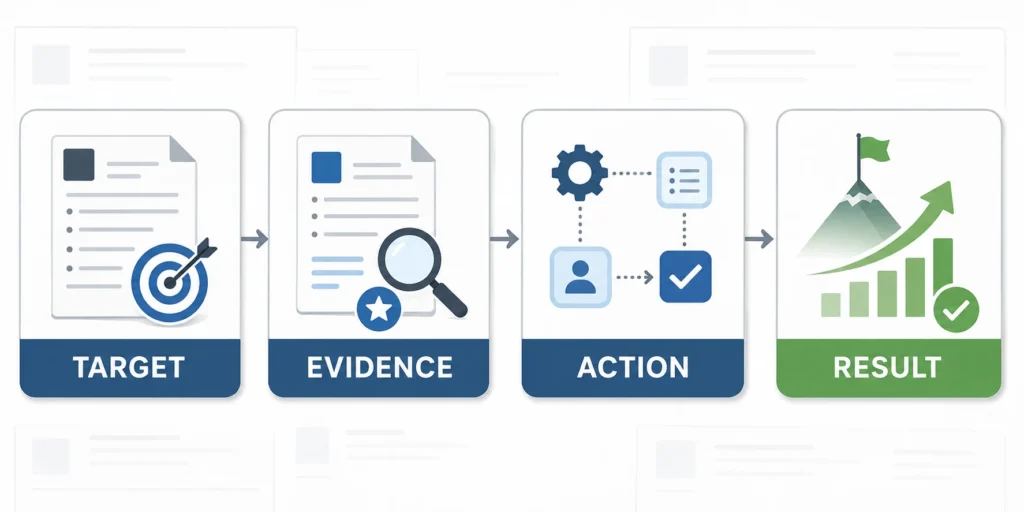
Use this formula:
Target requirement → transferable evidence → relevant action → measurable result
For a retail manager moving into project coordination:
- Requirement: Project tracking
- Evidence: Store refits
- Action: Managed schedules, contractors and issues
- Result: Five refits completed on time without closing the store
The resulting bullet might be:
Coordinated five store-refit projects, maintaining schedules, contractor communication and issue logs to complete each programme on time without interrupting trading.
Translation does not mean changing an official job title. It means replacing old-sector jargon with accurate language the target employer will recognise.
4. Write a career-change personal profile
A strong career change personal statement should include:
- the target direction;
- relevant previous context;
- two or three transferable strengths;
- brief evidence;
- recent training or practical activity where useful.
Avoid opening with what you lack. Start with the connection:
Retail operations manager transitioning into project coordination, with experience delivering store refits, system rollouts and time-sensitive operational changes across multiple stakeholders.
A career change CV profile should acknowledge the transition once and let the rest of the document prove that it makes sense. See this guide to writing a focused CV profile for a broader formula.
5. Rebuild employment history around relevance
Keep reverse chronology, but do not give every role equal space.
Expand relevant achievements in recent positions. Condense older or unrelated roles while retaining enough information to show continuity and progression.
Unrelated experience should usually stay, but its prominence should reflect its relevance. Keep official titles and accurate dates; remove routine duties that reinforce the wrong professional identity.
6. Present retraining and practical projects
Move relevant retraining above employment when it supplies an essential qualification or your strongest recent evidence.
Where appropriate, include:
- relevant modules;
- assessed projects;
- tools or methods used;
- practical outputs;
- completion dates.
Government guidance signposts UK career skills and training options. However, completing a course is not the same as performing a role professionally. The CIPD’s guidance on skills and qualifications explains that the two complement one another but are not interchangeable.
Strengthen training with practical evidence:
Completed PRINCE2 Foundation and produced an assessed project plan covering scope, stakeholders, milestones, risks and reporting.
7. Handle gaps and demonstrate commitment
Explain a gap briefly and factually:
Career break for caring responsibilities | 2024–2025
Completed project-management training and coordinated fundraising events for a local charity.
This guide provides more detailed advice on how to explain an employment gap on your CV.
Commitment is best demonstrated through action: training, projects, volunteering, professional memberships or temporary assignments. If the transition requires broader support, a career-change job-search strategy can align your role targeting, applications and interview preparation.
Career change personal statement examples
These examples are illustrative. Only include claims that the rest of your CV can support.
Industry change with transferable experience
Operations manager with 12 years’ experience improving service delivery, controlling budgets and leading cross-functional teams in multi-site hospitality environments. Now targeting customer-success management roles, bringing a record of increasing satisfaction, resolving complex issues and developing teams of up to 35 people.
Retraining with little direct experience
Administrative professional transitioning into HR coordination after completing CIPD Level 3 Foundation Certificate in People Practice. Offers seven years’ experience handling confidential records, supporting recruitment administration and coordinating onboarding activity, supplemented by an assessed project on inclusive recruitment.
Senior professional moving into a new function or level
Commercial director moving into a senior business-development role within the charity sector, offering 18 years’ experience building partnerships, securing complex contracts and translating strategy into sustainable income. Led negotiations generating £12 million in new business across public, private and third-sector organisations.
A senior candidate moving into a narrower role should make the decision sound deliberate rather than apologising for previous seniority.
Changing careers CV example: retail manager to project coordinator
This fictional career change CV example shows how selected elements might be rewritten. The figures are illustrative and should only be used when they reflect your experience.
Original profile
Hard-working retail manager with excellent communication and customer-service skills. Experienced in managing busy stores and motivating teams. Looking for a new challenge.
Improved profile
Retail operations manager transitioning into project coordination, with eight years’ experience delivering store refits, product launches and system implementations. Skilled in schedule coordination, progress reporting, supplier communication and issue resolution. Coordinated five refits on schedule without interrupting trading.
The revised profile identifies the target, translates relevant experience and supplies evidence without claiming a Project Coordinator title.
Skills and employment-history changes
Instead of leading with customer service, visual merchandising and sales targets, prioritise:
- project and schedule coordination;
- stakeholder communication;
- risk and issue tracking;
- supplier liaison;
- progress reporting;
- budget monitoring.
Retain the official Retail Manager title. Place project-style achievements first and condense routine duties.
Before-and-after achievement rewrites
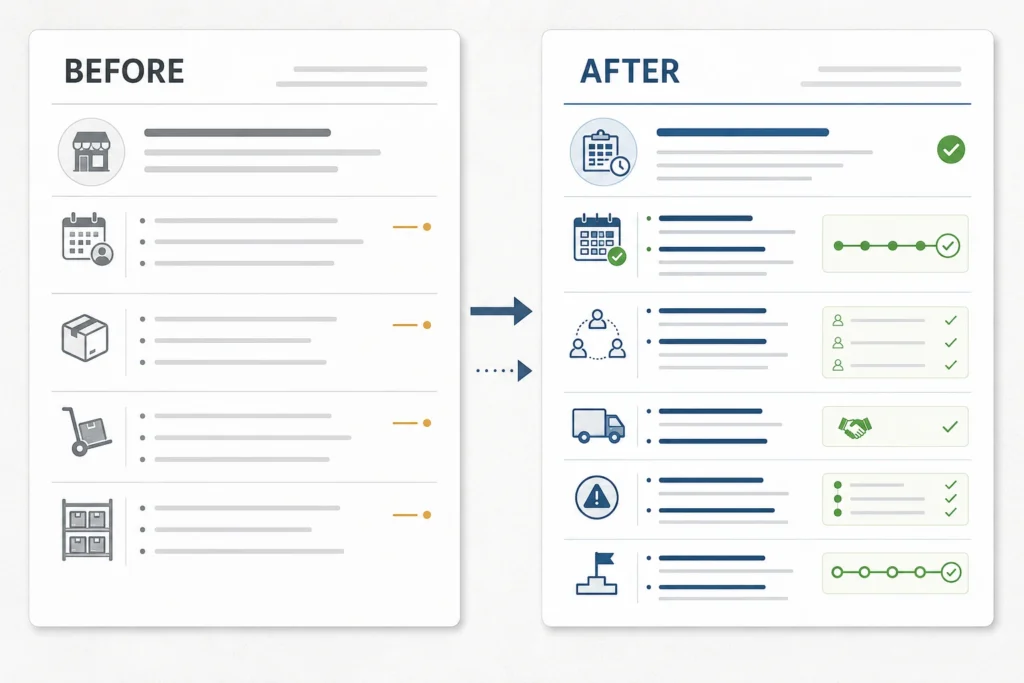
Before: Managed a team and prepared staff rotas.
After: Coordinated weekly resource plans for a 24-person team, adjusting schedules around training, leave and promotional activity to maintain peak-period coverage.
Before: Helped with store refits and worked with contractors.
After: Coordinated five store refits involving contractors, suppliers and operations teams, maintaining schedules and action lists to complete each programme on time without closing the store.
Before: Dealt with stock and delivery problems.
After: Identified and escalated delivery risks during three seasonal launches, working with suppliers and regional teams to protect agreed implementation dates.
A useful changing careers CV example does not make the previous career disappear. It helps the employer recognise its relevant evidence.
Common career change CV mistakes
- Relying on motivation instead of evidence. Support enthusiasm with training, projects or relevant achievements.
- Automatically using a functional CV. Keep employment context unless there is a sound reason not to.
- Retaining old-sector jargon. Translate it into recognisable actions and outcomes.
- Listing skills without proof. Show who, what, how and what changed.
- Manipulating chronology or titles. Accuracy matters more than making the transition appear seamless.
- Treating retraining as employment. Distinguish learning from professional application.
- Removing too much previous experience. Earlier roles may still show progression, scale and judgement.
- Targeting several careers with one CV. Each direction requires different evidence and terminology.
Review your career change CV in 15 minutes
Before applying, check:
- Is the intended role clear in the opening lines?
- Does every major skill have supporting evidence?
- Have you translated old-sector terminology?
- Do your bullets show actions and results?
- Is the most relevant information on page one?
- Is your employment history still clear?
- Have you condensed irrelevant detail?
- Is important retraining prominent enough?
- Are gaps explained briefly where necessary?
- Are titles, dates and figures accurate?
- Does the document use standard headings and an easy-to-read layout?
Compare the first half of page one with the target job description. The same priorities should be visible in both, supported by evidence rather than copied as keywords.
Get a second opinion before you apply
Career-change positioning can be difficult when you are too close to your own experience to recognise its strongest connections.
Start with a free CV review for practical feedback. For more hands-on support, explore the professional CV writing service.
If you are undecided, this guide considers whether to rewrite your CV yourself or get professional help.
Career change CV FAQs
How do I write a CV for a career change?
Analyse the target role, identify relevant evidence and translate it into language the new employer will recognise. Lead with a targeted profile and transferable achievements while retaining a clear employment history.
What is a transferable skills CV?
It is a CV that foregrounds capabilities useful across different roles or industries. Those skills should be supported by examples and results. It does not need to use a purely functional format.
What is the best CV format for a career change?
A chronological-hybrid is generally safest for UK candidates. It places relevant skills, achievements and retraining near the top while retaining a clear employment timeline.
Should I include unrelated experience?
Usually, yes—but reduce its detail. Retain enough to show continuity and progression while expanding evidence that supports the new role.
Should retraining appear before employment history?
Place it first when it provides an essential qualification or your strongest recent evidence. Otherwise, keep it concise and position it after professional experience.
How do I change career without direct experience?
Use projects, training, volunteering and transferable achievements to demonstrate capability. Be clear about the setting rather than presenting course or voluntary work as professional experience.
Do I need a cover letter for a career change?
Not always, but it can explain your motivation and interest in a particular employer. Keep the CV evidence-led and use the letter for the fuller context.
Recent Comments