

Examples, ATS-friendly template and what to write if you’ve never had a job.
Introduction
Staring at a blank CV because you’ve got nothing to put under “Work Experience”? You’re not alone, and you’re not stuck.
A strong CV with no work experience isn’t about filling space. It’s about showing employers what you can do: your skills, your attitude, and proof from education, projects, volunteering, and responsibilities outside paid work. That’s exactly what recruiters expect to see for first jobs, apprenticeships, internships and entry-level roles in the UK.
This guide gives you an ATS-friendly structure plus copy-ready examples so you’re not guessing what to write.
In this guide, you’ll get:
- a simple UK CV structure that doesn’t rely on job history
- personal statement examples you can adapt quickly
- the best skills to include (with proof, not fluff)
- how to make your CV ATS-friendly without overcomplicating it
- a checklist, a worked before/after example, and a free template-style layout to follow
If you want a second pair of eyes when you’re done, you can also use my free CV review. I’ll flag the biggest fixes around structure, keywords and clarity.
Quick answer: If you have no work experience, build your CV around skills, education and proof: projects, volunteering, school responsibilities and achievements. Add a 4–5 line personal statement, 6–8 relevant skills backed by examples, and an ATS-friendly layout (simple headings, one column, no graphics). Adapt keywords to each job and keep it to one page where possible.

How to write a CV with no experience: step-by-step (UK)
Follow these steps in order. They’re designed for first CVs, first jobs, and entry-level roles — and they’ll also keep your CV clean and ATS-friendly.
Step 1: Start with an ATS-friendly layout
Keep it simple so both humans and ATS systems can read it easily:
- Single column, clear headings, normal font (Calibri/Arial)
- No icons, text boxes, skill bars, or graphics
- Use bullet points (not paragraphs) for evidence
- Save as PDF unless the job ad asks for Word
Goal: Make your CV easy to scan in 10 seconds.
Step 2: Write a focused personal statement (4–5 lines)
At the top of your CV, include a short profile that answers:
- Who you are (student/school leaver/graduate/career starter)
- What you’re good at (2–3 strengths)
- What you’re applying for (type of role)
- A proof point (project, volunteering, achievement)
Goal: Make the employer think, “This person fits what we need.”
Step 3: Pick 6–8 skills that match the job (and prove them)
Don’t list 15 skills and hope one lands. Choose a small set that’s relevant and add proof in the form of examples (from school, projects, volunteering, clubs, caring responsibilities, informal work).
Goal: Skills that sound real, not generic.
Step 4: Put your education where it helps you most
If you’re a school leaver, college student or graduate, education is a major selling point. Include:
- GCSEs / A-levels / BTEC / T Levels / degree
- Predicted grades only if strong or requested
- 2–3 highlights (projects, awards, leadership, presentations)
Goal: Use education as evidence of effort, discipline and capability.
Step 5: Replace “work experience” with projects, volunteering and responsibilities
This is where most first CVs become convincing. Add 2–4 entries like:
- Volunteering
- School/college roles (prefect, rep, mentor, club leader)
- Projects (coursework, EPQ, portfolio, coding, content)
- Informal work (babysitting, tutoring, dog walking)
- Family responsibilities (admin support, caring duties)
Write them like mini roles with bullet points (action, context & outcome).
Goal: Show what you’ve done, not what you haven’t.
Step 6: Tailor your CV to the job ad (5 minutes)
For each application:
- Pull 5–10 keywords from the job description
- Mirror the most relevant ones in your profile, skills and project bullets
- Remove anything that doesn’t support the role
Goal: Make your CV look “made for this job” (without lying).
Step 7: Run a final quality check before you send
Use this quick check:
- Contact details correct and professional email
- Spelling/grammar checked
- File named clearly (e.g.,
FirstName-LastName-CV.pdf) - One page if possible (two only if you truly have relevant content)
- CV reads confidently (no apologies for lack of experience)
Goal: No avoidable rejections.
Mini checklist (copy/paste)
Before you apply, confirm you have:
- A 4–5 line personal statement tailored to the role
- 6–8 relevant skills with proof
- Education with 2–3 highlights
- 2–4 “experience substitutes” (projects/volunteering/responsibilities)
- ATS-friendly formatting (simple, one column)
- Keywords mirrored from the job ad
- Clear file name and clean PDF output
What employers want to see (even if you’ve never had a job)
Most employers hiring for first jobs, apprenticeships, internships and entry-level roles aren’t expecting you to have a long work history. They’re looking for signs you’ll be easy to train and safe to hire.
Here’s what they’re scanning for, often in seconds:
- Reliability: you turn up, meet deadlines, and follow through
- Communication: you can deal with people professionally (in person, email, phone)
- Organisation: you can manage tasks without constant chasing
- Teamwork: you collaborate without drama and pull your weight
- Initiative: you take action and solve small problems yourself
- Attitude: you’re willing to learn, take feedback, and improve
If your CV proves those things, the lack of job titles becomes far less important.
What counts as “experience” in the UK (even if it wasn’t paid)
If you’ve done any of the below, you already have experience, you just need to present it properly:
Volunteering
- Charity shop shifts, school fairs, community events, food banks
- Helping with admin, organising stock, speaking to visitors, handling cash
Need ideas fast? GOV.UK lists places to find volunteering opportunities (plus practical info like expenses and checks).
School/college responsibilities
- Prefect, form rep, peer mentor, student council
- Leading a group project, organising a fundraiser, supporting younger students
Projects (academic or personal)
- Coursework, EPQ, dissertations, presentations
- Portfolios (design, writing, coding), building a website, running a small online page
Clubs, sports and performing arts
- Commitment, training schedules, competition/team roles
- Captaining, helping coach, organising fixtures or events
Informal work or side income
- Babysitting, tutoring, dog walking, gardening
- Selling art/crafts, basic freelance tasks, helping neighbours
Family responsibilities
- Caring duties, household organisation, helping in a family business
- Admin tasks, deliveries, managing bookings, basic customer interactions
If you’re targeting apprenticeships, you can search and apply via Find an apprenticeship (GOV.UK).
The difference between “I did things” and “I’m employable”
The secret is evidence. Employers don’t want a list, they want proof.
Instead of:
- “Good communication”
- “Team player”
- “Hardworking”
Show it like this (simple and believable):
- “Worked in a group of four to deliver a project to deadline and present our findings clearly.”
- “Volunteered at a community event and handled questions from visitors calmly and politely.”
- “Organised revision plans across multiple subjects and met deadlines consistently.”
Quick prompt (use before you write the next sections)
Write down three moments from the past year where you showed one of these:
- reliability, teamwork, organisation, initiative, communication
Those three moments will become your strongest bullet points later, and they’ll make your CV feel real, even with no formal job history.
CV structure for no experience (ATS-friendly UK layout)
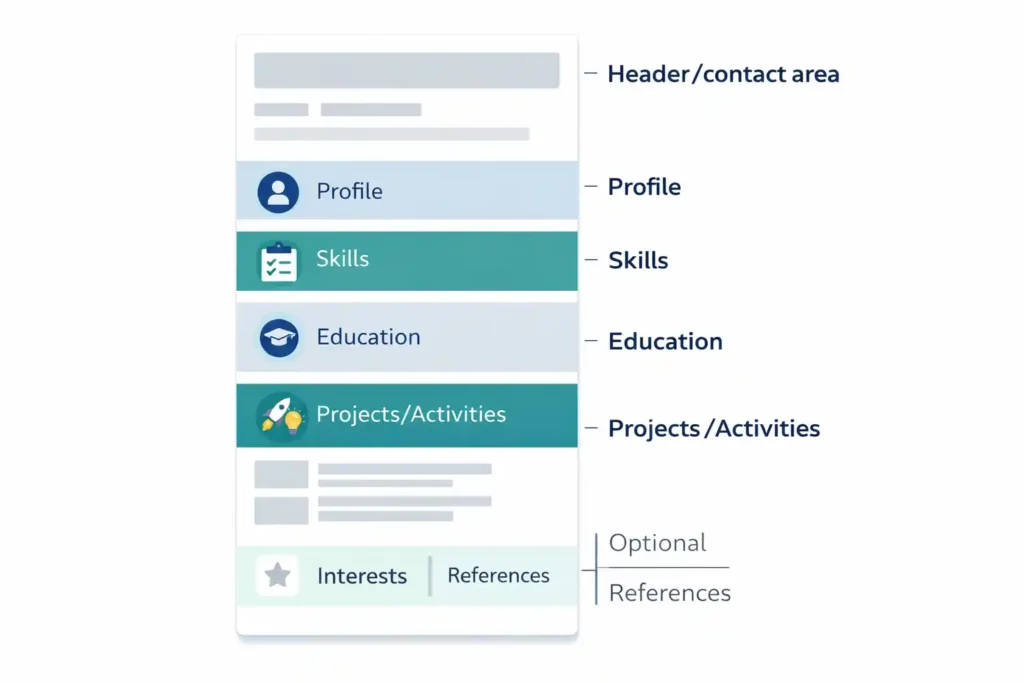
When you don’t have job history, structure matters more than ever. A clear layout helps recruiters scan quickly and keeps your CV readable for an ATS (Applicant Tracking System).
Recommended CV sections (and what to put in each)
| CV section | What to include | Make it stronger by… |
|---|---|---|
| Contact details | Name, town/city (UK), phone, professional email, LinkedIn (optional) | Use a sensible email address and make sure your voicemail sounds professional |
| Personal statement | 4–5 lines: who you are, your strengths, role target & proof | Mention the type of role and add one proof point (project/volunteering/achievement) |
| Key skills | 6–8 skills matched to the job | Add evidence (a short example) instead of listing skills with no proof |
| Education | GCSEs / A-levels / BTEC / T Levels / degree & dates | Add 2–3 highlights: awards, strong modules, projects, leadership |
| Projects & activities | Coursework, EPQ, portfolio, clubs, responsibilities | Write like mini roles with bullet points (action, context & outcome) |
| Volunteering / informal work | Charity, community roles, tutoring, babysitting etc. | Focus on what you did and what it shows (reliability, communication, teamwork) |
| Interests (optional) | Only if it supports the role | Team sport, coding, writing, content creation, volunteering; skip generic lists |
| References | “Available on request” | Only add referees if the employer asks for them |
Best section order for a first CV (UK)
- If you’re a school leaver/student: Personal statement; Education; Skills; Projects/Activities; Volunteering; Interests
- If you’re a graduate: Personal statement; Skills; Education; Projects/Activities; Volunteering
- If you’re a career starter with projects (e.g., tech/creative): Personal statement; Skills; Projects/Portfolio; Education; Volunteering
ATS checklist (keep this simple)
An ATS CV isn’t about gaming the system, it’s about making your CV easy to read.
- Use a single-column layout
- Use standard headings: Personal statement / Profile, Skills, Education, Projects, Volunteering
- Avoid CV “design” features: text boxes, icons, skill bars, columns, images
- Use a clean font (Calibri, Arial, Helvetica) and consistent spacing
- Bullet points > paragraphs (clear and scannable)
- Save as PDF unless the job ad requests Word
- Name your file clearly:
FirstName-LastName-CV.pdf - Mirror job keywords naturally (skills/tools/behaviours), don’t copy-paste whole sentences
If you want a quick check that your layout and keywords won’t trip up ATS, you can use the free CV review here: /free-cv-review/.
For a quick cross-check on standard UK CV sections and expectations, the National Careers Service has a useful guide on CV sections and structure.
Copy/paste CV headings (quick template)
Use these exact headings to keep your structure clean:
- Personal Statement
- Key Skills
- Education
- Projects & Activities
- Volunteering / Experience
- Interests (optional)
- References (optional)
CV template with no work experience (ATS-friendly copy/paste)
A good template does two things: it stops you overthinking the layout, and it keeps your CV ATS-friendly (simple headings, single column, no graphics).
The simple ATS-safe CV template (copy/paste layout)
Use this structure in Word or Google Docs:
[Your Name]
Town/City, UK • Phone • Professional email • LinkedIn (optional)
Personal Statement
4–5 lines: who you are, strengths, target role & one proof point.
Key Skills
- Skill & proof (one line each)
- Skill & proof
- Skill & proof
(6–8 max)
Education
School/College/University, Dates
Qualification(s) & grades (if strong/relevant)
Highlights: 2–4 bullets (projects, awards, leadership, presentations)
Projects & Activities / Volunteering
Role / Project | Organisation (Voluntary/Project) | Dates
- Action, context & outcome
- Action, tool/method & result
(2–4 bullets per entry)
Interests (optional)
Only include interests that support the role (e.g., team sport, coding, writing, volunteering).
References
Available on request
Formatting rules (don’t skip): single column • no icons/text boxes • normal font • bullet points • save as PDF unless the job asks for Word.
Personal statement examples (no experience)

Your personal statement (also called a CV profile) sits right at the top. If you’re writing your first CV, it does two jobs:
- Explains who you are and what you’re aiming for
- Gives the employer a reason to keep reading, even without job history
Keep it short: 4–5 lines. And make it specific enough that it couldn’t be copy-pasted onto any CV.
A simple structure that works every time
- Who you are: student / school leaver / graduate / career starter
- Strengths: 2–3 relevant skills or traits
- Target role: what you’re applying for
- Proof: one example (education, project, volunteering, responsibility)
Example 1: Student applying for a first part-time job (retail/hospitality)
Friendly and reliable sixth-form student with strong communication and teamwork skills developed through group projects and team sport. Confident speaking with customers and learning new tasks quickly. Looking for a part-time retail or hospitality role where I can contribute to a busy team and build professional experience.
Example 2: School leaver aiming for an apprenticeship
Motivated school leaver with a practical mindset and a strong record of meeting deadlines in coursework and group projects. Enjoy learning hands-on, taking feedback, and improving quickly. Seeking an apprenticeship where I can develop real workplace skills and contribute reliably from day one.
Example 3: Entry-level admin / office support
Organised and detail-focused school leaver with confidence using Microsoft Office and Google Workspace. Used to managing competing deadlines and supporting others through school responsibilities and event planning. Seeking an entry-level admin role where I can support day-to-day tasks, communicate professionally and learn quickly.
Example 4: Graduate with limited experience (project-led)
Recent graduate with strong research, writing and presentation skills, backed by academic projects and team-based coursework. Comfortable analysing information, working to deadlines and communicating clearly. Seeking an entry-level role where I can apply these strengths while continuing to develop in a structured environment.
Example 5: Career starter moving into tech (self-taught/projects)
Career starter transitioning into tech after completing self-directed learning and building small portfolio projects. Strong attention to detail, logical problem-solving skills and a consistent habit of learning independently. Looking for a junior role where I can contribute, learn fast and develop with support from an experienced team.
Make yours stronger (quick edits)
Do
- Mention the role type (retail, admin, apprenticeship, trainee, graduate role)
- Add one proof point (project, volunteering, achievement)
- Keep it confident and forward-looking
Don’t
- Apologise for lack of experience
- Use empty buzzwords (“hardworking team player”) without evidence
- Talk about personal circumstances that don’t help the employer decide
Plug-and-play personal statement template
Use this and fill in the brackets:
[Who you are] with strengths in [2–3 relevant skills] developed through [education/projects/volunteering]. Comfortable [relevant environment/task] and quick to learn. Seeking a [role type] where I can [contribute/how you’ll help] and develop professionally.
Skills section (with evidence): what to include when you have no experience
If you’ve never had a job, your skills section becomes a key decision point for the employer. But there’s one rule:
Never list a skill you can’t prove.
A CV full of “teamwork, communication, hardworking” with no evidence gets ignored.
Step 1: Choose 6–8 skills that match the role
Use the job advert to guide you. Look for repeated words like “customer service”, “organisation”, “attention to detail”, “team”, “fast-paced”, “Microsoft Excel”, etc.
Good skill types to mix:
- Soft skills (how you work): communication, reliability, teamwork, time management
- Transferable skills (what you can do): admin, research, presenting, data handling, social media
- Basic tools (what you can use): Microsoft Office, Google Workspace, Canva (if relevant)
Step 2: Prove each skill with a quick example
Use one short line per skill. Pull proof from:
- school/college projects
- volunteering
- clubs/sports
- caring responsibilities
- informal work (tutoring, babysitting, etc.)
Three strong formats (choose one)
Option A: Skill & proof bullets (best for most first CVs)
Key Skills
- Communication: delivered presentations in class and supported younger students through peer mentoring
- Organisation: managed deadlines across multiple subjects and kept group work on track using shared docs
- Teamwork: worked in a small group to plan and deliver a project, splitting tasks and presenting results
- Reliability: consistent attendance and on-time submission of coursework throughout the year
- Customer focus (if relevant): volunteered at an event speaking to visitors and answering questions politely
- IT confidence: Microsoft Word/PowerPoint, Google Docs/Drive (comfortable formatting and sharing files)
Option B: Two-column skills list (only if your theme supports it cleanly)
Use this if it still reads well on mobile and stays ATS-friendly.
Soft skills
- Communication
- Teamwork
- Time management
- Attention to detail
Tech/transferable
- Microsoft Office / Google Workspace
- Basic data handling (spreadsheets)
- Canva (if relevant)
- Social media basics (if relevant)
(Then add proof in your Projects/Activities section so it’s not just a list.)
Option C: Skill clusters (useful for admin/retail)
Skills for customer-facing roles
- Communication • Confidence speaking to the public • Handling queries calmly
Skills for organised work
- Time management • Following instructions • Attention to detail
Tools
- Microsoft Office • Google Workspace • Canva (basic)
“Best skills” examples by role type (quick guide)
Retail / hospitality
- Communication, teamwork, reliability, customer focus, working under pressure, timekeeping
Admin / office support
- Organisation, attention to detail, written communication, MS Office/Google Workspace, managing deadlines
Warehouse / operations
- Reliability, following instructions, punctuality, stamina, teamwork, safety awareness
Apprenticeships
- Coachability, curiosity, problem-solving, reliability, communication, practical learning mindset
Micro-template: turn a vague skill into proof
- Skill: Organisation
- Proof: “Managed coursework deadlines across 5 subjects and kept shared notes and files organised for group work.”
Common mistakes to avoid
- Listing 12–15 skills (looks unfocused)
- Using generic claims with no proof
- Adding tools you don’t actually know
- Including irrelevant skills (tailor to the job)
Next up: we’ll make your Education section do more work for you (GCSEs/A-levels/BTEC/T Levels/degree) or we can go straight to Projects/Volunteering as ‘experience’ with a before/after bullet example.
Education section (UK-specific): how to make it work harder for you
When you don’t have work experience, your education is often your strongest “evidence” section, especially in the UK, where employers recognise GCSEs, A-levels, BTECs, T Levels and apprenticeships.
The goal isn’t to list everything. It’s to show effort, relevance and proof.
Where should education go on a no-experience CV?
- School leaver / student: put Education near the top (often straight after your personal statement).
- Graduate: education can sit just below skills (unless your degree is the main selling point for the role).
- Career starter with strong projects/portfolio: you can place Education below Projects.
What to include (and what to leave out)
Include:
- School/college/university name and location (town/city is enough)
- Dates attended (or expected completion date)
- Qualification(s) and subjects
- Grades (if strong or requested)
- 2–4 highlights that prove your capability (projects, presentations, awards, leadership)
Avoid:
- Every subject you’ve ever studied (unless it’s highly relevant)
- A long list of weak grades (you can summarise instead)
- Paragraphs: keep it clean and scannable
Examples (copy/paste formats)
Example 1: GCSE student / school leaver
Greenbridge High School, London — 2021–2026 (Expected)
GCSEs (Predicted): English Language (7), Maths (6), History (8), Biology (7), Geography (6)
Highlights: Peer mentor for Year 7 pupils • Led a group presentation • Supported a school fundraiser
If you have fewer grades or don’t want to list them all:
GCSEs: 8 subjects including English and Maths (details available on request)
Example 2: A-level student
St Mary’s Sixth Form, Croydon — 2024–2026 (Expected)
A-levels (Predicted): Business (B), Sociology (B), English Language (C)
Highlights: Group lead on coursework project • Strong presentation feedback • Consistent deadline performance
Example 3: BTEC / college
City of Bristol College, Bristol — 2024–2026
BTEC Level 3 Business — Distinction predicted
Highlights: Led a marketing project (mock campaign) • Produced reports using spreadsheets • Won “Best Presentation” award
Example 4: T Level
Leeds College, Leeds — 2024–2026
T Level in Digital Production, Design and Development
Highlights: Built a simple website as part of coursework • Worked to briefs and deadlines • Comfortable with teamwork and feedback
Example 5: University (graduate)
University of Nottingham, Nottingham — 2022–2025
BA (Hons) Psychology — 2:1
Highlights: Research project using data and written analysis • Presented findings to a group • Strong academic writing and deadline management
If you’re unsure how a qualification is described (or how it should appear on a CV), GOV.UK has a clear explanation of UK qualification descriptions.
Add “Relevant modules” only when it helps
If the job is specific (e.g., finance, IT, marketing), add a short line like this:
Relevant modules: Data analysis • Business communications • Digital marketing
Keep it to 3–6 modules max.
Quick checklist: make your education section stand out
- Clear qualification and dates
- Grades included only if useful/strong
- 2–4 highlights that prove effort/skill
- Relevant modules included only when role-specific
- Clean formatting (easy to scan in 5 seconds)
Next section: we’ll replace “Work Experience” with projects, volunteering and responsibilities, and I’ll include a strong before/after bullet example so it reads like real experience.
What to put instead of work experience (and how to write it so it counts)
If you haven’t had a paid job yet, don’t leave your CV looking empty. Replace “Work Experience” with Projects, Volunteering, Responsibilities (and any informal work you’ve done).
The goal is simple: prove you can show up, learn, communicate, and deliver.
What counts as experience (even if it wasn’t paid)
You can use any of the below, as long as you write it like a mini role:
- Volunteering (charity shop, school events, community groups, food banks)
- School/college roles (prefect, peer mentor, student rep, club leader)
- Projects (coursework, EPQ, portfolio, content creation, coding, design)
- Informal paid work (babysitting, tutoring, dog walking, helping neighbours)
- Family responsibilities (caring duties, admin, organising, helping in a family business)
- Clubs/sports/performing arts (commitment, teamwork, leadership, discipline)
How to write “experience substitutes” (simple bullet formula)
Treat each entry like a job:
Role / Activity: Organisation (Voluntary/Project)
Month Year – Month Year
- Action you took
- What you used (tool/method)
- Outcome (result, improvement, positive feedback)
If you can add a number, do it, but don’t force it. (“Helped 40 attendees”, “posted weekly”, “raised £300”, “completed 10-hour course”, etc.)
Use this mini-STAR line when you’re stuck
Did [X] to achieve [Y] by [Z].
Example: “Created a simple weekly content plan to promote a school event by designing posts in Canva and scheduling updates.”
Worked example: CV bullet points (before vs after)
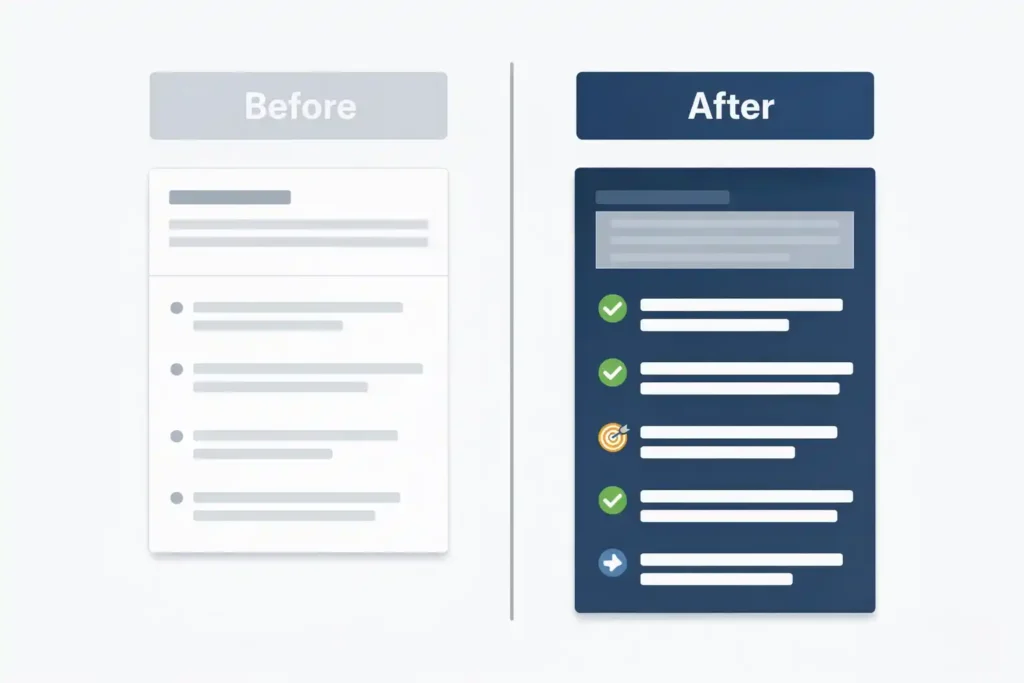
Before (too vague):
- Helped with social media
- Did a group project
- Good communication and teamwork
- Helped at a school event
After (credible and ATS-friendly):
- Planned and created weekly posts for a school club to promote events and keep members informed
- Worked in a four-person team to deliver a project to deadline, splitting tasks and presenting findings clearly
- Supported an event by welcoming visitors, answering questions politely and helping keep the stall organised
- Took initiative to organise shared files and reminders so the team stayed on track during exam season
Why the “after” works: it shows what you did, how you did it, and what it proves (reliability, teamwork, communication).
Copy/paste experience examples (no work experience)
Example 1: Volunteering (retail/customer roles)
Event Volunteer | Local Community Fair | Jun 2025
- Helped set up stalls and kept the area tidy and organised throughout the day
- Spoke with visitors, answered questions and directed people to the right stalls
- Supported the team with restocking and basic cash handling under supervision
Example 2: School responsibility (any first job)
Peer Mentor | School Support Programme | Sep 2024 – Mar 2025
- Supported younger pupils with settling in and encouraged positive behaviour
- Communicated calmly and clearly when helping with questions or small issues
- Followed guidance from staff and handled responsibilities reliably
Example 3: Project (great for admin/office/graduate roles)
Group Project, Business/EPQ/College Coursework | Jan 2025 – Apr 2025
- Researched information and summarised key points into a clear written report
- Coordinated tasks using shared documents and tracked deadlines to keep the project on schedule
- Presented findings confidently and responded to feedback to improve the final outcome
Example 4: Informal paid work (counts if you write it properly)
Private Tutor, GCSE Support (Informal) | Oct 2024 – Feb 2025
- Helped a GCSE student plan revision and understand key topics through weekly sessions
- Adapted explanations to suit their learning style and tracked progress over time
- Improved organisation and communication through consistent session planning
Example 5 : Family responsibilities (yes, this can count)
Family Support , Admin/Organisation (Responsibilities) | 2024 – 2025
- Managed basic organisation tasks (scheduling, messages, reminders) to support day-to-day routines
- Kept information tidy and easy to find using notes and shared documents
- Handled responsibilities consistently while balancing school/college deadlines
Quick rules (so it reads like real experience)
- Use role-like titles (Volunteer, Project Lead, Peer Mentor, Tutor)
- Keep entries relevant to the job you’re applying for
- Use bullet points (2–4 per entry is enough)
- Make it easy to scan (your CV still needs to work for ATS)
If you’d like, we can make your entries even sharper later by tailoring them to a specific job type, or by rewriting them in the style a professional CV writer would use (without making them sound fake).
CV with no work experience example (UK)
Below are three UK examples you can copy and tailor — pick the one closest to your situation.
Example CV 1 : School leaver (UK) (copy/paste)
Ava Patel
Croydon, UK • 07900 123 456 • ava.patel@email.com • LinkedIn (optional)
Personal Statement
Reliable school leaver with strong communication and organisation skills developed through school projects, volunteering and team sport. Comfortable working to deadlines and dealing with people politely and professionally. Seeking an entry-level role where I can contribute to a team and build workplace skills quickly.
Key Skills
- Communication: presentations in class and supported younger pupils through peer mentoring
- Organisation: managed deadlines across subjects and kept group work on track using shared docs
- Teamwork: worked in a 4-person team to deliver a project to deadline and present findings clearly
- Reliability: strong attendance and consistent on-time coursework submission
- IT confidence: Microsoft Word/PowerPoint, Google Docs/Drive; basic Canva
- Customer focus: helped at a school event welcoming visitors and answering questions
Education
St Mary’s High School, Croydon — 2019–2024
GCSEs: English Language (7), Maths (6), History (8), Biology (7), Business (6)
Highlights: Student Council member • Helped organise a fundraising event • Strong presentation feedback
Projects & Activities / Volunteering
Event Volunteer, School Fundraiser (Voluntary) | Mar 2023
- Helped set up and run a stall, speaking to visitors and keeping the area organised
- Supported basic cash handling under supervision and restocked items as needed
Interests (optional)
Netball team (teamwork and commitment) • Creative writing (clear written communication)
References
Available on request
Example CV 2: Part-time retail/hospitality (UK) (copy/paste)
Jordan Smith
Leeds, UK • 07xxx xxx xxx • jordan.smith@email.com • LinkedIn (optional)
Personal Statement
Friendly and reliable student with strong communication skills and a calm approach in busy environments. Used to working to deadlines through coursework and volunteering, and confident speaking with the public. Seeking a part-time retail or hospitality role where I can support customers, learn quickly and contribute to a team.
Key Skills
- Customer communication: spoke with visitors at community/school events and answered questions politely
- Teamwork: supported group tasks and shared workload fairly to meet deadlines
- Reliability: consistent attendance and on-time coursework submission
- Organisation: kept tasks on track using checklists and reminders
- Handling pressure: stayed calm during busy event periods and followed instructions
- Basic IT: confident using email, documents and shared files
Education
[School/College Name], [Town/City] — [Dates]
Qualifications: GCSEs/A-levels/BTEC (include English/Maths if relevant)
Highlights: [one project/award/role]
Projects & Activities / Volunteering
Event Volunteer — Local Community Fair (Voluntary) | Jun 2025
- Helped set up and keep the stall tidy and stocked throughout the day
- Welcomed visitors and directed them to the right areas
- Supported the team with restocking and basic cash handling under supervision
Interests (optional)
Team sport / gym / cooking (only if it supports the role)
References
Available on request
Example CV 3: Graduate with no experience (UK) (copy/paste)
Priya Shah
Birmingham, UK • 07xxx xxx xxx • priya.shah@email.com • LinkedIn (optional)
Personal Statement
Recent graduate with strong research, writing and presentation skills developed through academic projects and team-based coursework. Comfortable analysing information, working to deadlines and communicating clearly. Seeking an entry-level role where I can apply these strengths and continue developing in a structured environment.
Key Skills
- Research & analysis: gathered information, identified key points and produced clear written summaries
- Written communication: created structured reports and improved quality through feedback
- Teamwork: coordinated tasks in group work and contributed reliably to deadlines
- Organisation: tracked tasks and deadlines using shared documents and checklists
- Presentation: delivered findings confidently and answered questions clearly
- IT confidence: Word/Docs, PowerPoint/Slides, basic spreadsheets
Education
[University Name], [City] — [Dates]
Degree: [Degree Title] — [Grade]
Relevant modules: [3–6 max if role-specific]
Project highlight: [final project / dissertation topic, one line]
Projects
Group Project — [Module/Coursework Name] | [Dates]
- Researched and summarised key findings into a clear report
- Coordinated tasks using shared docs and tracked deadlines
- Presented findings and improved the final version based on feedback
References
Available on request
Want feedback before you apply?
If you’re not getting replies, it’s rarely because you “lack experience”. It’s usually because your CV isn’t showing proof (or it’s being filtered by ATS).
Send your draft and I’ll tell you what to fix first, structure, keywords, and how to make your strengths clear.
Prefer hands-on support writing it properly from scratch? Use our Graduate CV Writing Service
Ideal for students and graduates who want a polished, job-targeted CV fast.
FAQs: CV writing with no work experience
What should I put on a CV if I’ve never had a job?
Focus on skills, education and proof. Use projects, volunteering, school responsibilities, informal work (babysitting/tutoring), and achievements. Write bullet points that show what you did and what it demonstrates (reliability, teamwork, communication).
How long should a CV be if I have no experience?
In the UK, a first CV should usually be one page. Only go to two pages if you genuinely have relevant projects, volunteering, training or certifications that strengthen your application.
Should I include my GCSE grades?
If they’re strong or the job asks for them, yes, especially English and Maths. If you’d rather not list every grade, you can summarise (e.g., “8 GCSEs including English and Maths”) and add details if requested.
Where should education go on a no-experience CV?
If you’re still in education or recently finished, put Education near the top (often after your personal statement). It’s one of your strongest credibility signals when you don’t have job history.
How do I make my CV ATS-friendly?
Keep formatting simple: single column, standard headings, no graphics/icons/text boxes, and use bullet points. Mirror relevant keywords from the job description naturally (skills, tools, behaviours) without copy-pasting chunks of text.
Should I put hobbies and interests on my CV?
Only if they support the role or show transferable skills. Team sports, volunteering, coding, writing, or running a small project can help. Skip generic hobbies that don’t strengthen your application.
Is it worth using a professional CV writer for a first CV?
It can be, especially if you’re applying for competitive roles or you want your strengths positioned clearly. A good first step is a free CV review. If you want full support, the graduate CV writing service is the best fit.
Conclusion
You don’t need work experience to write a strong CV. You need structure, relevance and proof, even if that proof comes from projects, volunteering, responsibilities, and how you’ve performed in education.
Use the steps above, keep it ATS-friendly, and tailor your skills and examples to the job you want. If you’d like a second pair of eyes before you apply, start with a free cv review.
Recent Comments