

A strong finance CV does not just list reporting cycles, reconciliations and month-end duties. It shows that you can be trusted with numbers, controls, analysis, deadlines and decisions. Whether you work in FP&A, management accounting, financial analysis, audit, commercial finance or finance leadership, your CV needs to prove two things quickly: that you understand the technical side of the role, and that your work has commercial value.
That is where many finance candidates go wrong. They describe responsibilities in broad terms, but they do not show scale, systems, stakeholders, controls, accuracy, time savings or business outcomes. The result is a CV that looks busy but does not feel convincing.
This guide is designed for UK finance professionals across levels, from analyst through to manager and director. It will show you how to structure a finance CV clearly, write a stronger profile, choose better keywords, and turn routine finance work into achievement-led bullet points that are more likely to resonate with recruiters and hiring managers.
Finance CV: key takeaways
- A good finance CV is built around evidence, not generic claims.
- Recruiters usually scan for level, sector, qualifications, systems, progression and measurable impact before they read in depth.
- Your strongest points should show a mix of technical credibility, controls awareness, commercial judgement and results.
- Finance CV bullets are stronger when they include scope, analysis, risk or control, and outcome rather than just a task.
- Tailoring matters. A financial analyst CV, finance manager CV and finance director CV should not all sound the same.
- ATS-friendly formatting is still important, especially if you are applying through large employers or online portals.
What makes a strong finance CV in the UK?
A strong finance CV in the UK makes it easy for an employer to understand four things fast: what level you operate at, what type of finance work you do, what complexity you can handle, and what value you have delivered.
In practice, that means your CV should show more than technical competence. Yes, employers want to see forecasting, budgeting, reporting, variance analysis, reconciliations, controls, audit support or systems knowledge. But they also want signs of judgement. Can you improve reporting quality? Tighten controls? Support decision-making? Reduce delays? Improve visibility for senior stakeholders? Strengthen compliance? Influence non-finance teams?
That is especially important in finance because trust matters. A candidate who simply says they are “hard-working” or “detail-oriented” sounds generic. A candidate who shows they produced monthly board reporting, shortened close cycles, improved forecast accuracy, supported audit readiness or identified cost-saving opportunities sounds credible.
A strong finance CV also reflects the role type. A commercial finance candidate should sound more commercially engaged and business-facing. A reporting or controls candidate should sound more precise, governance-aware and technically robust. A senior finance leader should show direction, stakeholder influence, leadership and accountability, not just production work.
The best finance CVs are therefore not the flashiest. They are clear, well-structured and evidence-led. They use language that reflects real finance work, and they make it obvious why the candidate would be trusted in the role.
What recruiters scan first on a finance CV
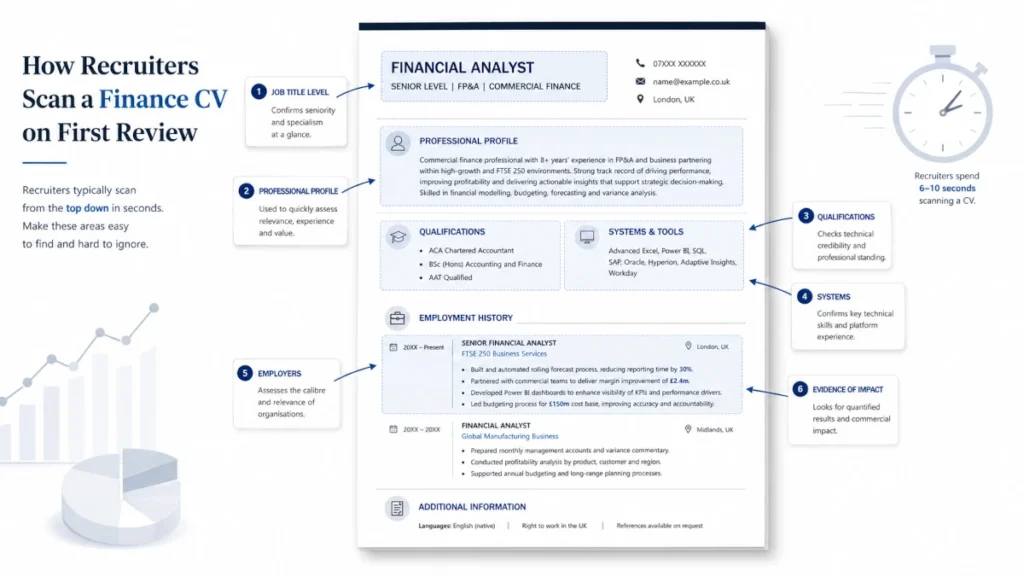
Most recruiters do not read a finance CV top to bottom on the first pass. They scan it for signals. In a matter of seconds, they are trying to work out whether you are operating at the right level, whether your background matches the vacancy, and whether there is enough evidence to justify a closer look.
The first thing they tend to look for is your level. Are you an analyst, a part-qualified accountant, a finance manager, a financial controller, or a finance director? Your profile, job titles and overall positioning should make that clear straight away. If a recruiter has to decode your level from the middle of page two, your CV is already doing too much work the hard way.
Types of finance experience
Next comes your type of finance experience. Finance is broad. A CV that says “finance professional” but does not quickly show whether you are stronger in FP&A, management accounts, reporting, controls, audit support, business partnering, statutory work, commercial finance or leadership will often feel too vague. The broad title can stay, but the detail underneath needs to anchor you properly.
After that, recruiters usually look for employers, sectors and complexity. Have you worked in SMEs, listed businesses, PE-backed environments, charities, public sector, banking, retail, manufacturing or professional services? Have you supported multi-entity reporting, board reporting, budgeting cycles, month-end close, audit preparation or senior stakeholders? This is where scale matters. A finance CV should help the reader understand the environment you have been trusted to work in.
They will also scan for qualifications and systems. If you are ACCA, CIMA or ACA qualified, part-qualified or qualified by experience, make that easy to find. The same applies to systems and tools that are often used as screening shortcuts: SAP, Oracle, NetSuite, Xero, Power BI, Excel, Hyperion, Tableau or sector-specific platforms. These should not dominate the CV, but they should not be buried either.
Then comes the most important test: proof. Can the recruiter see measurable value, or only a list of duties? Strong finance CVs show signs of impact such as improved forecast accuracy, faster reporting cycles, stronger controls, better cash visibility, cleaner audit outcomes, cost reductions, margin support or better decision-making for stakeholders.
That is why the opening third of your CV matters so much. If the first page gives a clear sense of level, finance specialism, credentials and evidence, the rest of the document becomes much easier to believe.
Finance CV structure: simple, ATS-safe and easy to tailor
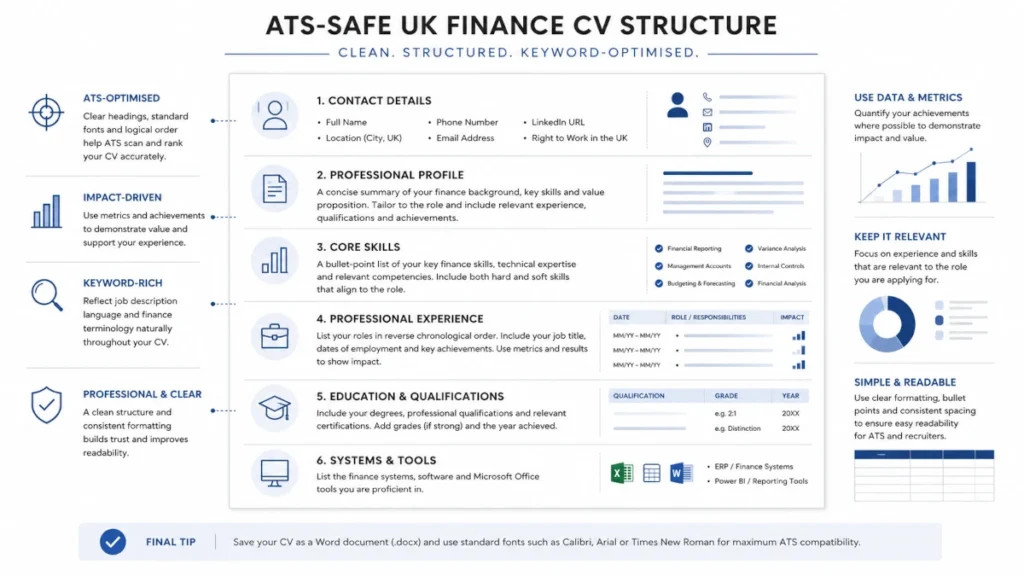
A finance CV should be easy to scan, easy to tailor and easy to process through employer systems. That usually means resisting the temptation to overdesign it. For most UK finance roles, a clean, single-column layout with clear headings will do more for you than graphics, icons, text boxes or decorative skill bars.
The structure itself should also reflect how finance recruiters read. They want to understand your level and relevance quickly, then move into your evidence. That is why a strong finance CV usually follows this order:
- Name and contact details
- Professional profile
- Key skills / core competencies
- Professional experience
- Education and qualifications
- Systems / technical tools if not already covered well
- Optional additional information such as languages or professional memberships
That basic format is flexible enough for most finance professionals, from analyst level through to senior leadership. It is also easier to keep ATS-friendly. If you are applying through online portals or large employer systems, avoid complicated layouts, dense sidebars and design-heavy templates that can make information harder to parse. This guide to ATS CV optimisation goes into that in more detail.
The biggest structural mistake finance candidates make is giving too much space to low-value content and not enough to proof. A short opening profile is useful. A concise skills section is useful. But the core of the document should still be your experience, because that is where you prove scale, complexity, controls, analysis, stakeholder exposure and results.
Finance CV Structure
Here is a simple copy-and-paste finance CV structure you can adapt:
[Full Name]
Phone | Email | LinkedIn | Location
Professional Profile
A short paragraph summarising your finance specialism, level, sector background, qualifications and strongest value points.
Core Skills
Forecasting and budgeting | Management accounts | Variance analysis | Financial reporting | Business partnering | Controls and compliance | Month-end close | Excel | SAP | Power BI
Professional Experience
Job Title | Employer | Dates
Short one-line description of the business, team or remit if needed for context.
- Achievement-led bullet
- Achievement-led bullet
- Achievement-led bullet
- Achievement-led bullet
Previous Job Title | Employer | Dates
- Achievement-led bullet
- Achievement-led bullet
- Achievement-led bullet
Education and Qualifications
ACCA / CIMA / ACA / degree / relevant certifications
Systems and Tools
Excel, SAP, Oracle, NetSuite, Power BI, Tableau, Xero, Hyperion
If you want a broader starting point before tailoring it for finance, this CV template guide is a useful reference point.
The main thing is not to mistake structure for strategy. A tidy layout helps, but it will not rescue weak content. Your structure should create space for the right evidence to stand out. In finance, that means your CV needs to lead the reader towards impact, not just process.
Finance CV profile examples by seniority
Your profile is not there to repeat your job title. Its job is to position you quickly and make the rest of the CV easier to read. For a finance candidate, that usually means covering four points in a short space: your level, your specialism, your environment, and the value you bring.
A weak profile often sounds like this:
“A motivated finance professional with strong communication skills and attention to detail, seeking a challenging new role.”
That tells the reader almost nothing. It does not say what kind of finance work you do, how senior you are, what you have handled, or why you are credible.
A stronger finance CV profile is more specific. It should sound grounded in real finance work and should hint at outcomes, not just personality traits.
Example: finance analyst profile
Part-qualified finance analyst with experience supporting budgeting, forecasting, variance analysis and management reporting in fast-paced commercial environments. Strong track record of turning financial data into clear insight for stakeholders, with advanced Excel skills and experience using Power BI to improve reporting visibility. Confident working across month-end, performance analysis and business partnering activity, with a focus on accuracy, deadlines and decision support.
Example: finance manager profile
CIMA-qualified finance manager with experience leading management accounts, budgeting, forecasting and performance reporting across multi-site operations. Strong background in improving reporting processes, strengthening controls and partnering with operational leaders to support cost management and commercial decisions. Combines technical finance capability with a practical, business-facing approach and a consistent record of delivering accurate, deadline-driven reporting.
Example: finance director / senior finance leader profile
Senior finance leader with extensive experience across financial control, strategic planning, board reporting and team leadership within complex, growth-focused organisations. Proven ability to improve financial visibility, strengthen governance, support commercial decision-making and lead high-performing finance functions through change. Brings a strong blend of operational grip, risk awareness and senior stakeholder influence, with a track record of aligning finance performance to wider business objectives.
For most finance roles, your profile should cover:
- your current or target level
- your finance specialism
- your sector or environment, where relevant
- any important qualifications
- two or three of your strongest value signals, such as forecasting, controls, commercial insight, reporting improvement, audit readiness or business partnering
Try to keep it to around 60 to 100 words. Longer than that, and it often becomes repetitive. Shorter than that, and it may not give enough context.
A useful rule is this: if your profile could sit on almost any office-based CV, it is too generic. It should sound recognisably finance-specific within the first sentence or two.
If you want to sharpen this section further, this guide on CV personal profile writing tips goes deeper into clarity, positioning and tone.
Finance proof framework: scope, analysis, risk/control, commercial result
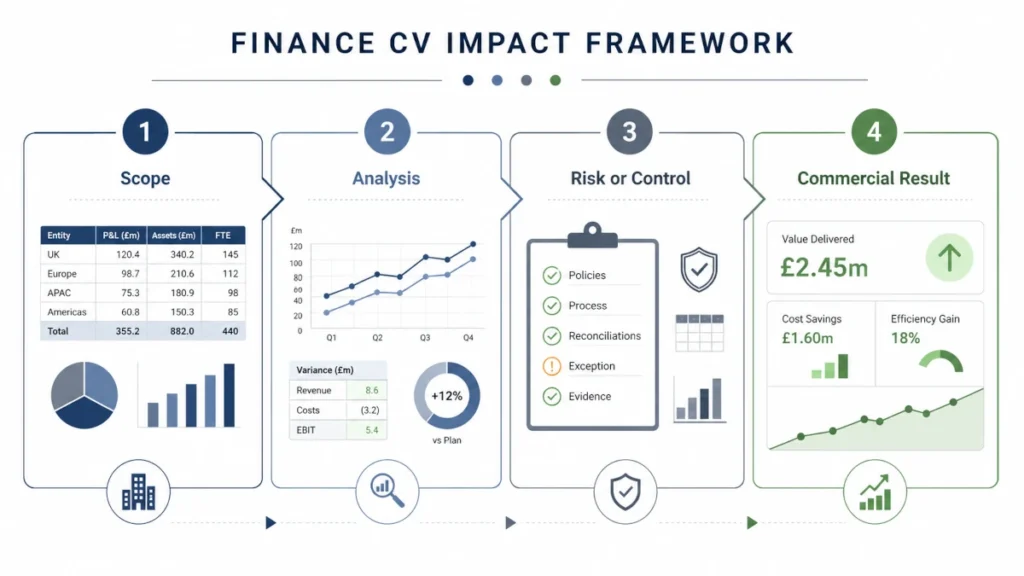
A finance CV gets stronger when you stop writing bullets as isolated tasks and start writing them as proof.
A simple way to do that is to use this framework:
Scope, analysis, risk/control, commercial result
You do not need every bullet to include all four elements in full, but the more of them you can bring in naturally, the more convincing your CV becomes.
- Scope shows size, complexity or responsibility
- Analysis shows thinking, not just processing
- Risk/control shows accuracy, governance, compliance or financial discipline
- Commercial result shows why the work mattered
That matters because finance work is rarely judged on activity alone. Producing a report is not the achievement. Producing accurate reporting that improves visibility, supports decisions, reduces risk or speeds up close is the achievement.
Finance task and weak CV wording vs stronger proof angles.
| Finance task | Weak CV wording | Stronger proof angle |
|---|---|---|
| Monthly reporting | Prepared monthly reports | Produced monthly management reporting for a £25m cost base, improving variance visibility for senior stakeholders and supporting faster decision-making |
| Forecasting | Assisted with forecasts | Supported rolling forecasts across multiple business units, identifying variance trends early and helping leaders adjust spend plans more accurately |
| Budgeting | Managed budgets | Managed departmental budgeting process, challenging assumptions, improving cost visibility and helping reduce overspend risk |
| Controls | Maintained controls | Strengthened financial controls around purchase approval and reconciliations, improving audit readiness and reducing process errors |
| Business partnering | Worked with stakeholders | Partnered with operational leaders to analyse performance drivers, improve margin visibility and support more informed commercial decisions |
| Cash flow | Monitored cash flow | Monitored short-term cash flow, highlighted risks to leadership and supported actions that improved working capital control |
Notice what changes. The stronger version does not just describe the process. It shows context, judgement and value.
Start with one of your existing bullets and ask:
- What was the scale?
- What did I actually analyse, improve or influence?
- Where was the control, risk, governance or accuracy element?
- What was the outcome for the team, finance function or wider business?
For example, instead of this:
- Produced weekly sales reports
you could move towards this:
- Produced weekly sales and margin reports for senior stakeholders, highlighting trends and variances that informed short-term trading decisions
Or instead of this:
- Completed reconciliations
you could write:
- Completed balance sheet reconciliations across multiple entities, improving month-end accuracy and supporting a cleaner audit trail
This approach is particularly useful in finance because many responsibilities sound routine on paper. The framework helps you show why your version of that work was commercially important, operationally useful or risk-sensitive.
Finance achievement examples and before/after bullet rewrites
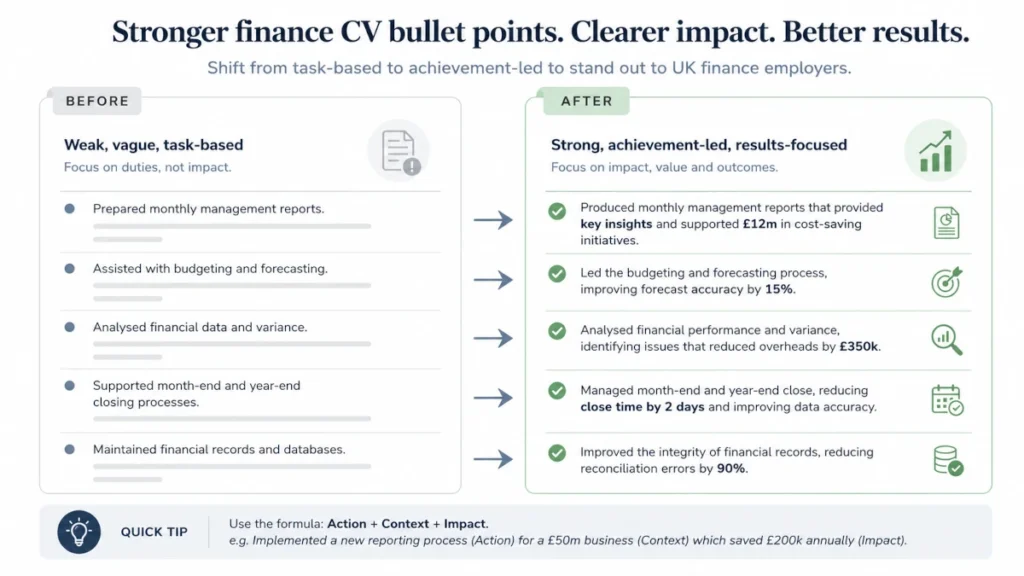
This is where a finance CV usually becomes either credible or forgettable.
A lot of finance candidates write bullets that describe activity but do not show value. The reader can see that work was done, but not why it mattered, how well it was done, or what level of ownership it involved. That is a problem because many finance duties are common across the market. Month-end, reconciliations, reporting, budgeting and analysis appear on thousands of CVs. The difference is in the proof.
Below are some common examples of weak finance bullets, followed by stronger rewrites.
1) Reporting
Before
- Prepared monthly management accounts
After
- Produced monthly management accounts and variance commentary for senior stakeholders, improving visibility on cost movements and supporting faster budget decisions
2) Forecasting
Before
- Assisted with forecasting
After
- Supported rolling forecasts across multiple departments, identifying key variances early and helping budget holders adjust spend plans more accurately
3) Controls and compliance
Before
- Responsible for financial controls
After
- Strengthened finance controls across reconciliations and approval processes, reducing error risk and supporting a more audit-ready reporting environment
4) Business partnering
Before
- Worked closely with stakeholders
After
- Partnered with operational managers to review performance trends, challenge assumptions and improve understanding of cost and margin drivers
5) Cash flow
Before
- Monitored cash flow
After
- Monitored short-term cash flow positions, flagged risks early and supported actions that improved working capital visibility for senior management
6) Process improvement
Before
- Improved finance processes
After
- Streamlined month-end reporting processes, reducing manual workload and helping deliver more timely management information to key stakeholders
7) Systems and reporting tools
Before
- Used Excel and Power BI to create reports
After
- Built Excel and Power BI reporting packs that improved access to performance data and reduced reliance on manual reporting updates
A useful formula for writing stronger finance bullets is:
Action, finance context, level of ownership and business result
For example:
- Delivered weekly performance reporting for regional leadership, highlighting revenue and margin trends that supported short-term trading decisions
- Managed balance sheet reconciliations across multiple entities, improving month-end accuracy and strengthening audit support
- Produced budget and forecast analysis for senior management, helping identify cost pressures and refine planning assumptions
The goal is not to force a number into every line. Some finance achievements are measurable in pounds, percentages or time saved, and where you have those figures, use them. But even without hard numbers, you can still make a bullet stronger by showing one of the following:
- scale
- stakeholders
- complexity
- control or governance value
- speed or efficiency improvement
- commercial usefulness
A good test is this: if your bullet could fit almost any finance candidate in almost any business, it is too generic. If it clearly shows what you handled, how you added value and why that mattered, it is much more likely to land.
Finance CV skills and keywords by role type
The right skills section can help a finance CV in two ways. First, it helps recruiters and hiring managers understand your technical fit quickly. Second, it improves your chances of matching the wording used in job descriptions and applicant tracking systems. The mistake is treating it like a dumping ground.
A long list of disconnected buzzwords does not make a finance CV stronger. What works better is a focused skills section that reflects the kind of finance role you do, backed up by clear evidence in your experience section.
Core skills most finance CVs should consider
Most finance professionals will want some combination of the following, depending on level and remit:
- Budgeting and forecasting
- Management accounts
- Variance analysis
- Financial reporting
- Business partnering
- Reconciliations
- Month-end and year-end close
- Cash flow management
- Financial controls
- Audit support
- Excel
- ERP systems
- Data analysis
- Stakeholder reporting
Finance analyst CV keywords
If you are targeting analyst roles, your CV should usually lean more heavily into analytical and insight-led terms, such as:
- Financial analysis
- Variance analysis
- Forecast modelling
- Budget support
- KPI reporting
- Power BI
- Excel modelling
- Trend analysis
- Data visualisation
- Decision support
- Performance reporting
Finance manager CV keywords
A finance manager CV normally needs a broader operational and supervisory feel. Useful keywords might include:
- Management accounts
- Budget ownership
- Forecasting
- Financial controls
- Month-end close
- Board reporting
- Cost analysis
- Business partnering
- Process improvement
- Team supervision
- Audit liaison
- Budget holder support
Reporting, controls and technical finance keywords
If your background is more technical, statutory or control-oriented, relevant terms may include:
- Balance sheet reconciliations
- Financial controls
- Internal controls
- Compliance
- Audit readiness
- Statutory reporting
- IFRS
- Consolidation
- Journal entries
- Regulatory reporting
- Process standardisation
This is also where qualifications can carry more weight. If you hold or are working towards a recognised credential such as ACCA, ACA or CIMA, make sure that appears clearly on the CV rather than being hidden near the end. ACCA describes its qualification route as globally recognised, which helps explain why employers often use it as an early signal in finance hiring.
Finance leadership keywords
For more senior candidates, including those targeting finance director-level positions, the skills mix should move away from pure production language and towards leadership, direction and commercial accountability. That may include:
- Strategic planning
- Financial leadership
- Board reporting
- Commercial finance
- Risk management
- Governance
- Cash and working capital oversight
- Performance improvement
- Team leadership
- Stakeholder management
- Decision support
- Change leadership
The key point is this: choose keywords that reflect the actual job you want, not just the tasks you have done before. A finance CV that mixes analyst terms, clerk-level processing terms and director-level leadership terms without any clear logic will often feel unfocused.
Tailoring your finance CV for analyst, manager and director roles
One reason broad finance CV articles fall flat is that they treat all finance candidates as if they should sound the same. They should not.
A financial analyst CV needs to emphasise analysis, reporting insight, modelling, forecasting support and the ability to translate data into something useful. A finance manager CV usually needs a broader sense of ownership, stronger process and controls language, and clearer evidence of stakeholder support. A more senior finance director CV needs to sound like leadership rather than production. That means strategic direction, governance, board exposure, commercial judgement and accountability matter far more than task lists.
If you are targeting analyst roles
At analyst level, your CV should show that you can work with data confidently and that your analysis helps people make decisions. That means leaning into areas such as forecasting and budget support, variance analysis, KPI reporting, Excel and BI tools, trend analysis, commentary for stakeholders and performance insight.
The tone should be sharp and evidence-led. Recruiters do not just want to know that you “produced reports”. They want to know whether you spotted trends, explained variances, improved reporting visibility or supported better decisions.
If you are targeting finance manager roles
At manager level, the emphasis usually shifts from pure analysis to ownership. Your CV should suggest that you can run finance processes reliably, support the wider business and maintain strong standards. That often means giving more space to management accounts, budgeting and forecasting, month-end and year-end close, controls and reconciliations, audit liaison, business partnering, team support or supervision, and reporting improvement.
This is also where commercial judgement becomes more important. A manager-level CV should not sound like a list of transactions. It should show that you can help budget holders understand numbers, challenge assumptions and keep reporting useful and dependable.
If you are targeting director or senior finance leadership roles
At director level, your CV needs to sound materially different. The focus should be on leadership, governance, financial direction and business impact. A senior reader will expect signs of board and executive reporting, financial strategy, risk and control oversight, cash and working capital leadership, finance team leadership, performance improvement, stakeholder influence, and change or transformation.
This is where many candidates undersell themselves by writing like a senior manager rather than a business leader. If you are targeting more senior roles, your bullets should show how you shaped decisions, improved visibility, strengthened governance or led the function through growth, change or challenge. For a deeper look at senior-level positioning, this guide to writing a director CV is a useful next step.
What about banking and finance CVs?
A banking and finance CV may share some of the same foundations, but it often needs more emphasis on regulated environments, client exposure, product knowledge, market context or risk awareness, depending on the role. So while this article covers the broader finance-CV intent, candidates in banking should tailor more carefully rather than copy generic finance wording wholesale.
The key principle is simple: keep the overall structure consistent, but shift the emphasis so your CV sounds like the level and type of finance professional the employer is actually hiring.
Common finance CV mistakes
Finance CVs often miss the mark for surprisingly simple reasons. The candidate may have solid experience, credible qualifications and relevant systems knowledge, but the CV still feels weaker than it should because the evidence is buried, diluted or too generic.
Describing duties without showing outcomes
One of the biggest mistakes is describing duties without showing outcomes. Phrases such as “prepared reports”, “assisted with forecasting” or “worked with stakeholders” are not wrong, but they are too thin on their own. In finance, employers usually want to know what the work supported, improved or protected. Did your reporting improve visibility? Forecasting help budget control? Stakeholder work influence decisions? If the CV does not answer that, it can feel flat.
Using generic profile language
Another common problem is using generic profile language. Terms like “motivated”, “hard-working” and “excellent communication skills” do very little unless they are backed up by finance-specific context. A stronger profile makes your level, specialism and value clear in the first few lines.
Many finance candidates also make the mistake of hiding useful technical signals. If you are ACCA, ACA or CIMA qualified or part-qualified, that should be easy to spot. The same goes for systems such as SAP, Oracle, NetSuite, Power BI or advanced Excel. Recruiters often scan for these points early, so do not make them work to find them.
Formatting can also get in the way. An overdesigned document with columns, graphics, icons or dense text boxes can look polished at first glance, but it may be harder to scan and harder to process through employer systems. In most cases, finance CVs benefit from a cleaner, more restrained format.
Another weakness is lack of stakeholder or business context. Finance does not happen in a vacuum. If your CV only lists reconciliations, reporting cycles and month-end activity, it may suggest process exposure but not influence. Wherever possible, show who the work supported: operational leaders, budget holders, senior management, directors or auditors.
Finally, many candidates try to cover every finance task they have ever done rather than shaping the CV around the target role. A finance CV should feel selective and purposeful. The aim is not to prove you have been busy. It is to show that your background matches the level, environment and priorities of the job you want now.
Fix your finance CV in 15 minutes
If your finance CV feels broadly right but not especially strong, do this quick reset before you send another application.
- Rewrite your profile so it shows your level, specialism and value in plain terms.
- Check your top bullet points and upgrade any line that only lists a duty.
- Make sure your qualifications, ERP tools and reporting tools are easy to spot.
- Review page one only and ask whether your level and relevance are obvious.
- Remove filler content that adds length but not evidence.
- Make sure the document still feels clean, readable and easy to scan.
A stronger finance CV is usually more selective, not more crowded.
Get an expert second opinion on your finance CV
If your CV is getting applications out but not enough traction back, the issue is often not your experience. It is how that experience is being positioned. Finance CVs need to show trust, clarity, commercial relevance and the right level of evidence quickly.
If you want tailored feedback on what is working, what is weak and what to improve first, request a free CV review. If you already know you want more hands-on support, you can also look at the professional CV writing service for more tailored help.
FAQs
How long should a finance CV be in the UK?
For most finance professionals in the UK, two pages is usually the right target. That gives you enough room to show your level, qualifications, systems knowledge and evidence without drifting into repetition. Early-career candidates can sometimes keep it tighter, while more senior finance leaders may need a fuller second page to cover board exposure, leadership and strategic scope. The important point is not the page count on its own. It is whether the space is being used well.
What should come first on a finance CV?
Your profile should usually come near the top, followed by a focused skills section and then your professional experience. That gives recruiters the three things they tend to want first: your level, your specialism and your evidence. In finance, that opening section should make clear whether you are stronger in analysis, reporting, controls, commercial finance, leadership or a blend of those areas.
Should I include qualifications after my name?
Only if they are genuinely relevant and recognised for the roles you are targeting. If you are ACCA, ACA or CIMA qualified, or part-qualified and the status is important to the job, it can help to surface that clearly either after your name or very near the top of the CV.
What skills should go on a finance CV?
Use skills that reflect the role you want, not just every finance task you have ever touched. For many candidates, that means a mix of technical finance capability, systems/tools and business-facing strengths. Examples include budgeting, forecasting, management accounts, variance analysis, reporting, controls, business partnering, cash flow, Excel, ERP systems and stakeholder communication. The right balance will shift depending on whether you are targeting analyst, manager or director-level roles.
Should I mention SAP, Oracle, Power BI or Excel on my finance CV?
Yes, if you have used them in a meaningful way. These systems often matter in finance recruitment because they help employers assess fit quickly. The key is to do more than name them. Wherever possible, show how you used them. For example, instead of simply listing Power BI, you might show that you used it to improve reporting visibility or reduce manual reporting effort.
How is a finance manager CV different from a finance director CV?
A finance manager CV usually needs to show operational ownership: management accounts, budgeting, forecasting, reporting, controls, audit liaison and support for budget holders or operational leaders. A finance director CV needs to sound more strategic and leadership-led, with stronger emphasis on board reporting, governance, risk, team leadership, commercial direction and organisational accountability.
Is a banking and finance CV the same as a general finance CV?
Not always. There is overlap, especially around analytical credibility, controls and stakeholder communication, but banking roles may need more explicit emphasis on regulated environments, risk, products, client context or market-facing responsibilities. That means a banking and finance CV often needs tighter tailoring rather than a straight copy across from a broader commercial-finance CV.
Do I need to show governance or regulatory awareness on a finance CV?
For some roles, yes. It matters more where your work sits close to control environments, statutory reporting, regulated firms or senior financial oversight. In FCA-regulated environments, accountability and conduct frameworks can matter, particularly for more senior candidates. The Senior Managers and Certification Regime is designed to strengthen individual accountability and improve conduct standards across financial services firms.
Conclusion
A strong finance CV is not built by listing everything you have done. It is built by showing the right evidence in the right order. Recruiters want to see level, relevance, credibility and value quickly. That means clear structure, finance-specific language, visible qualifications and systems, and bullet points that show more than routine process.
Whether you are targeting analyst, manager or director-level roles, the principle stays the same: focus on proof. Show what you handled, what you improved, what you protected and what your work helped the business do.
Recent Comments