
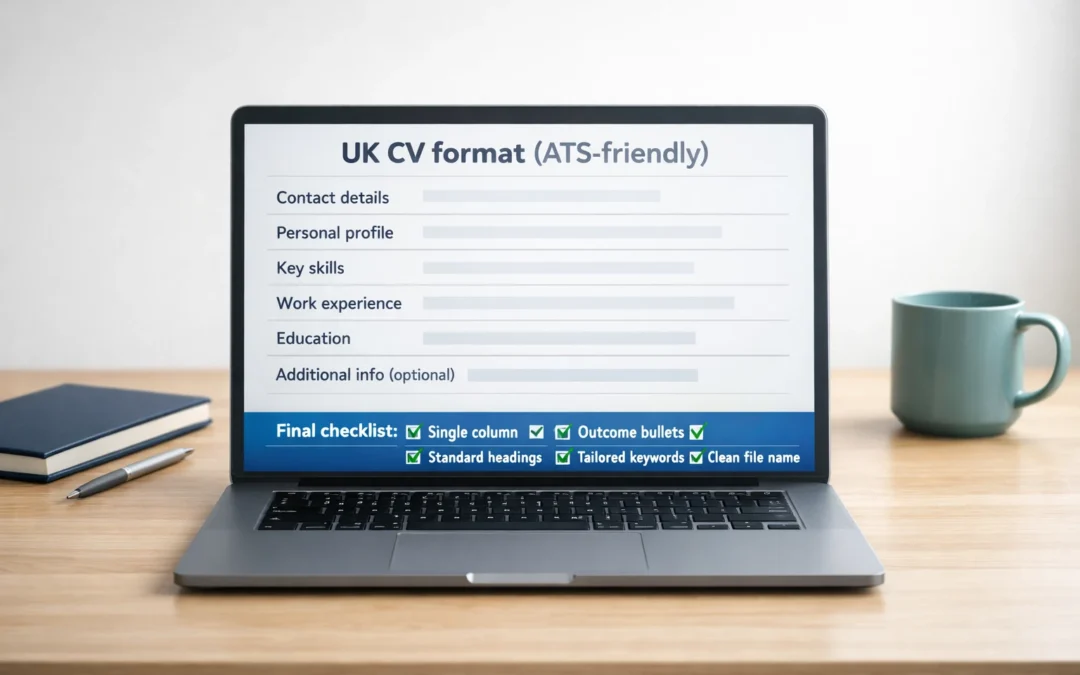
Last updated: January 2026
If you’re applying for UK roles in 2025/2026, your CV needs to do two jobs:
- Read cleanly in an ATS (the screening software many employers use)
- Scan brilliantly for a human in 10–20 seconds
This guide gives you the UK CV structure, an ATS-friendly format, a copy/paste template, and a final checklist so you can stop second-guessing and start landing interviews.
A quick note on wording: in the UK, we usually say CV (not “resume”). The expectations are broadly similar, but UK hiring typically favours a clear 1–2 page CV, strong achievement bullets, and minimal personal details.
If you want feedback on your current CV structure and format before you apply, you can use the free CV review here: Free CV review.
Quick answer: What should a UK CV look like in 2025/2026?
A modern UK CV should be:
- 1–2 pages for most people (new grads and early career often 1; more experience can justify 2)
- For UK CV length, structure, and formatting basics, see the Prospects guide to writing a CV.
- Easy to scan: clear headings, bullet points, consistent spacing and fonts
- Structured in a standard order, typically:
Contact details; Profile; Key skills; Experience; Education; (Optional) Additional info; References available on request - ATS-friendly formatting: single-column layout, minimal design, no icons/graphics that could confuse parsing
- Tailored to the job advert: mirror the role’s keywords (naturally) and prioritise the most relevant evidence
- Focused on outcomes, not duties: show what changed because you were there (metrics, scale, impact)
- Light on personal details: include name, phone, email, and a LinkedIn URL if helpful, but don’t include age, date of birth, marital status, or nationality
If you only fix three things this week, fix these: structure (easy to scan), achievements (evidence), and relevance (tailoring to the advert).
If you want an official UK breakdown of the standard CV sections (and what not to include), use the National Careers Service CV sections guidance.
UK CV format at a glance (copy this structure)
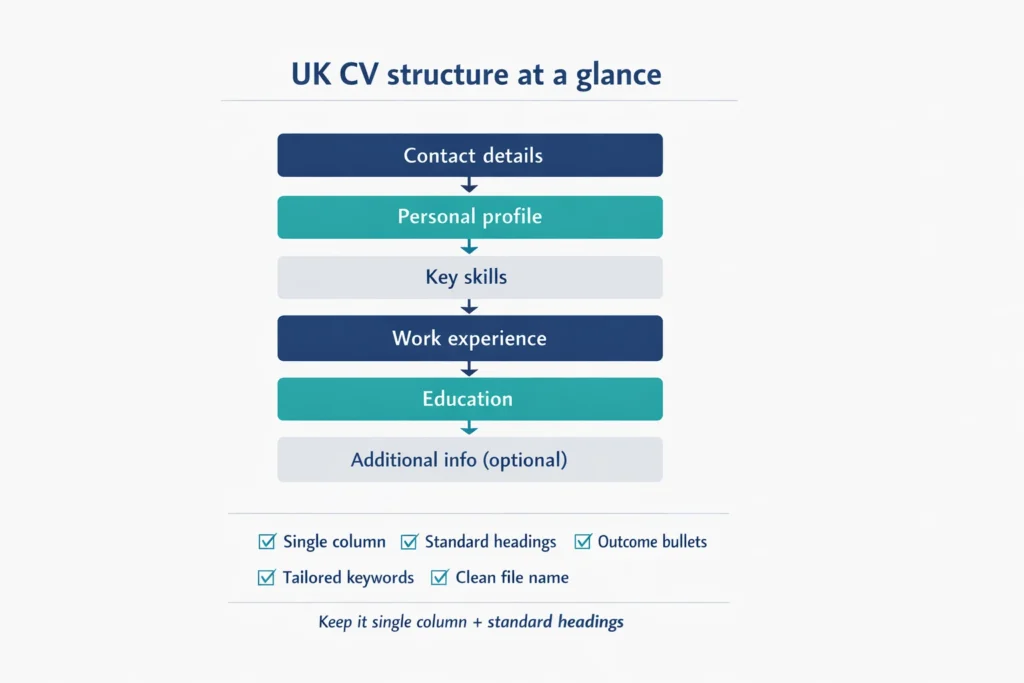
Use this as your default UK CV layout. It’s recognisable to UK recruiters, easy to skim, and works well with ATS when kept in a simple, single-column format.
Tip: keep headings standard (e.g., “Work Experience”, “Education”, “Key Skills”). Unusual headings can reduce clarity and (in some systems) weaken parsing.
| CV section (in order) | What to include | Quick UK-specific tips |
|---|---|---|
| Contact details | Name, mobile, email, location (town/city), LinkedIn URL (optional) | You don’t need a full postal address. Avoid extra personal info like DOB, nationality, marital status. |
| Personal profile | 3–5 lines: target role + niche + strongest proof + what you bring next | Keep it specific to the role. “Hard-working team player” doesn’t differentiate you. |
| Key skills | 8–14 skills relevant to the advert (mix of technical + role skills) | Match wording from the job ad where it’s accurate (e.g., “stakeholder management”, “Power BI”, “case management”). |
| Work experience | Reverse-chronological roles, each with 3–6 achievement bullets | Lead with outcomes (numbers, scope, speed, quality, savings). Keep duties minimal. |
| Education | Highest/most relevant first; include key modules if early career | UK employers generally don’t expect school detail if you’re experienced. |
| Additional / professional info (optional) | Certifications, tools, projects, volunteering, professional memberships | Use this if it strengthens fit. If not, leave it out. |
| References | “References available on request” | Don’t list referee contact details on the CV. |
Formatting rules (keep it simple)
- Single column layout; avoid tables, icons, and text boxes (better for ATS and readability).
- Use a clean font, consistent sizing, and bullet points for achievements.
- Save as “FirstName-LastName_CV.pdf” or “.docx” depending on the employer’s application instructions (we’ll cover file format later).
UK CV structure (section-by-section)
1) Contact details (keep it compact)
Your contact header should make it effortless for an employer to reach you.
Include:
- Full name
- Mobile number
- Professional email address
- Location (town/city is enough)
- LinkedIn URL (optional, but useful if it supports your application)
Avoid:
- Age / date of birth
- Marital status
- Nationality
Example (1–2 lines):
Brendan Hope | 07xxx xxxxxx | name@email.com | London, UK | LinkedIn: linkedin.com/in/xxxx
2) Personal profile (3–5 lines that earn the read)
This is your “why you” snapshot. Most UK recruiters skim this first, so it needs to be specific, role-relevant, and evidence-led.
Use this mini-structure:
- Who you are (target role + level)
- Your niche (industry, specialism, domain)
- Proof (1–2 credibility signals: outcomes, scale, tools, sectors)
- What you’re aiming for next (aligned to the job)
Example (generic: don’t do this):
Hard-working professional with excellent communication skills seeking a new challenge.
Example (better):
Customer Success Manager with 6+ years in B2B SaaS, specialising in retention and account growth across mid-market clients. Improved renewal rates from 82% to 91% by rebuilding onboarding and QBR cadence, and partnered with Sales to expand key accounts. Now targeting CSM roles focused on revenue retention and customer expansion.
If you want a deeper walkthrough (with more examples), link out here: CV personal profile writing tips.
3) Key skills (make it searchable, not fluffy)
This section helps both humans and ATS quickly confirm fit. The rule is simple: if the job ad mentions it and you genuinely have it, it should show up here (in plain language).
Aim for 8–14 skills and mix:
- Role skills: stakeholder management, client retention, project delivery
- Tools/technical: Excel, Power BI, Salesforce, SQL (only what you can actually use)
- Domain: procurement, FM, NHS, fintech, safeguarding, etc.
Example skills list (format):
Key skills: Stakeholder management | Customer retention | Data reporting (Power BI) | Process improvement | Onboarding | Contract renewals | Cross-functional delivery | CRM (Salesforce)
Tip: Keep this as a simple list (no tables, no graphics) for maximum readability and ATS safety.
4) Work experience (where you win interviews)
This section should do more than prove you’ve done the job, it should prove you’ve delivered results.
Use a simple, UK-standard layout:
- Job title | Employer | Location (optional)
- Dates: MMM YYYY – MMM YYYY (or “MMM YYYY – Present”)
- 1 line context (optional): team size, customers, budget, region, systems
- 3–6 bullets focused on outcomes (not a task list)
Example layout:
Customer Success Manager | Acme SaaS, London
Jun 2022 – Present
- Improved renewal rate from 82% to 91% by rebuilding onboarding and introducing a quarterly success cadence.
- Reduced support escalations by 28% through tighter handovers and a new “first 30 days” playbook.
- Expanded 6 key accounts, contributing £240k in additional ARR in 12 months.
Bullet rules that keep it strong (and ATS-friendly):
- Start with an action verb (improved, reduced, delivered, introduced).
- Add scope (size, volume, budget, region) and proof (numbers, speed, quality, outcomes).
- Keep formatting plain (no icons, no tables) so it reads cleanly and parses well.
If you want a bank of strong verbs for UK CVs, use: CV power words.
5) Education (keep it relevant to your level)
List education highest/most relevant first.
Include:
- Qualification (e.g., BA, BSc, MSc, NVQ, A-levels, GCSEs)
- Institution
- Year (or date range)
- 1–2 lines of modules/projects only if it strengthens your fit (usually early career)
As your experience grows, you can shorten this section significantly. Prospects’ general guidance is to keep things clear and concise and prioritise what supports your applications.
6) Additional / professional info (optional, but often valuable)
Use this section when it strengthens your candidacy, for example:
- Certifications (PRINCE2, CIPD, AWS, CompTIA, NEBOSH, etc.)
- Tools/tech stacks (if role-relevant)
- Projects (especially for career changers)
- Volunteering (if it demonstrates transferable value)
Keep it to short bullets, it’s there to support the CV, not become a second CV.
7) References (one line only)
For UK CVs, it’s standard to add: “References available on request” rather than listing referee details.
What NOT to include on a UK CV (2026)
A modern UK CV is professional, relevant, and light on personal detail. Including unnecessary information can date your CV fast, and in some cases, it can introduce bias or simply distract from your evidence.
Here’s what to leave out (unless the employer explicitly asks for it):
- Date of birth / age: not needed on a UK CV.
- Marital status / relationship status: irrelevant to hiring decisions.
- Nationality (in most cases): if you need to reassure on right-to-work, handle it carefully and only when relevant (e.g., “Eligible to work in the UK”).
- A photo/headshot: generally not expected in the UK (exceptions exist in modelling/acting-type contexts).
- Full home address: your town/city is usually enough; don’t give more personal data than necessary.
- Religion, health details, gender identity, or other sensitive personal data: keep the focus on role evidence.
- References and referee contact details: use “References available on request” instead.
- Long lists of hobbies: only include interests if they genuinely strengthen fit (e.g., leadership, competition, volunteering with impact).
Quick UK-specific note (important)
If you’re applying to the Civil Service, you may be asked for an anonymised CV (removing identifiers like name/gender/age), and your CV will be assessed against the criteria in the advert, so relevance and evidence matter even more.
ATS-friendly CV formatting (high-level only)
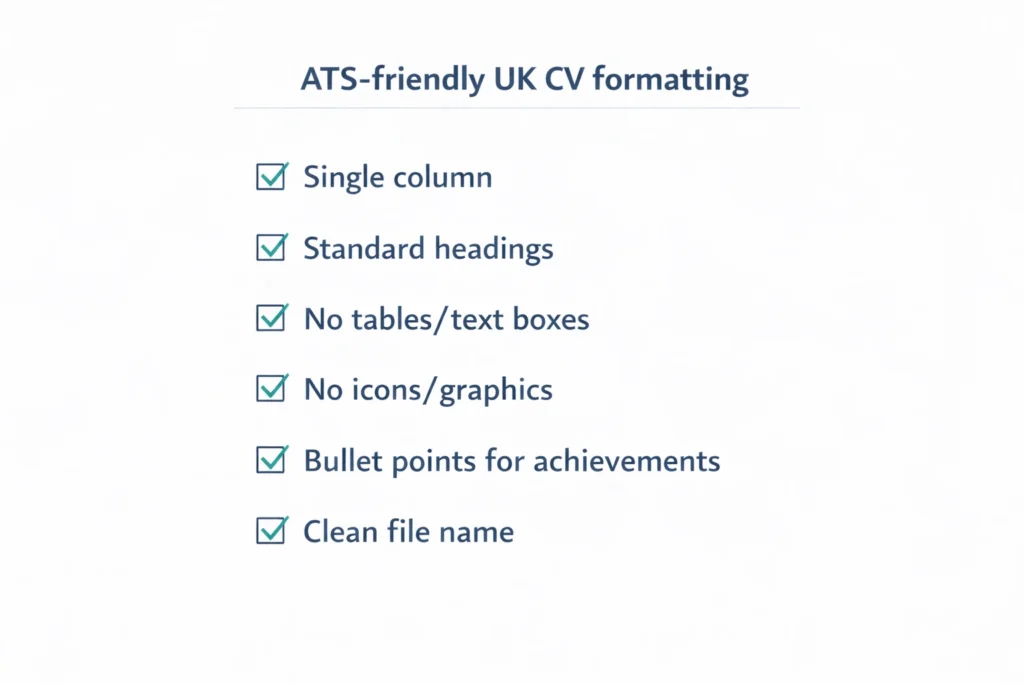
An ATS-friendly CV is simply a CV that’s easy for recruitment software to read and categorise, so your application actually reaches a human. The CIPD describes ATS as “machines” that apply criteria your CV needs to match to progress, which is why clarity and relevance matter.
The CIPD explains how CVs often go through a machine (ATS) before reaching a hiring manager, which is why clean formatting matters. See the CIPD CV360 ATS overview.
The ATS-safe formatting rules (UK)
Keep your CV simple and predictable:
- Use a single-column layout (avoid sidebars).
- Avoid tables, text boxes, icons, and heavy graphics: these can break or scramble how some systems read your CV.
- Stick to standard headings like Personal Profile, Key Skills, Work Experience, Education. Unusual headings can reduce clarity (and sometimes parsing).
- Use bullet points for achievements (not long paragraphs).
- Keep fonts clean and consistent (the goal is legibility, not design).
- Don’t hide key info in headers/footers if you can avoid it; keep the important content in the main body of the document.
For practical ATS-friendly formatting tips and examples, read Indeed’s ATS-friendly CV guide.
File type: PDF or Word?
Follow the employer’s instructions first. If they don’t specify:
- A clean PDF usually preserves formatting well.
- A clean .docx can be safer in some ATS setups.
Either way, the “ATS-friendly” part comes from the layout and headings, not the file extension.
60-second ATS check before you apply
- Can you copy/paste your CV into a plain text editor and it still reads in the right order?
- Do your skills and job titles match the job advert wording where accurate?
- Are your section headings standard and easy to spot?
- Are your achievements written as outcomes (not duties)?
If you want the full deep dive (keyword placement, common parsing traps, and an ATS checklist), use: ATS CV optimisation UK guide.
Keywords & achievement bullets (STAR-lite, without the waffle)
If your CV isn’t getting interviews, it’s usually not because you “don’t have experience”.
It’s because the CV is written in a way that makes you look like a safe pair of hands, not a high-impact hire.
Two quick fixes make the biggest difference:
- Use the right keywords (naturally)
- Turn duties into outcomes
How to pull the right keywords (in 5 minutes)
Open the job advert and copy the text into a note.
Now highlight:
- Role keywords (e.g., stakeholder management, procurement, case management, project delivery)
- Tools/tech (e.g., Excel, SAP, Power BI, Salesforce)
- Proof words (e.g., improve, reduce, deliver, streamline, compliance, KPIs)
Then make sure those terms appear in the right places:
- Personal profile (2–3 key terms)
- Key skills (8–14 skills mirroring the advert)
- Experience bullets (sprinkled naturally where they’re true)
Don’t keyword-stuff. The goal is recognition, not repetition.
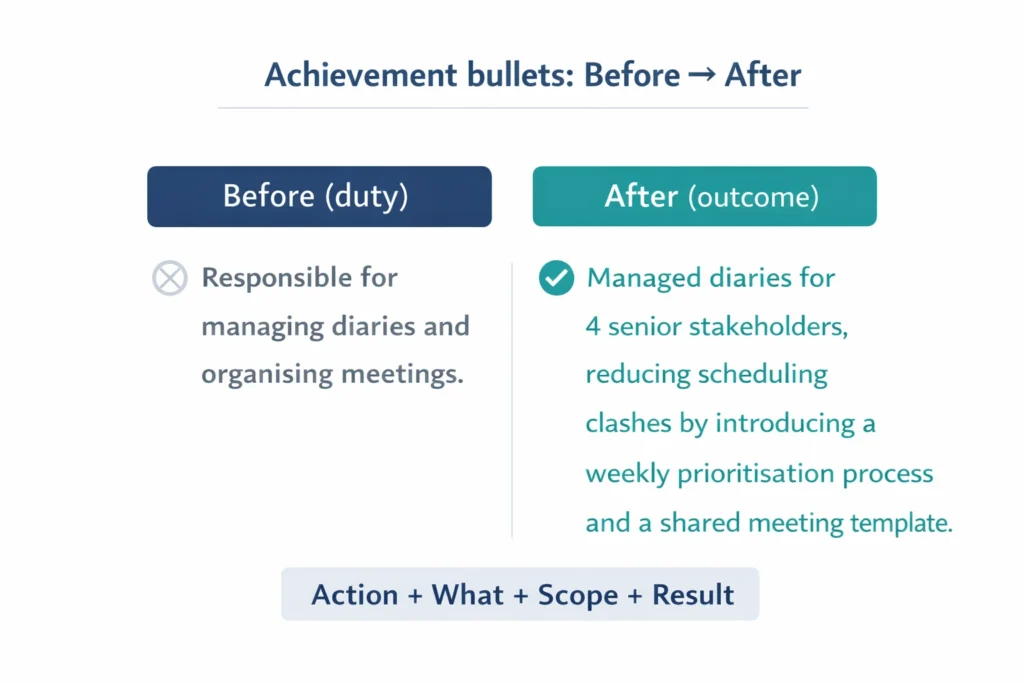
The bullet formula that wins interviews
Use this simple structure:
Action, What, Scope, Result (quantified)
Where “metric” can be numbers, speed, quality, risk reduction, customer impact, revenue, cost, compliance, or time saved.
If you prefer STAR, keep it short:
- Situation/Task: 1 short phrase (or implied)
- Action: what you did
- Result: what changed (proof)
3 before/after bullet rewrites (copy the pattern)
Admin / operations
- Before (duty): Responsible for managing diaries and organising meetings.
- After (outcome): Managed diaries for 4 senior stakeholders, reducing scheduling clashes by introducing a weekly prioritisation process and a shared meeting template.
Customer service
- Before (duty): Dealt with customer queries by phone and email.
- After (outcome): Resolved 40–60 customer queries daily across phone/email, improving first-contact resolution by tightening triage and creating 12 reusable response templates.
Project / change
- Before (duty): Worked on a process improvement project.
- After (outcome): Streamlined the onboarding process by mapping handovers across 3 teams, cutting time-to-productive by 20% and reducing avoidable rework.
Quick checklist for every experience section
Before you move on from a role, ask:
- Did I include numbers or scope at least once?
- Are the bullets mainly results, not “responsible for…”?
- Would a stranger understand the impact in 10 seconds?
- Do the bullets reflect the job advert’s priorities?
For stronger action verbs (and UK-friendly wording), use: CV power words.
Adapt your CV to UK job ads (in 15 minutes)
Tailoring doesn’t mean rewriting your whole CV for every role. It means aligning your top evidence to what the employer is actually hiring for, so both the ATS and the recruiter can see the match quickly. The National Careers Service explicitly recommends highlighting the skills an employer asks for, because it can improve your chances of getting an interview.
Step 1 (3 minutes): Pull the “must-haves” from the advert
Scan the job description and list:
- Top 5 responsibilities (what you’ll be paid to do)
- Top 5 requirements (skills, tools, certifications, sector knowledge)
- Any repeated keywords (they’re telling you what matters)
If you’re not sure what to prioritise, start with anything labelled essential, required, or must.
Step 2 (5 minutes): Mirror the language in 3 places
Use the employer’s wording (only where it’s true) in:
- Personal profile: 2–3 role keywords + 1 proof line
- Key skills: include the most “searchable” terms (tools and role skills)
- Most recent role bullets: match the advert’s priorities
This is enough to make your CV feel “built for the role” without turning it into keyword soup.
Step 3 (5 minutes): Re-order your strongest evidence
Recruiters don’t read from top to bottom. They scan.
So:
- Move the most relevant bullets to the top of each role
- Keep older or less relevant roles shorter
- Add one “proof” bullet that speaks directly to the role’s outcome (e.g., cost savings, turnaround time, compliance, customer impact)
Step 4 (2 minutes): Add a quick “fit check”
Ask:
- If I only read the profile, skills and first 3 bullets, would I obviously shortlist myself?
- Does my CV reflect the advert’s essential criteria, not just my job history?
Civil Service applications (important exception)
If you’re applying to the Civil Service, your skills and experience may be scored against the essential criteria in the job advert, so relevance and evidence are non-negotiable.
If that’s your route, use this guide: How to write a winning Civil Service CV (with a template).
You’ll need to show how you meet the essential criteria. The Civil Service explains this in How to write your CV (Civil Service Careers).
UK CV template (ATS-friendly) & short filled example
Below is a copy/paste UK CV template designed to be easy to scan and ATS-friendly (single column, standard headings, clean spacing). Use it as your base, then tailor your profile/skills/bullets to each job advert.
Copy/paste UK CV template (plain text)
FULL NAME
Mobile: 07xxx xxxxxx | Email: name@email.com | Location: Town/City, UK | LinkedIn: linkedin.com/in/xxxx (optional)
PERSONAL PROFILE
[Target role + level] with [X years / type of experience] in [industry / niche]. Known for [2–3 strengths that match the advert], including [tool/skill] and [tool/skill]. Recent results include [1 quantified outcome] and [1 quantified outcome]. Now targeting [role type] where I can [relevant value].
KEY SKILLS
Skill 1 | Skill 2 | Skill 3 | Skill 4 | Skill 5 | Skill 6 | Skill 7 | Skill 8
(Optional second line) Skill 9 | Skill 10 | Skill 11 | Skill 12
WORK EXPERIENCE
Job Title | Employer, Town/City
MMM YYYY – MMM YYYY
(1 line context optional) [Team size / customers / budget / scope / tools]
- [Outcome bullet: action + scope + result]
- [Outcome bullet: action + scope + result]
- [Outcome bullet: action + scope + result]
- (Optional) [Outcome bullet]
Job Title | Employer, Town/City
MMM YYYY – MMM YYYY
- [Outcome bullet]
- [Outcome bullet]
- [Outcome bullet]
EDUCATION
Qualification | Institution (Year / Date range)
(Optional) Relevant modules / project / dissertation (1 line)
ADDITIONAL INFORMATION (optional)
Certifications: [e.g., PRINCE2 / CIPD / NEBOSH / Google certs]
Tools: [e.g., Excel, Power BI, Salesforce]
Volunteering / Projects: [1–2 bullets if relevant]
REFERENCES
References available on request
Filled mini example (so you can see the “shape”)
TAYLOR JAMES
Mobile: 07xxx xxxxxx | Email: taylor@email.com | Location: Manchester, UK | LinkedIn: linkedin.com/in/taylorjames
PERSONAL PROFILE
Customer Support Team Leader with 5+ years’ experience in high-volume contact environments (phone, email, live chat). Strong in triage, coaching, and process improvement, with a track record of improving first-contact resolution and reducing escalations. Recently led a workflow refresh that cut average response time by 18%. Now targeting customer operations roles focused on quality, efficiency, and customer outcomes.
KEY SKILLS
Customer support | Team leadership | Coaching | Escalation handling | QA & training | KPI reporting | Process improvement | CRM (Zendesk)
WORK EXPERIENCE
Customer Support Team Leader | BrightCo, Manchester
Apr 2022 – Present
- Improved first-contact resolution by introducing a triage checklist and weekly coaching sessions for 8 advisors.
- Reduced escalations by standardising handovers and creating reusable response templates for top 15 query types.
- Built a simple KPI dashboard to track response times and backlog trends, improving visibility for stakeholders.
Customer Support Advisor | BrightCo, Manchester
Jun 2020 – Apr 2022
- Managed 40–60 daily queries across phone/email/chat while maintaining strong customer feedback scores.
EDUCATION
BA (Hons) Business Management | University of X (2019)
REFERENCES
References available on request
If you’re early career or switching fields and need a version that works without much experience, use: How to write a CV with no work experience.
Common UK CV mistakes (and quick fixes)
Even strong candidates lose interviews because their CV is hard to scan, too generic, or missing proof. Here are the most common UK CV mistakes I see, and how to fix each one quickly.
1) A “nice” CV that says nothing
Mistake: Personal profile filled with soft phrases (“hard-working”, “team player”, “good communication”).
Fix: Replace with role, niche and proof. Add 1–2 outcomes (numbers, scope, impact). If you can’t quantify, use scale (volume, stakeholders, region, complexity).
2) Duties instead of outcomes
Mistake: Bullets that list tasks (“Responsible for…”, “Duties included…”) without results.
Fix: Rewrite each bullet using: Action, What, Scope, Result. Aim for at least 1 metric per role, even if it’s time saved, error reduction, throughput, SLA, NPS, revenue, cost, or quality.
3) Over-designed formatting that hurts readability
Mistake: Two-column templates, icons, text boxes, heavy styling, cramped margins.
Fix: Go single column, standard headings, clean spacing, simple bullets. Your CV should look professional even when copied into plain text.
4) “One CV for every job”
Mistake: The CV reads like your history, not the employer’s needs.
Fix: Tailor only the high-impact parts: profile + key skills + first third of your most recent role. That’s usually enough to make it feel built for the job.
5) Missing the basics recruiters scan for
Mistake: No clear target role, no key skills section, dates hard to find, inconsistent formatting.
Fix: Make it scannable: consistent date format, role titles bold, and a skills line that mirrors the advert.
6) Weak file naming
Mistake: CV_final_final2.pdf or Resume.pdf.
Fix: Use: FirstName-LastName_CV.pdf (or .docx if requested).
Final checklist before sending (UK CV)
Run this checklist before every application; it catches the stuff that silently kills interviews.
Format + readability
- Single column layout (no sidebars)
- Clear headings: Personal Profile / Key Skills / Work Experience / Education
- Consistent font sizes and spacing (easy to skim in 10 seconds)
- Dates are consistent (e.g., Apr 2022 – Present) and easy to find
- No icons, charts, text boxes, or heavy design
ATS & keyword fit
- Your target role is obvious in the profile (not “open to opportunities”)
- Key skills reflect the job advert’s wording (only where true)
- Your most recent role includes 3–6 outcome bullets (not duties)
- You’ve included at least one concrete proof point (numbers or scope)
Content quality
- Bullets start with strong verbs (improved, reduced, delivered, introduced)
- Older roles are shorter; the most relevant experience is most detailed
- No waffle (generic soft skills removed unless backed by evidence)
UK-specific hygiene
- No DOB/age, marital status, nationality, or sensitive personal info
- “References available on request” (no referee details)
File + submission
- File name: FirstName-LastName-CV.pdf (or .docx if requested)
- You followed the employer’s file instructions (don’t guess if they’re explicit)
- Spelling/grammar checked and read aloud once (fastest way to catch errors)
Editorial note: I’ll remove the stray placeholder citation markers that appeared earlier in the draft when we compile the final version; they’re not meant to be there.
Want an expert check before you apply?
If you’re not getting interviews, it’s rarely “lack of experience”, it’s usually format, relevance and evidence.
Get a free CV review
I’ll review your CV and tell you (plainly) what’s helping or hurting your applications, and what to fix first.
➡️ Request your free CV review
You’ll get feedback on:
- UK CV format & structure (scan-friendly, recruiter-friendly)
- ATS readiness (layout + headings + keyword placement)
- Achievement bullets (turn duties into outcomes)
- The fastest changes that will improve your shortlist chances
If you’d rather hand it over end-to-end, see the Professional CV writing service.
FAQs (UK CV format, ATS, and templates)
How long should a UK CV be in 2025/2026?
For most UK applicants, 1–2 pages is the norm. Early-career candidates can often keep it to 1 page; mid-level and senior professionals may need 2 pages to show scope and outcomes (without padding). Prospects explicitly notes that your CV should be clear, relevant, and that some detail should be cut if it doesn’t sell you.
Should I include a photo or date of birth on a UK CV?
Generally, no. UK guidance commonly advises leaving out personal details like date of birth, and Prospects notes you typically don’t need a photo unless you’re applying for acting/modelling-type work.
Do I need to include my full home address?
Usually not. A town/city location is typically enough for UK hiring, unless a specific employer asks for more. Keeping personal data minimal is also sensible from a privacy perspective.
Should I put references on my CV?
Most of the time, keep it to a single line: “References available on request.” UK guidance commonly treats references as something you provide later, rather than listing referee details on the CV.
Is it a CV or a resume in the UK?
In the UK, the standard term is CV. Some candidates searching online will use “resume”, but employers and job adverts typically refer to a CV.
How many bullet points should I use per job?
A good rule is 3–6 bullets for your most recent/relevant roles, fewer for older/less relevant roles. Prioritise outcomes over duties, and put the most relevant bullets first so a skim-reader sees the match quickly.
Will an ATS reject my CV if it’s not “ATS-friendly”?
An ATS can struggle to correctly read CVs with irregular formatting, complex designs, or graphics, which can affect how your information is sorted or surfaced. Keeping the layout simple and the headings standard is the safest approach.
For the full deep dive, use: ATS CV optimisation UK guide.
Do I need a cover letter in the UK?
Sometimes. Many employers still read them, especially for competitive roles or when you’re changing industry, but it depends on the application process. If the advert asks for one, write it. If optional, a short, tailored letter can still help when your CV needs context. Want a practical structure, use: Cover letter writing tips.
Next steps
If you do nothing else, do this:
- Use the UK structure above
- Keep formatting ATS-safe (simple, single column)
- Rewrite your experience into proof-led achievements
And if you want an expert check before you apply: Request your free CV review.
Recent Comments