

Writing your very first CV is harder than it looks. Most CV guides online assume you already have a job to describe. If you are sixteen, seventeen or eighteen, that advice rarely fits. You might be applying for your first part-time role, an apprenticeship or a college leaver scheme. You have not had a job yet. There is nothing to list under “work experience.” Most templates leave that section looking painfully empty.
This guide is written specifically for school leavers and A-level students writing a first CV in the UK. It covers what to put instead of work experience. It explains how to structure a one-page CV that still looks complete. It also includes a full before-and-after example, so you can see exactly how a finished version should read.
Why a school leaver’s CV is different
A CV for a sixteen-year-old with no experience and a CV for a university graduate are not solving the same problem. Many general “no experience” guides treat them as one topic, but they are not. A graduate CV leans on a degree, a dissertation and perhaps a placement year. A school leaver’s CV has none of that to draw on. It needs to work much harder on three things instead: school achievements, any informal experience you do have, and transferable skills proven through specific examples.
Employers hiring school leavers know what they are getting. They expect limited or no paid work history. What they are actually checking for is reliability, basic communication skills, and whether you can follow instructions and turn up on time. A well-structured CV signals all three, even without a single paid job on it.

What to put instead of work experience
The first instinct when you have no jobs to list is to leave the CV short. Do not do that. There is almost always more relevant material than it first appears. It just needs the right heading and the right framing.
School subjects and achievements
List your GCSE and A-level (or equivalent) subjects and grades. Go further than a bare list where you can. Did you lead a group project, present to the class, or score particularly well in a subject relevant to the role? Say so directly. A retail employer cares that you can handle numbers accurately. A maths GCSE grade with a short note about a related project supports that claim much more directly than the grade alone.
Extra-curricular activities and positions of responsibility
Sports team captaincy, school council membership, running a club, organising a charity bake sale, or being a peer mentor are all genuine evidence of the skills employers want. They show leadership, organisation, working with others and taking initiative. Describe the activity and the specific responsibility you held. Do not just name the activity.
The Duke of Edinburgh’s Award and similar schemes
The Duke of Edinburgh’s Award is one of the strongest things a school leaver can put on a first CV. Employers recognise it, and it maps directly onto three things they look for: commitment over several months, teamwork during the expedition section, and a genuine skill learned during the skills section. If you have completed Bronze, Silver or Gold, name the level. Briefly describe what the expedition or volunteering element involved.
Volunteering, babysitting and informal work
Volunteering at a charity shop, helping a family business, babysitting, dog walking or coaching a junior sports team all count as experience. None of it needs to be a formal paid job to matter. List it under a heading such as “Experience” rather than “Work Experience,” so a mix of paid and unpaid items does not look out of place. Describe what you actually did and for how long.
Coursework projects
A-level and vocational coursework is legitimate project experience, especially where it had a practical, group or presentation element. A business studies group project that involved research, a written report and a presentation demonstrates research skills and written communication. It also shows you can work as part of a team, which many entry-level job adverts ask for directly.
Step by step: writing your first CV
Start with a personal profile, not an objective
Open with three or four sentences describing who you are, what you are looking for, and your strongest one or two qualities. Back every quality with a specific example rather than an adjective on its own. Avoid a generic opening such as “I am a hard-working and enthusiastic student seeking opportunities.” It says nothing an employer has not already read a hundred times. Instead, name a real example. Try something closer to: “Currently studying A-levels in Biology, Chemistry and Maths, with experience leading a Duke of Edinburgh expedition team of six and a part-time role helping run a local charity shop’s till and stock.” That one sentence proves reliability, teamwork and basic numeracy without using any of those words directly.
List your education clearly, most recent first
Put your current school or college first. Include the qualification type (GCSEs, A-levels, BTEC), subjects and grades or predicted grades. If you have not received final results yet, say “predicted” clearly. Do not leave that ambiguous.
Build an experience section from everything above
Combine any paid work, volunteering, Duke of Edinburgh involvement and significant coursework projects into one section. Title it “Experience” rather than “Work Experience.” That way, a mixture of paid and unpaid items does not look out of place. For each entry, include the organisation or context and the dates or duration. Add two or three short bullet points describing what you actually did and what it demonstrated.
Add a skills section with evidence, not just a word list
Rather than a bare list such as “teamwork, communication, punctuality,” pick three or four skills and attach one line of evidence to each. “Teamwork: captained the school five-a-side football team for one season” is far stronger than the word “teamwork” sitting alone in a bullet point.
Keep it to one page
A first CV should never run to two pages. Recruiters reviewing entry-level or part-time applications are often looking at a high volume of candidates quickly. A one-page CV that is easy to scan reads as more professional than a padded two-page version trying to stretch thin content.
Proofread, then ask someone else to proofread it too
Spelling and grammar mistakes stand out more on a short CV, since there is little other content to distract from them. Read it aloud once. Then ask a teacher, parent or careers adviser to check it as well. A second pair of eyes nearly always catches something you have read past without noticing.
Tailoring your CV to each application
Sending the exact same CV to every employer is tempting when time is short. A few minutes spent tailoring each application makes a real difference, especially at entry level, where competition for part-time and first-job roles is often high.
Match the job advert’s own language
Read the job advert carefully. Note the specific words it uses for the skills it wants, such as “customer-facing,” “team player” or “attention to detail.” Where you genuinely have evidence for one of those exact qualities, use the same wording in your skills section or personal profile. This is not about inventing experience to match the advert. It is about surfacing the real examples you already have under the heading the employer is actually scanning for.
Reorder experience by relevance, not just by date
Say you are applying for a retail role, and your experience section includes both a charity shop placement and a coursework project. Put the charity shop placement first. It is more directly relevant, even if the coursework project happened more recently. A CV does not have to be rigidly chronological within a short experience section when one item is clearly more relevant to the specific role.
Send a short cover note or email alongside it
Many entry-level applications, especially online ones, allow a short cover message alongside the CV. A few sentences explaining why you want that specific role help. Point to what from your CV supports it: your volunteering experience if applying to a charity shop, or your team captaincy if applying somewhere that values teamwork. That context is something a bare CV cannot provide on its own.
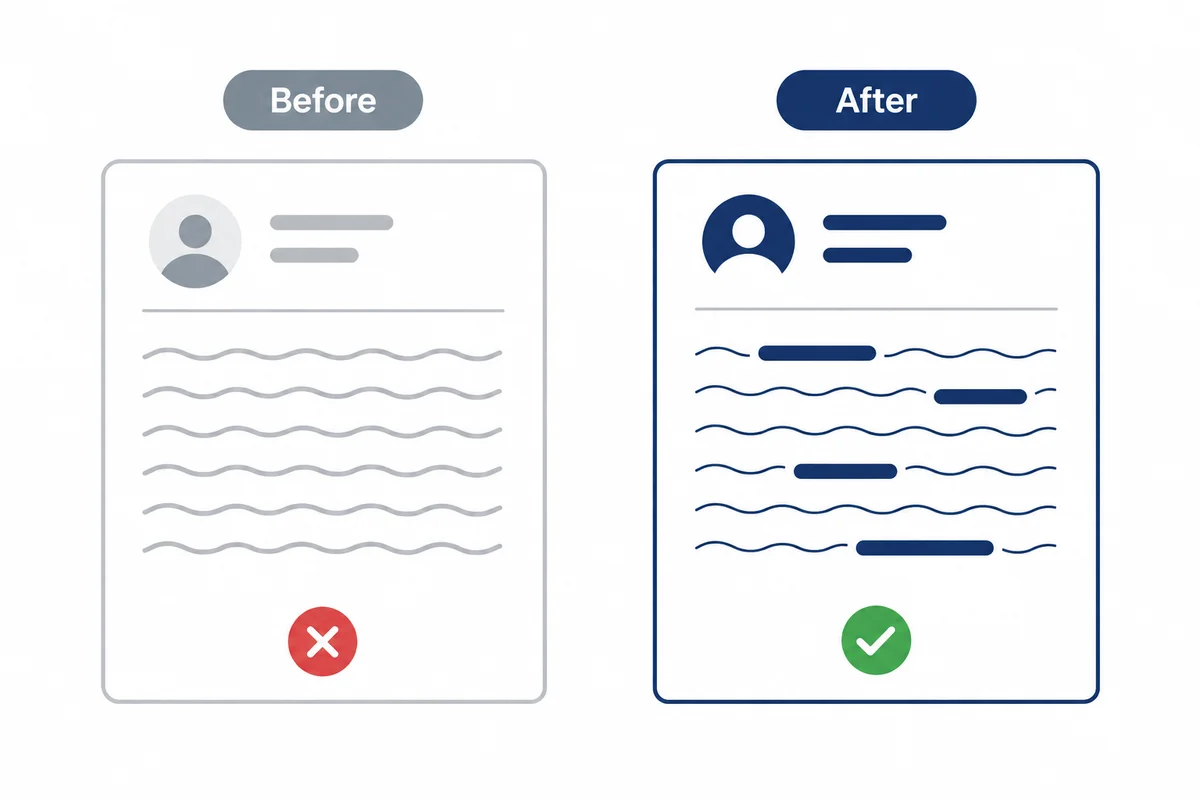
Example: before and after
Before (too vague, no evidence):
Personal Profile: I am a hard-working and enthusiastic student looking for my first job. I am a good team player and I am reliable.
Work Experience: None.
Skills: Teamwork, communication, hard-working.
After (specific, evidence-led):
Personal Profile: Currently studying A-levels in Biology, Chemistry and Maths at Riverside College, with experience captaining a school sports team and volunteering weekly at a local charity shop. Looking for a part-time retail role where reliability and customer-facing confidence can be put to immediate use.
Experience:
Charity Shop Volunteer, Age UK, Sept 2025 to present. Serve customers on the till, restock shelves and sort donated stock twice a week, working as part of a small team of volunteers and staff.
Duke of Edinburgh’s Award, Silver, 2025. Completed a two-day expedition with a team of six, including route planning and navigation, and a six-month volunteering placement at a local animal shelter.
Skills:
Customer service: handled till transactions and customer queries unsupervised during charity shop shifts.
Teamwork: captained the school netball team for one season, organising weekly training attendance.
Reliability: maintained a consistent weekly volunteering commitment for over six months alongside full-time A-level study.
Notice that the “after” version never uses the words “hard-working” or “enthusiastic” on their own. Every quality is backed by a specific, checkable example instead.
Common mistakes to avoid
Leaving the CV at one page with large gaps is the most common mistake, because there is supposedly “nothing to put.” That gap is almost always avoidable using the sources listed earlier in this guide. A second common mistake is writing a personal profile full of adjectives with no evidence behind them. Words such as “dedicated,” “motivated” and “driven” carry no weight on their own. They need a specific example in the next line to mean anything.
Using an overly complex template is another frequent problem. A first CV does not need colour blocks, graphics or a two-column layout. A simple, single-column format is easier for an employer to scan quickly. It is also far less likely to cause problems if the CV is later uploaded to an applicant tracking system.
Finally, do not guess exam results that have not been confirmed yet. State predicted grades clearly as predictions. Presenting an unconfirmed grade as final can look careless if it is ever checked.
A less obvious mistake is listing an email address that does not look professional. An address based on a childhood nickname or an old gaming handle is fine for personal use, but it reads oddly on a job application. A simple address built from your name is a five-minute fix. It removes an unnecessary distraction before an employer even opens the CV itself. Double-check your phone number and contact details are current and correctly typed too. A single wrong digit means a missed call that never gets explained.
Frequently asked questions
What should a 16-year-old put on their first CV if they have never had a job?
Focus on school achievements, extra-curricular activities, positions of responsibility, the Duke of Edinburgh’s Award if completed, and any informal or volunteering experience. Frame all of it under an “Experience” heading rather than limiting that section to paid work only.
How long should a school leaver’s CV be?
One page. A first CV with limited content should never be stretched to two pages. A focused, well-organised single page reads as more professional than a padded one.
Should I include my predicted A-level or GCSE grades?
Yes, if final results are not yet available. Label them clearly as “predicted” so the information stays accurate and is not misleading.
Does the Duke of Edinburgh’s Award actually help on a CV?
Yes. Employers recognise it as evidence of commitment over several months, teamwork during the expedition section, and a specific skill learned during the skills section. That combination makes it one of the strongest items a school leaver can include.
What is the difference between a school leaver’s CV and a graduate CV?
A graduate CV typically leans on a degree, academic projects and possibly a placement year or internship. A school leaver’s CV instead draws on school achievements, extra-curricular responsibility, volunteering and informal experience. Formal placements and degree-level projects are not yet available at this stage.
Should I use a CV template with colour and graphics to stand out?
No. A simple, single-column layout is easier for an employer to scan. It is also safer if the CV is uploaded to an applicant tracking system, which can misread complex graphics or multi-column layouts.
Recent Comments