

If you are applying for project manager roles in the UK, your CV needs to do two jobs at once. First, it needs to be clear enough for screening software to read without friction. Second, it needs to make sense to a busy recruiter or hiring manager who may only give it a quick first scan. That means a project manager CV should not just list responsibilities. It should show scope, delivery, methods, stakeholders, tools and results in a way that is easy to spot quickly.
This guide is built for UK project managers who want practical help, not vague “CV tips”. You will get a clean structure you can copy, a PM-specific keyword bank, stronger bullet examples, and clear ways to tailor your CV for IT/digital, construction, and change/transformation roles. Where useful, I’ll also point to broader UK CV and ATS guidance, including the Association for Project Management’s advice on tailoring your CV and Brendan Hope’s Free CV Review.
Key takeaways
- A strong project manager CV in the UK should show what you delivered, how you delivered it, and what changed as a result.
- Your top third matters most: job title, profile, methodologies, sector cues, and 4–8 relevant skills should all be easy to spot.
- Generic phrases like “responsible for projects” are weak. Strong PM CVs show delivery across budget, risk, timelines, stakeholders, suppliers, governance, change, or benefits.
- Tailor the language to the role: an Agile IT project manager CV should not sound the same as a construction project manager CV.
- ATS-friendly usually means simple layout, standard headings, and readable wording, not gimmicks. For broader formatting help, see this UK guide to ATS-friendly CV structure and keyword strategy.
- If your CV already looks “fine” but still is not converting, the issue is often not format alone. It is usually positioning, evidence, specificity, or weak bullet writing.
Recruiter 30-second scan: what hiring managers look for first
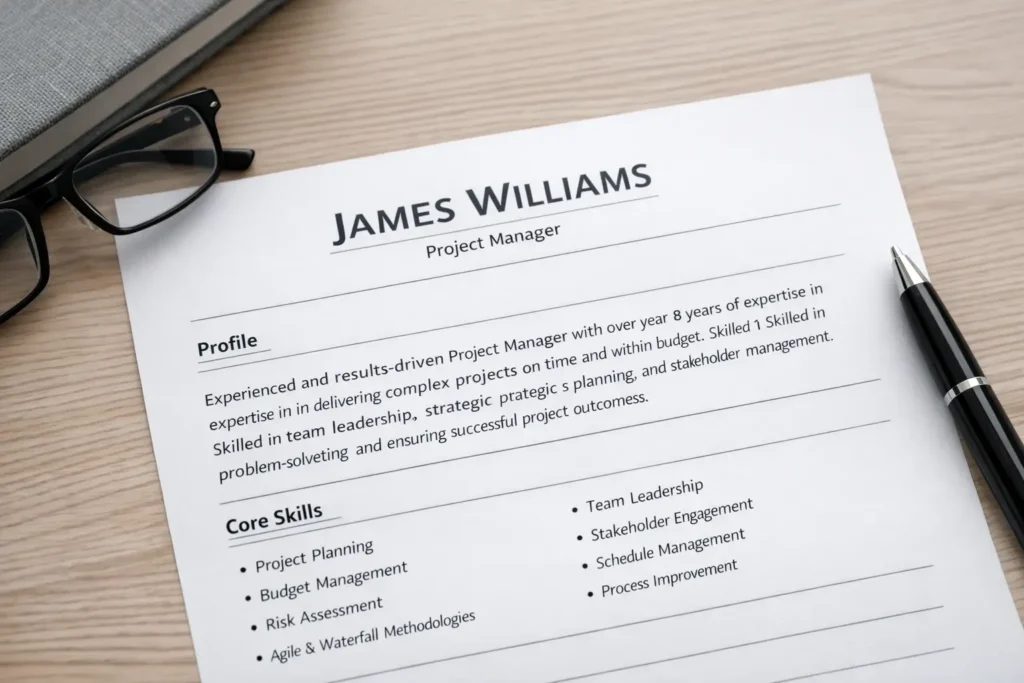
Before anyone reads your CV in depth, they are usually trying to answer a small set of questions very quickly.
1) Are you the kind of project manager they need?
Your headline, opening profile and first few skills should make that obvious. If you are applying for digital delivery roles, say so. If your background is mainly construction, infrastructure, ERP, software, transformation, or operational change, that should appear near the top. Do not make the reader dig through page one to work it out.
2) What level are you operating at?
A recruiter wants to see your level fast. Are you coordinating workstreams, leading full projects, managing multiple concurrent projects, or operating closer to programme level? Your CV should signal scale through cues like team size, budgets, number of sites, business-critical systems, governance exposure, or cross-functional leadership. If your work is increasingly about influence, strategic alignment and leadership rather than task execution, this broader guide to a leadership CV in the UK may also help.
3) What delivery environments do you know?
For PM roles, methodology matters. If you work in Agile environments, say so clearly. If your background is Waterfall, PRINCE2-led, hybrid delivery, vendor-led implementation, or change-heavy transformation, bring that language into the top third. A good recruiter scan should immediately reveal whether you understand the delivery model the employer is hiring into.
4) Can you show outcomes, not just activity?
Most weak PM CVs describe process. Better ones show movement. A hiring manager is scanning for evidence that you improved timelines, reduced risk, controlled budgets, coordinated suppliers, delivered system rollouts, supported adoption, or kept delivery on track in messy environments.
5) Is this CV easy to trust?
Clarity matters. Vague claims, inflated jargon, and long dense paragraphs make PM CVs feel weaker, not stronger. A solid project manager CV reads like someone who can bring order to complexity: clear sections, sensible wording, relevant detail, and proof where it counts.
A useful rule is this: if someone scanned only the top third of your first page, they should already know your PM type, level, delivery environment, and core value.
Project manager CV template (UK): copy/paste this ATS-safe structure
A good project manager CV does not need fancy design to work. In fact, a simple layout is usually the safer choice. Use one clear column, standard headings, readable spacing, and consistent job-entry formatting. If you want a broader generic starting point, Brendan Hope’s CV template guide for the UK is a useful companion. For this page, though, the aim is to give you a project-manager-specific version you can adapt quickly.
Below is a clean, ATS-friendly structure you can copy into Word or Google Docs.
Copy/paste template
[Your full name]
[Phone number] | [Professional email address] | [LinkedIn URL] | [Town/City, UK]
Project Manager / Senior Project Manager
Results-focused Project Manager with [X] years of experience delivering [IT / construction / change / business transformation / infrastructure] projects across [sector(s)]. Strong background in [Agile / Waterfall / hybrid] delivery, stakeholder management, planning, risk control and cross-functional coordination. Proven record of delivering [systems / rollouts / change initiatives / client projects / site projects] on time, within scope and with clear business impact. Confident working with [senior stakeholders / suppliers / technical teams / operational teams / governance forums].
Core skills
- Project delivery
- Agile / Scrum / Waterfall / PRINCE2 / hybrid delivery
- Stakeholder management
- RAID / risk and issue management
- Budget tracking / cost control
- Resource planning
- Change management / business readiness
- Supplier / vendor management
- Governance / reporting / PMO alignment
- Tools: [Jira, MS Project, Trello, Asana, Monday.com, Smartsheet, Excel, Power BI etc.]
Professional experience
Job title — Company name, Location
[Month Year] – [Month Year]
Short 1–2 line scope statement: what kind of projects did you lead or support, in what environment, and at what level?
- Delivered [project / programme / rollout / implementation] valued at [£X / scale if known], achieving [result].
- Managed timelines, risks, dependencies and stakeholder communications across [teams / sites / departments / suppliers].
- Coordinated [technical / operational / commercial] workstreams to support delivery of [system / product / change initiative].
- Reduced [delay / risk / cost / rework / escalation] by [X% / measurable outcome if known] through [specific action].
- Produced governance updates, status reporting and delivery plans for [SteerCo / PMO / leadership team / client stakeholders].
- Supported adoption, training, handover or benefits tracking following project delivery.
Job title — Company name, Location
[Month Year] – [Month Year]
- Use the same format.
- Focus on achievements, not a long task list.
- Keep bullets relevant to the roles you are targeting now.
Earlier career
You can shorten older or less relevant roles. Keep enough detail to show progression, but do not let old experience crowd out your strongest PM evidence.
Education
Qualification — Institution, Year
Certifications
- PRINCE2 [Foundation / Practitioner]
- AgilePM
- Scrum Master / Scrum certifications
- APM qualification
- MSP / change / Lean Six Sigma / relevant technical certifications
Tools
[Jira, Confluence, MS Project, Excel, Power BI, Smartsheet, SAP, Salesforce, Oracle, AutoCAD, Primavera P6, depending on your background]
Additional information
Optional, only if useful:
- Right to work in the UK
- Security clearance
- Languages
- Professional memberships
What makes this structure work?
It does four things well.
First, it tells the reader quickly what kind of PM you are. Second, it keeps methodology, tools and delivery signals close to the top. Third, it makes room for evidence-led bullets instead of long paragraphs. Fourth, it stays easy for both people and systems to read.
That lines up with general UK CV best practice too. Prospects, for example, recommends a clear, well-structured CV with relevant detail and focused tailoring rather than overdesigned presentation.
A final tip: do not treat this template as fixed. A construction project manager CV and an IT project manager CV may use the same basic structure, but the language inside it should be different.
How to write each section of a project manager CV
Once you have the structure in place, the real difference comes from what you put inside each section. A strong project manager CV should feel focused and controlled. It should give enough detail to prove delivery capability, but not so much that the reader has to dig for the point.
If you want a broader refresher on modern UK CV structure, this guide is worth keeping open in another tab while you edit: How to write a UK CV
1) Your headline
Do not make the recruiter guess what level you are or what kind of PM role you want.
Good examples:
- Project Manager
- Senior Project Manager
- IT Project Manager
- Construction Project Manager
- Change Project Manager
- Project Manager | Agile Delivery | Business Change
Weak examples:
- Experienced professional
- Operations and project specialist
- Management professional
Your headline should match the role you are targeting now, not just the title on your contract. If your current title is unusual or overly internal, use a clearer market-facing version if it is still accurate.
2) Your profile
This is where many PM CVs go wrong. The profile should not be a vague paragraph about being “motivated”, “dynamic” or “results-driven”. It should quickly answer four questions:
- What kind of PM are you?
- In what environments have you delivered?
- What methods or delivery models do you use?
- What value do you usually bring?
A stronger PM profile sounds like this:
Project Manager with 7 years’ experience delivering business change and technology projects across financial services and operations. Background includes Agile and hybrid delivery, stakeholder engagement, RAID management, supplier coordination and governance reporting. Proven track record of delivering cross-functional initiatives that improved process efficiency, reduced operational risk and supported successful system adoption.
That is clearer than a generic statement because it shows domain, delivery environment and value in a small space.
3) Your core skills section
This section helps both readers and screening systems. Keep it concise and relevant. Do not dump every tool or buzzword you have seen in job adverts.
A good PM skills section usually mixes:
- delivery methods
- core project disciplines
- stakeholder/governance strengths
- relevant tools
- sector-specific language where useful
For example:
- Agile, Waterfall and hybrid delivery
- Project planning and scheduling
- RAID and dependency management
- Stakeholder engagement
- Budget tracking and cost control
- Supplier and vendor management
- Change readiness and adoption
- Governance reporting
- Jira, Confluence, MS Project, Smartsheet, Excel
Indeed’s UK guidance also emphasises clear sections and relevant skills, rather than an unfocused list.
4) Your experience section
This is the section that carries the most weight.
For each role, start with a short scope line before the bullets. This helps the reader understand the environment quickly.
For example:
Project Manager — ABC Company, London
Led cross-functional software and process improvement projects across operations and customer service, working in a hybrid delivery environment with internal teams and third-party suppliers.
That one line gives context before the achievements begin.
Then focus your bullets on:
- what you delivered
- the size or complexity of the work
- who you worked with
- what improved as a result
A weak bullet might say:
- Responsible for managing multiple projects and stakeholders.
A stronger version might say:
- Managed concurrent business change projects across customer operations, coordinating internal teams and external suppliers to deliver milestones on schedule and improve service continuity during rollout.
You do not need every bullet to include a number, but you do need enough evidence to show scale, ownership and outcome.
5) Education and certifications
For most PMs, education should sit below experience unless you are earlier in your career.
Keep it clean:
- degree or diploma
- institution
- year if useful
- relevant certifications
Certifications can carry real weight in PM CVs, especially when they align with the role:
- PRINCE2
- AgilePM
- Scrum-related certifications
- APM qualifications
- MSP
- Lean Six Sigma
- sector-specific systems or delivery credentials
Do not overplay certifications if your practical delivery evidence is thin. They help most when they reinforce experience, not replace it.
6) Tools and systems
Tools matter, but only when they are relevant to the role and supported by the rest of the CV.
For example:
- IT/Digital PM: Jira, Confluence, Azure DevOps, Trello, Asana, Smartsheet
- Construction PM: Primavera P6, MS Project, AutoCAD, Procore
- Change/Transformation PM: MS Project, Excel, Power BI, Visio, stakeholder reporting tools
List tools that a recruiter may actively scan for, but do not build the CV around software names alone. Tools are supporting evidence, not the main story.
7) What to leave out or keep brief
Older, less relevant roles can be shortened. So can certifications or training that do not support your current direction. The goal is not to document every task you have ever done. The goal is to build a CV that makes a hiring manager think, “Yes, this person looks credible for this PM role.”
Project manager CV keywords and skills bank
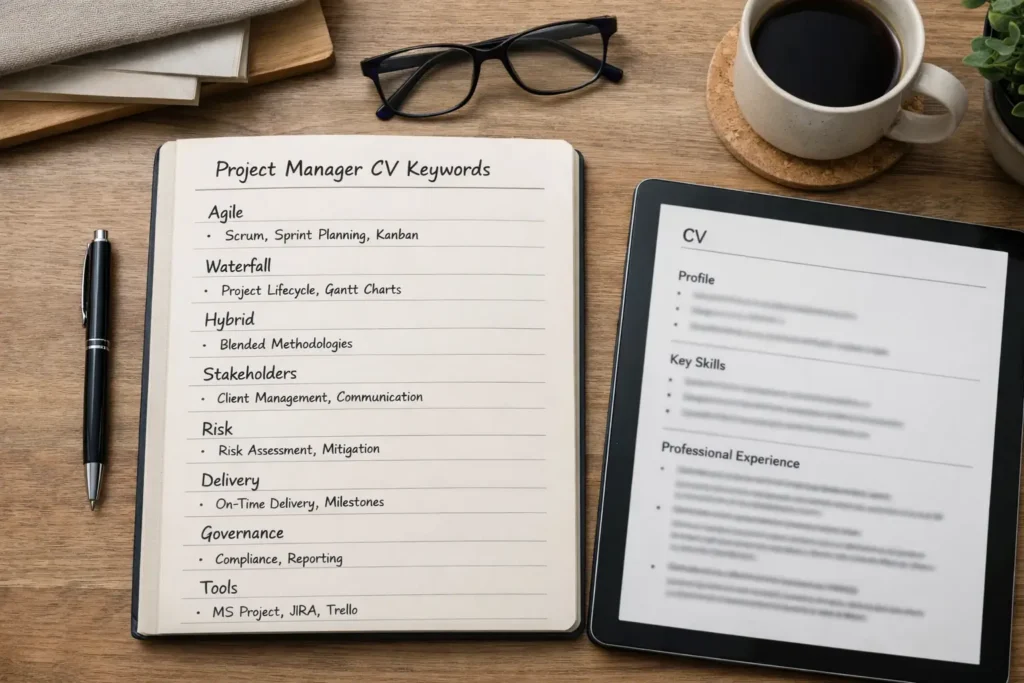
A good project manager CV should include relevant keywords, but not in a way that feels forced. The aim is not to cram in as many project terms as possible. The aim is to use the language that helps an employer recognise that your background fits their delivery environment.
This matters for two reasons.
First, recruiters often skim for familiar terms before they read in depth. Second, many employers use ATS or other screening tools to help surface applicants with the right match signals. If you want a broader explanation of how this works in the UK, read: ATS CV optimisation UK guide
The best way to approach PM keywords is to think in clusters:
- delivery method
- project disciplines
- stakeholder/governance language
- tools and systems
- sector-specific terms
Use keywords where they naturally belong
Do not dump keywords in one long skills block and hope for the best. Spread them through the CV where they make sense:
- Headline: IT Project Manager / Senior Project Manager / Change Project Manager
- Profile: Agile, Waterfall, hybrid, stakeholder engagement, business change, supplier management
- Core skills: RAID, planning, governance, reporting, budgeting, resource management
- Experience bullets: rollout, implementation, delivery, migration, site coordination, benefits realisation, risk mitigation
- Certifications: PRINCE2, AgilePM, Scrum-related credentials, APM qualifications
- Tools: Jira, Confluence, MS Project, Primavera P6, Smartsheet, Excel, Power BI
Keyword bank by PM type
| PM type | Useful keywords and phrases |
|---|---|
| General / hybrid PM | project delivery, end-to-end delivery, cross-functional coordination, stakeholder management, governance, milestone tracking, budget tracking, resource planning, risk and issue management, dependency management, reporting, supplier management, project lifecycle, benefits realisation |
| Agile / IT / digital PM | Agile delivery, Scrum, sprint planning, backlog management, Jira, Confluence, product and engineering teams, change control, release planning, system implementation, software delivery, user adoption, testing, UAT, migration, digital transformation, Azure DevOps |
| Waterfall / traditional PM | Waterfall delivery, project plan, work breakdown structure, critical path, RAID log, stage gates, scope control, governance reporting, project documentation, schedule management, budget control, vendor coordination, risk mitigation |
| Construction PM | site delivery, subcontractor coordination, programme management, health and safety, procurement, contractor management, site meetings, schedule control, cost control, snagging, handover, client liaison, regulatory compliance, Primavera P6, MS Project |
| Change / transformation PM | business change, operating model change, stakeholder engagement, communications planning, training coordination, business readiness, process improvement, change impact, adoption, implementation planning, governance, benefits tracking, transformation delivery |
| Senior PM / programme-facing PM | strategic delivery, portfolio alignment, executive stakeholders, steering committee reporting, governance frameworks, financial oversight, delivery assurance, multi-workstream leadership, programme governance, benefits realisation, supplier performance |
Agile, Waterfall and hybrid wording: use the right signals
A lot of PM CVs say “Agile and Waterfall experience” without proving either. That is not enough.
If you claim Agile experience, support it with practical language such as:
- sprint planning
- backlog refinement
- cross-functional delivery
- incremental rollout
- release planning
- collaboration with product, engineering or delivery teams
If you mention Scrum-related terminology, make sure you are using it accurately. The Scrum Guide is the cleanest reference point for standard Scrum language, and the Agile Manifesto remains the best-known reference for core Agile principles.
If your work is more Waterfall or traditional project delivery, stronger terms often include:
- project plan
- scope management
- milestones
- stage gates
- critical path
- budget control
- formal governance
- vendor management
- documentation and reporting
If your environment is hybrid, say so clearly. Many UK employers do not operate in a purely Agile or purely Waterfall model. A hybrid PM CV often performs better when it shows that you can adapt method to business need rather than forcing one framework onto every project.
Certification keywords: use them properly
Relevant PM certifications can help, especially when they are recognised by the employer. Common examples include:
- PRINCE2
- AgilePM
- Scrum certifications
- APM qualifications
- MSP
- Lean Six Sigma
If you mention PRINCE2, use the official naming properly rather than vague shorthand. PeopleCert’s PRINCE2 pages are the best reference point for that.
That said, do not lean on certifications too heavily if your experience bullets are weak. Employers usually care more about whether you can show delivery evidence than whether you can list acronyms.
Keep the wording specific to your target role
This is where tailoring matters most.
If the job advert is for an IT project manager, terms like migration, systems implementation, release planning, UAT, third-party software, digital delivery and cross-functional technology teams may matter more than generic “project coordination”.
When the role is construction-focused, the employer may care far more about site delivery, contractor management, programme control, compliance, cost management and handover.
Seeking a change or transformation role, your CV should bring through business readiness, stakeholder buy-in, process redesign, communications, training, adoption and benefits tracking.
The strongest project manager CVs do not try to sound impressive to everyone. They sound relevant to the employer reading them.
KPI and achievement bank for project managers
One of the hardest parts of writing a strong project manager CV is knowing what counts as a good achievement. Many PMs are used to describing activity rather than impact, so their bullets end up sounding like process notes instead of evidence.
That is usually the difference between an average CV and a persuasive one.
A hiring manager already assumes a project manager can run meetings, update plans and track actions. What they want to know is whether you helped deliver something important, controlled complexity well, and improved the outcome. If your CV needs to show more ownership, scale and influence, this guide to building a stronger leadership CV can help with the way you frame scope and stakeholder impact.
The good news is that not every achievement needs a perfect number. You can still write a stronger PM CV by showing one or more of these things:
- scale
- pace
- complexity
- control
- improvement
- stakeholder impact
- delivery outcome
Below is a practical bank you can use to identify stronger evidence from your own work.
1) Delivery and timeline KPIs
These show that you can move work forward and keep delivery under control.
Examples:
- Delivered projects to agreed milestones across a [X]-month timeline
- Brought a delayed project back on track ahead of a key deadline
- Coordinated multiple concurrent workstreams to support on-time delivery
- Reduced delivery slippage by improving planning, dependencies or stakeholder alignment
- Managed implementation across several teams, sites or functions without disruption to business-critical activity
- Accelerated rollout by removing blockers and tightening governance or decision-making
Useful prompts:
- Did you deliver on time, or recover a project that was drifting?
- Did you manage several projects at once?
- Did you improve visibility, reduce delays or improve decision speed?
2) Budget and commercial KPIs
Not every PM owns the full budget, but many influence cost, spend, supplier value or resource efficiency.
Examples:
- Managed project budgets of up to £[X] across [programme / portfolio / workstream] delivery
- Supported cost control by improving planning accuracy, resource allocation or supplier coordination
- Reduced overspend, rework or avoidable delays through tighter change control
- Improved commercial visibility through clearer reporting, forecasting or governance
- Delivered implementation within agreed budget parameters while maintaining scope and quality
Useful prompts:
- Did you manage or track project spend?
- Did you reduce waste, overspend or costly delays?
- Did your planning help the business avoid additional cost?
3) Risk, issue and governance KPIs
This is one of the biggest missed opportunities on PM CVs. Good employers care a great deal about how you handled uncertainty, escalation and control.
Examples:
- Maintained RAID logs and governance reporting across complex multi-stakeholder projects
- Reduced delivery risk by identifying dependencies early and escalating blockers in time
- Improved project control through tighter risk reporting and milestone tracking
- Supported leadership decision-making with accurate status updates, issue management and mitigation plans
- Strengthened governance processes, improving visibility of project health across key stakeholders
Useful prompts:
- Did you reduce the chance of failure?
- Did you improve reporting, governance or escalation?
- Did you stop issues becoming bigger problems?
4) Stakeholder and cross-functional KPIs
Project managers are often hired or rejected based on how well they manage people, not just plans.
Examples:
- Coordinated cross-functional teams across operations, technology, finance and third-party suppliers
- Improved stakeholder alignment through structured communication, regular reporting and clear action ownership
- Managed relationships with internal leadership, clients, vendors or site teams to keep delivery moving
- Built stronger buy-in for change initiatives by improving communication and expectation management
- Reduced friction between teams by clarifying timelines, responsibilities and dependencies
Useful prompts:
- Did you improve collaboration or reduce confusion?
- Did you manage senior stakeholders or difficult suppliers?
- Did you keep teams aligned during change, rollout or delivery pressure?
5) Change, adoption and business impact KPIs
This is especially important for change and transformation PMs, but it also matters in IT, systems, and operational projects.
Examples:
- Supported successful rollout of new systems, processes or tools across [department / region / function]
- Improved user adoption by coordinating communications, training and implementation support
- Helped embed new ways of working with minimal disruption to BAU activity
- Delivered projects that improved process efficiency, reporting quality or service performance
- Tracked benefits and post-implementation outcomes to support value realisation
Useful prompts:
- Did the project improve efficiency, service, control or user experience?
- Did you help people adopt the change successfully?
- Did the business work better afterwards?
6) Supplier, vendor and third-party KPIs
This is a strong area for many PMs, especially in implementation, infrastructure, construction and enterprise change.
Examples:
- Managed third-party suppliers to support delivery against agreed scope, schedule and quality expectations
- Improved delivery coordination across external vendors and internal teams
- Reduced delays or escalation by tightening supplier communication and dependency tracking
- Supported smoother handover, implementation or issue resolution across third-party relationships
Useful prompts:
- Did you keep external partners on track?
- Did you reduce supplier delays or misalignment?
- Did you improve vendor communication or accountability?
7) Team and resource coordination KPIs
Even if you were not a formal line manager, you may still have led delivery through influence.
Examples:
- Coordinated cross-functional delivery teams of [X] across project phases from planning to implementation
- Managed resource allocation and competing priorities across concurrent projects
- Improved team coordination by introducing clearer planning, ownership and reporting routines
- Supported delivery teams through shifting deadlines, emerging risks and evolving stakeholder requirements
Useful prompts:
- How many people, teams or departments did you coordinate?
- Did you balance competing demands successfully?
- Did you improve clarity, momentum or accountability?
A simple way to pressure-test each bullet
Before keeping a bullet on your CV, ask:
- Does this show what I delivered, not just what I handled?
- Does it show scope, complexity or scale?
- Does it show what improved, changed or stayed under control because of my work?
- Would this help a recruiter picture me in the role I want next?
If the answer is no, the bullet probably needs rewriting.
Before-and-after PM bullet rewrites
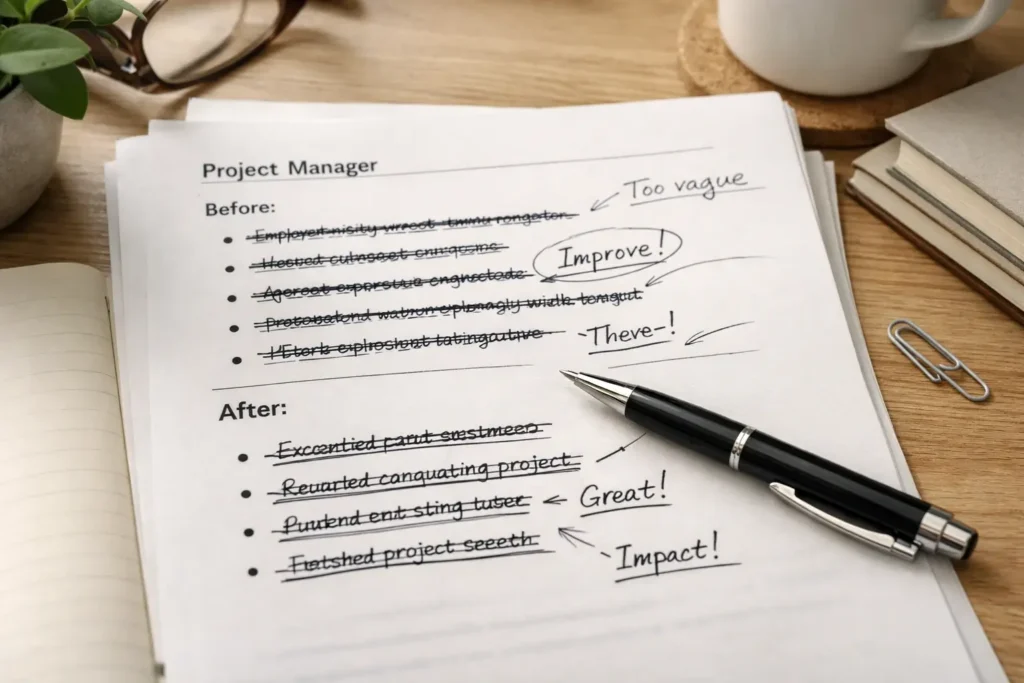
This is where many project manager CVs improve fastest.
A lot of PM bullet points are not wrong. They are just too flat. They describe activity, but they do not show enough ownership, scale, context or outcome. That makes the CV feel generic, even when the underlying experience is solid.
A useful way to improve your bullets is to move from:
task language → delivery language → impact language
If you also want a wider view of how ATS and recruiter scanning work together, this guide to ATS CV optimisation in the UK is worth reading alongside your edits.
Below are practical examples you can adapt.
1) Generic project coordination
Before
- Responsible for managing projects and coordinating stakeholders.
After
- Managed cross-functional projects from planning through delivery, coordinating internal stakeholders and third-party suppliers to keep milestones on track and maintain delivery momentum.
2) Planning and scheduling
Before
- Created project plans and tracked progress.
After
- Built and maintained project plans, tracking milestones, dependencies and risks to improve visibility and support on-time delivery across multiple workstreams.
3) Risk and issue management
Before
- Managed project risks and issues.
After
- Maintained RAID logs and escalated key risks early, reducing delivery disruption and improving decision-making across business and technical stakeholders.
4) Systems implementation
Before
- Worked on system implementation projects.
After
- Supported end-to-end system implementation projects, aligning business, technical and supplier teams to deliver rollout activities with minimal disruption to day-to-day operations.
5) Stakeholder management
Before
- Communicated with stakeholders throughout the project lifecycle.
After
- Managed stakeholder communication across delivery phases, providing clear updates, resolving blockers and improving alignment between operational teams, senior sponsors and external partners.
6) Budget support
Before
- Assisted with budget tracking.
After
- Supported budget tracking and project forecasting, helping maintain cost visibility and reduce avoidable overspend through tighter planning and change control.
7) Change and adoption
Before
- Helped with change management activities.
After
- Coordinated change readiness activity, including communications, training support and implementation planning, helping improve user adoption and smoother transition into business-as-usual operations.
8) Supplier management
Before
- Worked with external vendors to deliver projects.
After
- Coordinated third-party suppliers against agreed timelines, dependencies and delivery expectations, reducing delays and improving accountability across vendor-led workstreams.
9) Construction or site-based delivery
Before
- Oversaw work on construction projects.
After
- Coordinated site-based project activity, contractor communication and milestone tracking to support safe, controlled delivery against programme and handover deadlines.
10) Agile or digital delivery
Before
- Worked in Agile teams to deliver projects.
After
- Supported Agile delivery across cross-functional product and engineering teams, coordinating sprint-related activity, stakeholder updates and delivery priorities to keep releases moving effectively.
What changes in these examples?
The stronger versions do four things better:
- they show context
- they clarify what you actually did
- they signal scope or complexity
- they hint at result or control
You do not need to turn every bullet into a mini case study. But you do want to avoid thin wording like:
- responsible for
- involved in
- assisted with
- worked on
- helped with
A simple upgrade formula
When rewriting your own bullets, use this pattern:
Action + project context + delivery responsibility + result
For example:
- Delivered [type of project] across [team / department / site / function], managing [planning / risks / stakeholders / suppliers] to achieve [outcome].
- Coordinated [workstreams / teams / rollout activity] across [environment], improving [speed / visibility / control / adoption].
- Managed [project discipline] for [initiative], helping reduce [risk / delay / overspend / disruption].
If you can apply that formula across even five or six bullets, your project manager CV will usually feel sharper immediately.
Tailor your PM CV by sector: IT/digital, construction, change/transformation
One of the quickest ways to weaken a project manager CV is to make it too generic.
Even when two jobs share the same title, employers are often hiring for very different delivery environments. A project manager in software delivery will usually be judged on different signals from a project manager in construction or business change. That is why tailoring matters so much. APM’s guidance also stresses tailoring the CV to the role rather than using a one-size-fits-all version.
The structure of your CV can stay broadly the same. What should change is the language, the emphasis, and the evidence you bring forward.
IT / digital project manager CV
If you are targeting IT, software, systems, or digital delivery roles, employers usually want to see signs that you can work confidently across technical and business teams.
Bring these signals closer to the top of your CV:
- Agile, Scrum or hybrid delivery
- systems implementation
- migration, integration or rollout work
- collaboration with engineering, product, architecture or third-party technology vendors
- UAT, release planning, change control or deployment support
- tools such as Jira, Confluence, Azure DevOps, Smartsheet or MS Project
Your profile and bullets should sound like someone who understands delivery in a live, fast-moving environment.
For example, instead of:
- Managed projects across the business
Use something like:
- Delivered cross-functional technology and business change projects, coordinating product, engineering and operational stakeholders to support system rollout, user adoption and controlled delivery against milestones.
In this type of CV, strong evidence often includes:
- implementations delivered
- migrations completed
- release coordination
- reduced delivery risk
- improved adoption
- fewer delays or escalations
- clearer stakeholder alignment across technical and non-technical teams
Construction project manager CV
Construction employers are usually scanning for a different set of priorities. They want to know whether you can control delivery in a site-based, contractor-heavy, deadline-sensitive environment.
That usually means bringing forward language around:
- site delivery
- contractor or subcontractor coordination
- programme tracking
- budget and cost control
- procurement support
- compliance and health and safety awareness
- handover
- client liaison
- tools such as Primavera P6, MS Project or sector-specific systems
A construction-focused PM CV should feel grounded, controlled and practical. It should show that you can coordinate multiple moving parts without losing grip on schedule, cost, quality or communication.
For example, instead of:
- Oversaw construction projects from start to finish
Use:
- Coordinated site-based delivery across contractors, suppliers and internal stakeholders, supporting programme milestones, cost control and handover readiness across live project environments.
Strong evidence in a construction PM CV often includes:
- value or scale of projects
- number of sites or phases
- time-critical handovers
- contractor coordination
- programme recovery
- issue resolution
- delivery against compliance or operational constraints
Change / transformation project manager CV
Change and transformation roles often sit somewhere between project delivery and business improvement. Employers are usually looking for someone who can manage structure and momentum, but also bring people with them.
That means your CV should not read like a pure technical delivery CV unless the role clearly requires that.
Bring forward language such as:
- business change
- operating model change
- process improvement
- stakeholder engagement
- communications planning
- training coordination
- business readiness
- adoption
- implementation support
- benefits tracking
A weak change CV often focuses too heavily on meetings, reporting and coordination. A stronger one shows that the project moved people, processes or behaviours from one state to another in a controlled way.
For example, instead of:
- Supported change projects across the business
Use:
- Delivered business change initiatives across operations and support functions, coordinating stakeholder engagement, readiness activity and implementation planning to improve adoption and reduce disruption during transition.
Strong evidence here often includes:
- adoption or readiness support
- smoother transition into BAU
- improved efficiency or control
- stronger stakeholder buy-in
- reduced resistance or disruption
- measurable process or service improvements
What if your background is mixed?
A lot of UK project managers do not fit neatly into one box. That is normal.
If your background spans several environments, do not try to present yourself as everything at once. Instead, decide which direction matters most for the next role and tilt the CV towards that. You can still mention transferable delivery strengths, but the top third of the CV should make your target market obvious.
If you are moving closer to programme leadership, enterprise transformation, or high-level strategic delivery, your CV may also need a stronger leadership lens. In that case, this guide may help: Executive CV Writing Guide
Common project manager CV mistakes
A lot of weak project manager CVs are not weak because the candidate lacks experience. They are weak because the experience is buried, undersold, or described too vaguely.
Here are the mistakes I see most often.
1) Leading with a generic profile
If your opening profile says things like “hard-working”, “motivated”, “results-driven”, or “experienced professional”, it is not doing enough.
A recruiter should be able to tell, within a few lines:
- what kind of project manager you are
- what environments you work in
- what level you operate at
- what value you tend to bring
A vague profile makes the whole CV feel less targeted, even when the rest of your background is strong.
2) Listing responsibilities instead of outcomes
This is probably the biggest one.
Many PM CVs read like job descriptions:
- responsible for project delivery
- managed stakeholders
- created plans
- tracked risks
- worked with suppliers
None of that is wrong, but it is incomplete. Employers want to know what happened because of your work. Did you improve control? Deliver to deadline? Reduce risk? Support adoption? Recover momentum? Improve visibility? Keep a rollout on track?
If your bullets mostly describe activity, the CV will feel flatter than it should.
3) Making the CV too generic across sectors
A project manager CV for IT, construction and transformation roles cannot use exactly the same language throughout.
The problem is not having transferable experience. The problem is failing to signal relevance. If a recruiter cannot quickly see that your background maps to their environment, they may move on before they discover the detail.
That is why the top third of the CV matters so much. Your title, profile, skills, tools and first few bullets should all reinforce the direction you are targeting.
4) Hiding scale and complexity
Some PMs have worked on large, business-critical or high-pressure delivery, but you would never know it from the CV.
Do not make readers guess at scope. Where possible, show clues such as:
- number of projects or workstreams
- budget responsibility
- number of stakeholders, teams or suppliers
- operational criticality
- number of sites, users or departments
- governance exposure
- pace, deadlines or turnaround requirements
You do not need to force numbers into every line, but you do need enough evidence to show this was real project delivery, not just light coordination.
5) Overloading the CV with jargon
PM CVs can become crowded with acronyms, frameworks and delivery language very quickly.
A few well-placed terms help. Too many can make the CV feel noisy or inflated. Recruiters want relevant terminology, but they also want clarity. Use delivery language that fits the role, and make sure the rest of the bullet proves you actually applied it.
6) Using weak formatting choices
A project manager should look organised on paper.
That does not mean the CV needs heavy design. In fact, too much design often makes it worse. Common problems include:
- dense paragraphs
- inconsistent dates or formatting
- crowded skills sections
- odd headings
- tables, text boxes or graphics that hurt readability
- layout choices that make ATS parsing harder
If your CV is visually cluttered or structurally inconsistent, it can make even strong experience feel less credible. For a broader breakdown of this issue, see: ATS CV formatting mistakes UK
7) Underselling stakeholder management
Project management is not just about plans and trackers. It is about moving work through people.
A lot of CVs mention stakeholder management without showing what that meant in practice. Were you influencing senior sponsors? Coordinating suppliers? Managing tension between teams? Supporting business readiness? Keeping stakeholders aligned under pressure?
That is the kind of detail that makes stakeholder management sound real rather than generic.
8) Treating tools as proof of capability
Jira, MS Project, Primavera P6, Smartsheet, Power BI and other tools can help strengthen a CV. But tools alone do not prove delivery strength.
A recruiter is not hiring you because you can list software. They are hiring you because you can use process, planning, communication and control to deliver outcomes. Tools should support that story, not replace it.
9) Keeping too much irrelevant detail
Older or unrelated roles often take up too much space. So do long descriptions of routine duties.
Your CV does not need to preserve every task equally. It needs to build the strongest case for the role you want now. That may mean trimming older detail so you can give more room to stronger, more relevant PM evidence.
10) Failing to tailor before applying
Even a good baseline CV usually needs some adaptation before you send it.
That may mean changing:
- the headline
- the opening profile
- the skills mix
- the terminology
- the first few bullets
- the order of evidence
Small changes can make a big difference. A tailored CV feels easier to shortlist because the relevance is already visible.
Fix your project manager CV in 15 minutes
If your project manager CV is broadly decent but not converting, you do not always need a full rewrite before the next application. Sometimes a short, focused edit can improve it quickly.
Use this 15-minute checklist before you send your CV.
Minute 1–3: fix the top third
Ask yourself:
- Does my headline clearly say Project Manager, Senior Project Manager, or the right PM variant?
- Does my profile show sector, delivery environment, methodologies and value?
- Can someone tell within seconds whether I am more IT/digital, construction, or change/transformation focused?
If not, rewrite the headline and profile first. That is usually the highest-impact change.
Minute 4–6: tighten the skills and keywords
Check your core skills section.
Remove:
- vague filler
- duplicate terms
- tools that are not relevant
- buzzwords you cannot support later in the CV
Add:
- methodology terms that genuinely fit your background
- PM discipline keywords such as risk, governance, planning, budget, stakeholders, suppliers, change, delivery
- sector language that matches the target role
If you are applying through an ATS-heavy process, this is also the point to compare your wording against the advert and tighten the match. For broader help with that, see: ATS CV optimisation UK guide
Minute 7–10: upgrade three weak bullets
Do not try to rewrite the entire experience section in one sitting. Pick the three bullets that matter most, usually in your most recent or most relevant role.
Look for bullets that begin with:
- responsible for
- worked on
- involved in
- assisted with
- helped with
Then rewrite them so they show:
- what you delivered
- who or what you coordinated
- what improved, changed or stayed under control
Even three stronger bullets can make the CV feel much more credible.
Minute 11–12: make the layout easier to scan
Check for:
- long dense paragraphs
- inconsistent date formatting
- overly large skills blocks
- too many bullets under older jobs
- headings that are unclear or unconventional
A PM CV should feel organised. If the layout looks cluttered, the message will feel cluttered too. This companion guide is useful if formatting is one of the issues: ATS CV formatting mistakes UK
Minute 13–14: tailor the first page to the role
Before sending, make sure page one reflects the job you actually want.
That might mean changing:
- the headline
- the first line of the profile
- the first 4–6 skills
- the order of your strongest bullets
- one or two keywords to reflect the target environment
A generic CV may still be “good”, but a tailored one is usually much easier to shortlist.
Minute 15: ask one final question
Before you apply, ask:
If a recruiter scanned this CV for 30 seconds, would they know what kind of PM I am, what level I work at, and why I am worth interviewing?
If the answer is not clearly yes, keep editing.
Quick checklist
- My headline matches the role I want now
- My profile shows PM type, environment, methods and value
- My first page includes relevant PM keywords naturally
- My strongest bullets show delivery and impact, not just duties
- My CV is tailored to IT/digital, construction, or change if relevant
- My formatting is clean, simple and easy to scan
- My tools support the story rather than replacing it
Get a free CV review before you apply
If your project manager CV is close, but you are not sure whether it is targeted enough, clear enough, or strong enough for the roles you want, a second opinion can help.
Brendan Hope CV Writing offers a Free CV Review that looks at how your CV is positioning you, where it may be underselling your delivery experience, and what may be holding back interview conversion.
This is especially useful if:
- your CV reads as too generic
- you are applying across IT, construction or change roles and are unsure how to tailor it
- your bullets still sound task-heavy rather than impact-led
- you are getting applications out, but not getting enough response
If you would rather get hands-on professional help rewriting the document, the Professional CV Writing Service is here.
FAQs
Should a project manager CV be one page or two pages in the UK?
For most UK project managers, two pages is the safer and more realistic option. That usually gives you enough room to show delivery scope, methodologies, stakeholders, tools and achievements without cramming everything into one page.
A one-page CV may work if you are very early in your career or targeting junior project support roles. For most PM and Senior PM roles, though, forcing everything onto one page often leads to vague wording and missing evidence.
The better question is not “How short can I make it?” but “Can a recruiter see the right evidence quickly?”
What should a project manager CV include?
A strong project manager CV should usually include:
- a clear headline
- a short profile
- a focused core skills section
- relevant project delivery experience
- evidence of outcomes, scale or complexity
- education and certifications
- tools and systems where relevant
For PM roles specifically, it also helps to show your delivery environment clearly, such as Agile, Waterfall, hybrid, IT, construction, or change/transformation.
What are the best skills to put on a project manager CV?
That depends on the role, but common high-value skills include:
- project delivery
- stakeholder management
- planning and scheduling
- risk and issue management
- budget tracking or cost control
- supplier or vendor management
- governance and reporting
- change readiness or implementation support
- Agile, Waterfall or hybrid delivery
- relevant tools such as Jira, MS Project, Smartsheet or Primavera P6
The key is relevance. A strong PM CV uses the skills that fit the target role, not the longest possible list.
How do I write project manager achievements if I do not have exact numbers?
You can still write stronger achievements even if you do not know every figure.
Focus on:
- scope
- pace
- complexity
- control
- improvement
- stakeholder impact
For example, instead of saying you “managed risks”, you could say you “identified and escalated delivery risks early, improving visibility and helping keep workstreams on track”. That is still stronger, even without a percentage or budget figure.
If you do have numbers, use them. If you do not, show the effect of your work in another credible way.
Should I include Agile, PRINCE2 or Scrum keywords on my CV?
Yes, but only where they are accurate and relevant.
If you have worked in Agile environments, use Agile language in a way that reflects what you actually did. Hold PRINCE2 or Scrum-related certifications? Include them clearly. If your delivery environment is hybrid, say so rather than pretending everything was purely Agile or purely Waterfall.
The goal is not to collect buzzwords. It is to show that you understand the delivery model the employer is hiring into.
How do I tailor a project manager CV for different industries?
Start by changing the parts that carry the most weight:
- your headline
- your profile
- your first 4–8 skills
- the first few bullets in your most relevant role
- your methodology, tools and terminology
For example, an IT project manager CV may need stronger language around systems, migration, Agile delivery, release planning and digital stakeholders. A construction project manager CV may need more emphasis on contractors, programme tracking, site delivery, handover and cost control.
You usually do not need to rewrite the entire CV every time. But you do need the first page to feel relevant to the role.
What makes a project manager CV ATS-friendly?
An ATS-friendly project manager CV is usually:
- clearly structured
- easy to read
- written with standard headings
- free from overdesigned layouts
- aligned with the language of the target role
That generally means avoiding complicated formatting, unusual graphics, and keyword stuffing. It also means using the terminology an employer would reasonably expect to see in a PM application.
What if my project manager CV looks fine, but I am still not getting interviews?
That usually points to one of four issues:
- the CV is too generic
- the bullets are too responsibility-led
- the evidence is too thin or unclear
- the CV is not aligned closely enough to the roles you are applying for
Sometimes the layout is part of the problem. More often, it is the positioning.
If you want expert feedback before sending more applications, you can request a Free CV Review.
Final thoughts
A strong project manager CV should make three things easy to see: what kind of PM you are, how you deliver, and what changed because of your work.
If you can show that clearly through a focused headline, a relevant profile, strong PM keywords, and achievement-led bullets, your CV will usually feel sharper straight away. The aim is not to sound more impressive than you are. It is to make your real delivery value easier for employers to recognise.
Before you send your next application, compare your CV against the role, tighten the first page, and make sure the evidence is doing enough work.
Recent Comments