

If your CV says you are a strong leader, strategic thinker, or effective manager, that is not enough on its own.
A good leadership CV does not rely on traits. It shows evidence. Recruiters want to see what you led, how much responsibility you carried, who you influenced, what changed because of your leadership, and what results followed.
That matters whether you are applying as a team leader, department manager, head of function, or senior executive. The principle is the same: leadership has to be visible on the page. If it is buried in generic wording, your CV can undersell you badly.
This guide shows you how to make leadership clear in a UK CV without drifting into buzzwords or bloated claims. You will see how to frame leadership in a way that feels credible, specific, and commercially relevant. And if you want an expert view on whether your CV is already doing that well enough, you can start with a Free CV Review.
Key takeaways
- A leadership CV should show evidence of direction, ownership, influence, and results.
- “Managed a team” is weak unless you also show scope, stakeholders, and outcomes.
- Leadership can be demonstrated at any level, not only in executive roles.
- Strong leadership bullets usually show what you changed, who you led or influenced, and what improved.
- The top third of the CV should make your level of responsibility obvious within seconds.
- A leadership CV is not the same as an executive CV. If you are operating at director or C-suite level, this guide should support rather than replace Brendan Hope’s Executive CV Writing Guide.
What a leadership CV is really trying to prove
When employers read a leadership CV, they are usually trying to answer a small set of practical questions.
Can this person:
take ownership?
guide people through change?
improve results, not just maintain activity?
influence beyond their own immediate team?
And can they be trusted with bigger scope, more complexity, or more visibility?
That is why leadership on a CV should never be treated as a personality label. Saying you are “dynamic”, “motivational”, or “strategic” does very little unless the rest of the CV proves it.
A stronger approach is to think of leadership as evidence in four areas:
- Direction — what you set, improved, fixed, or delivered
- Scope — team size, budget, region, function, project scale, or service area
- Influence — who you managed, coached, persuaded, or aligned
- Impact — the result on revenue, efficiency, service, risk, growth, culture, or delivery
In other words, leadership is not simply about seniority. A supervisor who improved rota coverage, coached new starters, and reduced errors may be showing better leadership evidence than a senior manager whose CV is full of vague claims.
That distinction is important because many “leadership CV” articles drift into soft-skill lists. Useful as those can be, they often miss the real hiring question: what proof do you have that people trusted you to lead, and that your leadership made a difference?
That is the lens we will use throughout this article.
That broader view of leadership is also reflected in CIPD’s leadership factsheet.
Recruiter 30-second scan: what to show in the top third

The top third of your CV does a disproportionate amount of work.
Before a recruiter reads your whole employment history, they are usually scanning for fast proof of level, relevance, and credibility. On a leadership CV, that means the first part of the document should make three things obvious very quickly:
- What level you operate at
- What kind of leadership you bring
- What sort of results or scope sit behind it
If those points are unclear, the rest of the CV has to work harder than it should.
That emphasis on a clear introduction and relevant work history is consistent with National Careers Service guidance on CV sections.
For most UK leadership CVs, the top third should include:
- a clear job-title headline or target-role line
- a short profile that shows your leadership value
- a tightly chosen core-skills or expertise section
- early proof of scale, complexity, or impact
This is not the place for generic statements such as “experienced leader with excellent communication skills”. That kind of wording is easy to ignore because it could apply to almost anyone.
Instead, the top third should answer questions like these:
- Have you led people, projects, functions, or change?
- What sort of environment have you led in?
- How big was the team, budget, account base, region, or operational remit?
- What commercial, operational, or people outcomes followed?
Opening Profile
A stronger opening profile sounds more like this in practice:
Operations leader with experience leading multi-site teams across service delivery, process improvement, and performance management. Known for stabilising underperforming functions, improving KPI visibility, and building accountable teams that deliver stronger customer outcomes.
That works better because it suggests leadership through action and context. It gives the reader clues about your leadership style and operating environment without sounding inflated.
You should also think carefully about what appears early in your skills section. A leadership CV should not just list broad terms such as “communication”, “teamwork”, and “organisation”. Instead, prioritise leadership-related themes that support your target role, such as:
- team leadership
- stakeholder management
- operational improvement
- change delivery
- coaching and development
- cross-functional collaboration
- budget oversight
- strategic planning
- service transformation
If you are unsure whether the structure of your opening section feels right for the UK market, Brendan Hope’s UK CV guide is a useful companion piece.
The key point is simple: a recruiter should not have to hunt for your leadership. It should be visible early through the language you use, the scope you show, and the results you hint at before they even reach your full career history.
For readers who want broader UK formatting guidance, Prospects’ guide to writing a CV is a useful reference point.
The leadership proof formula: Action, Scope, Stakeholders & Result

A simple way to enhance a leadership CV is to test your wording against four points:
Action, Scope, Stakeholders & Result
This is the easiest way to turn weak leadership claims into evidence.
Most leadership bullets fail because they stop too early. They tell the reader what you were responsible for, but not what you actually changed, how wide your remit was, who you had to influence, or what difference your leadership made.
Here is how the framework works.
1) Action
Start with what you actually did.
This should be more specific than “responsible for” or “in charge of”. Use verbs that show leadership in motion, such as:
- led
- introduced
- delivered
- restructured
- improved
- launched
- coached
- aligned
- stabilised
- transformed
The point is to show movement. Leadership is easier to believe when it sounds like a series of deliberate actions rather than a static list of duties.
2) Scope
Then show the size or complexity of what sat under you.
This could include:
- team size
- department size
- number of sites
- budget value
- region covered
- size of client portfolio
- scale of project or transformation
- volume, turnover, or service output
For example, “Led a team” is weak. “Led a team of 18 across two sites” is stronger. “Led a 25-person service function through a period of restructure and KPI redesign” is stronger again.
Scope tells the reader how much weight your leadership carried.
3) Stakeholders
Leadership is rarely just about the people who reported directly to you.
Strong CVs also show who you influenced, aligned, or managed around the work. That might include:
- senior leadership teams
- board members
- clients
- cross-functional peers
- suppliers
- regulators
- union representatives
- external partners
This matters because it helps distinguish simple line management from broader leadership impact. Someone who can align operations, finance, HR, and commercial teams around change is showing a different level of leadership from someone whose evidence stays entirely within their own team.
4) Result
This is the part many people forget.
What changed because of your leadership?
That could be:
- revenue growth
- cost reduction
- improved retention
- stronger engagement
- faster delivery
- fewer errors
- better compliance
- improved service levels
- smoother change adoption
- higher productivity
If possible, quantify it. If you cannot quantify it exactly, describe the practical outcome clearly.
Compare these two versions:
- Managed a customer service team and improved performance.
- Led a 12-person customer service team through workflow changes and coaching improvements, reducing complaint escalation rates and improving response times during a peak-demand period.
The second version works because it gives the reader a chain of evidence. It shows leadership as something real, not merely claimed.
As you review your CV, look at each bullet and ask:
- What action does this show?
- What was the scope?
- Who was involved or influenced?
- What result followed?
If one or two of those elements are missing, the bullet may still be usable. If three are missing, it probably needs rewriting.
Leadership CV mini example (UK top third and sample bullets)
Sometimes it helps to see what “visible leadership” actually looks like on the page.
This is not a full CV template. It is a short example of the kind of top-third positioning and achievement language that helps a leadership CV feel stronger from the outset.
Example headline and profile
Operations Manager | Multi-site Leadership | Service Improvement | Team Development
Operations leader with experience managing multi-site service teams, improving performance against KPIs, and leading change in fast-moving environments. Strong track record of stabilising underperforming areas, improving accountability, and working cross-functionally to deliver better customer outcomes, stronger team capability, and more efficient day-to-day operations.
Example core expertise
- Team leadership and performance management
- Service improvement and process redesign
- Stakeholder management
- KPI reporting and operational analysis
- Coaching, mentoring, and staff development
- Change implementation
- Resource planning and budget awareness
- Cross-functional collaboration
Example leadership bullets
- Led a 22-person frontline operations team across two sites, introducing clearer performance rhythms, tighter escalation processes, and more consistent coaching, which improved service reliability and reduced avoidable delays.
- Worked with HR, senior management, and team supervisors to embed a new attendance and performance approach, helping improve accountability and reduce disruption across a high-pressure service function.
- Restructured rotas and workflow allocation during a peak-demand period, protecting service levels while improving team morale and reducing pressure on key staff.
- Supported the development of new and existing team leaders through regular 1-to-1 coaching, clearer expectations, and practical feedback, strengthening day-to-day management across the wider function.
What makes this example work is not that it sounds grand. It works because it shows leadership through context and consequences.
The profile does not just say “experienced leader”. It hints at the type of leadership involved: stabilising performance, improving accountability, and delivering better outcomes.
The bullet points then reinforce that picture by showing:
- scope — team size, multi-site responsibility, function type
- action — introduced, worked with, restructured, supported
- stakeholders — HR, senior management, supervisors, team leaders
- result — better service reliability, improved accountability, reduced disruption, stronger management capability
That is the standard to aim for.
If you are targeting more senior roles and need help positioning leadership at head-of-function, director, or executive level, Brendan Hope’s Executive CV Writing Guide is the better companion piece for that.
Before-and-after leadership bullet rewrites

This is where many leadership CVs either gain credibility or lose it.
The weak version usually sounds duty-based, vague, and hard to picture. The stronger version makes leadership visible by showing what changed, how much responsibility you carried, who was involved, and what happened as a result.
Here are some practical rewrites.
1) Team leadership
Before
Managed a team and helped improve performance.
After
Led a 10-person service team through a performance reset, introducing clearer expectations, weekly KPI reviews, and more consistent coaching, which improved accountability and strengthened day-to-day delivery.
Why the second version works: it shows leadership as an intervention, not just a job title. It also hints at method and outcome.
2) Cross-functional leadership
Before
Worked with other departments to improve processes.
After
Coordinated with operations, finance, and HR to streamline handovers and reduce process bottlenecks, helping improve workflow consistency and reduce delays across a high-volume function.
Why it works: leadership often happens through influence, not direct authority. This version shows cross-functional alignment rather than simple participation.
3) Change leadership
Before
Supported change within the department.
After
Helped lead the rollout of new working practices across the department, briefing staff, resolving adoption issues, and maintaining engagement during transition, which supported smoother implementation and reduced disruption.
Why it works: it gives the reader a clearer picture of how leadership showed up during change.
4) People development
Before
Responsible for staff training and mentoring.
After
Coached new and existing team members through regular 1-to-1 support, practical feedback, and clearer performance expectations, contributing to stronger confidence, faster onboarding, and improved consistency across the team.
Why it works: it shows that people development was active and outcome-focused.
5) Commercial leadership
Before
Oversaw sales activity and team targets.
After
Led a regional sales team against monthly revenue targets, tightening pipeline discipline, improving follow-up activity, and raising visibility of conversion performance to help drive more consistent commercial results.
Why it works: the leadership is tied to performance management and commercial rhythm, not just oversight.
6) Operational leadership
Before
Managed operations and ensured service standards were maintained.
After
Led day-to-day operations across two sites, improving shift coordination, escalation handling, and performance monitoring to protect service standards during a period of high demand and staffing pressure.
Why it works: it adds context and pressure, which makes the leadership more believable.
A useful test is this: if your bullet could apply to almost anyone in a supervisory role, it is probably too generic. Recruiters and hiring managers respond far better to specific, evidence-led wording that reflects real ownership and impact. That also tends to align better with ATS-friendly CV writing, because clearer role-specific language and outcome-led phrasing make relevance easier to detect. Brendan Hope’s ATS guide is helpful here.
You do not need every bullet to contain a perfect metric. But you do need enough specificity that a reader can understand the nature of your leadership without having to guess.
Leadership achievements and KPI examples by function
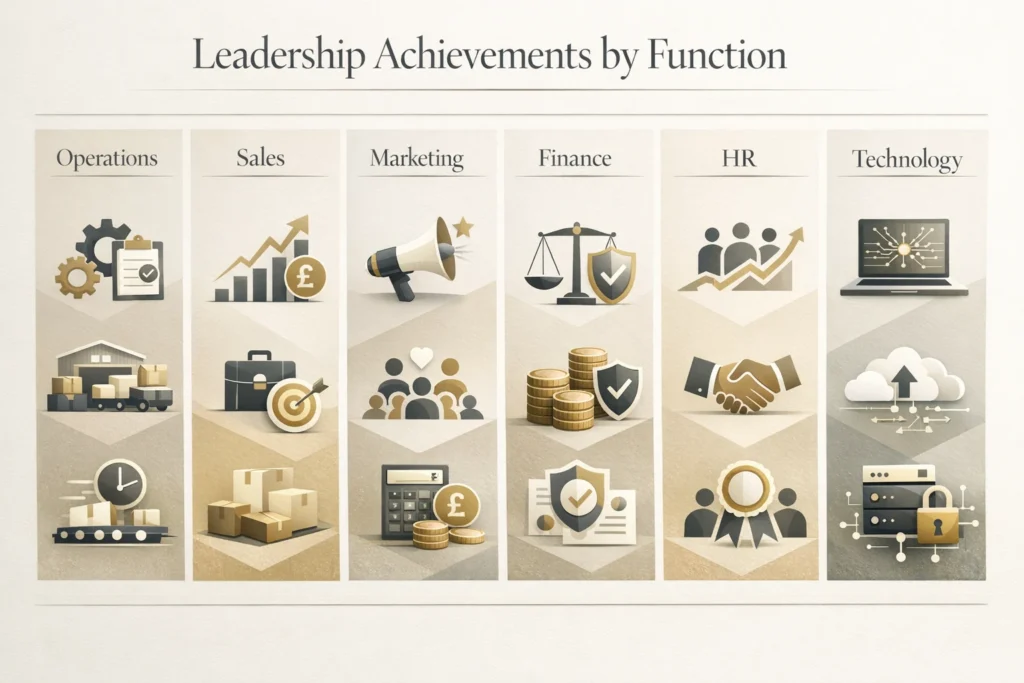
One of the easiest ways to strengthen a leadership CV is to stop thinking only in terms of duties and start thinking in terms of leadership evidence.
In practice, that usually means showing one or more of the following:
- improved performance
- stronger team capability
- better commercial results
- reduced risk or waste
- smoother delivery
- improved customer or stakeholder outcomes
- successful change adoption
- greater visibility, control, or accountability
The exact measures will depend on your function. A strong leadership CV does not need to force every achievement into revenue language. It just needs to show that your leadership moved something important in the right direction.
A simple way to think about it:
| Function | What leadership proof often looks like | Example KPI / achievement angles |
|---|---|---|
| Operations | Running teams, improving workflow, stabilising delivery, managing service under pressure | service levels, turnaround time, productivity, error reduction, cost savings, on-time delivery, downtime reduction |
| Sales | Leading people to target, improving pipeline discipline, coaching performance, strengthening commercial rhythm | revenue growth, conversion rate, target attainment, average order value, account retention, margin improvement |
| Marketing | Directing campaigns, aligning teams, improving planning and execution, leading cross-channel delivery | lead volume, cost per lead, campaign ROI, engagement, conversion rate, brand reach, launch delivery |
| Finance | Improving controls, leading process change, building reporting discipline, supporting decision-making | reporting accuracy, month-end speed, cost control, forecast accuracy, audit readiness, cash-flow visibility |
| People / HR | Coaching managers, improving people processes, supporting change, strengthening engagement and capability | retention, absence reduction, time-to-hire, onboarding effectiveness, engagement, manager capability, policy adoption |
| Technology | Leading delivery, improving collaboration, managing change, translating technical work into business outcomes | release quality, delivery speed, incident reduction, adoption rates, system uptime, backlog reduction, project completion |
The point of this table is not to encourage keyword stuffing. It is to help you spot the kinds of results that make leadership visible.
For example, if you work in operations, a weak bullet might say:
- Managed a busy operational team.
A stronger bullet might say:
- Led a 15-person operations team through workflow changes and tighter performance monitoring, improving service consistency and reducing avoidable delays during a high-demand period.
Likewise, if you work in HR, “supported managers” is too soft on its own. A stronger version might show what leadership changed:
- Partnered with department heads to improve absence management and performance conversations, helping strengthen manager confidence and reduce avoidable team disruption.
Conclusion:
You do not need to include every possible KPI. In fact, that often makes a CV feel cluttered. A better approach is to choose the evidence that best supports your target role.
Ask yourself:
- Which measures would a hiring manager in my field actually care about?
- Where did my leadership improve performance, control, delivery, or capability?
- Which achievements show I was trusted with more than routine supervision?
Those answers will usually give you the raw material for far stronger leadership bullets.
Leadership skills vs leadership behaviours on a CV
This distinction matters more than many people realise.
On a CV, leadership skills are usually the labels recruiters expect to see. They help frame your relevance quickly. Examples include stakeholder management, team leadership, change management, performance improvement, coaching, strategic planning, and cross-functional collaboration.
Those terms are useful. They help your CV align with job descriptions and make it easier for both recruiters and applicant tracking systems to understand your fit.
But on their own, they are not enough.
Leadership behaviours are what make those skills believable. They show how you operate in practice. For example:
- “Stakeholder management” becomes credible when you show that you aligned senior leaders, peers, and delivery teams around a shared outcome.
- “Coaching” becomes stronger when you show that you developed capability, improved confidence, or raised performance consistency.
- “Change management” becomes more convincing when you show that you implemented new ways of working, handled resistance, and kept delivery steady during transition.
This is why a leadership CV should not read like a list of abstract strengths. It should combine the two:
- the skill label that signals relevance
- the behavioural evidence that proves you can do it
In simple terms, this is the difference between saying:
- Strategic leadership
- Change management
- Team development
and saying:
- Led a service redesign across two teams, aligning managers around new priorities and embedding clearer reporting rhythms to improve visibility and accountability.
The second version gives the first version substance.
That is also closer to how employers think about leadership in practice. Good leadership is not just a set of qualities; it is visible through decisions, behaviours, accountability, communication, and follow-through.
If your CV lists leadership skills, make sure your experience section proves them.
That practical view is close to the approach set out in the Acas guide on leadership.
Common leadership CV mistakes
A leadership CV can fall flat even when the candidate is genuinely strong.
The problem is usually not a lack of substance. It is that the substance is hidden behind vague wording, weak structure, or evidence that is too thin to carry much weight.
Here are some of the most common mistakes.
1) Confusing job title with proof of leadership
A title such as Team Leader, Manager, Head of Operations, or Director does not prove leadership on its own.
Recruiters still need to see what that leadership looked like in practice. If the CV relies too heavily on senior-sounding titles without showing actions, scope, stakeholder complexity, or outcomes, it can feel surprisingly unconvincing.
2) Using generic leadership language
Phrases such as these are very common:
- strong leader
- strategic thinker
- motivational manager
- excellent communicator
- proven track record
None of these is automatically wrong. The issue is that they are too broad to carry much meaning unless supported immediately by evidence.
A better move is to show what made you effective. For example, instead of calling yourself a strong leader, show that you improved performance, aligned teams, led change, coached managers, or stabilised delivery under pressure.
3) Listing responsibilities instead of achievements
This is one of the biggest weaknesses in leadership CVs.
If your work-experience section mainly says what you were responsible for, the reader may understand your remit but still have no clear sense of your effectiveness.
For example:
- Responsible for overseeing the team
- Managed departmental operations
- Worked with stakeholders on key projects
These lines describe position, not impact.
A leadership CV becomes stronger when at least some bullets show what changed because of your leadership.
4) Hiding the scale
Leadership is easier to assess when scope is visible.
That does not mean every bullet needs a number. But your CV should give a reasonable picture of scale where relevant, such as:
- team size
- number of sites
- budget value
- client base
- regional remit
- project size
- operational volume
Without that context, even strong work can look smaller or less complex than it really was.
5) Failing to show influence beyond direct reports
Many people present leadership as if it only counts when they have formal line-management responsibility.
That is too narrow.
Leadership can also show up in matrix environments, project delivery, stakeholder alignment, change implementation, and cross-functional collaboration. If your CV only shows direct management duties, you may be missing some of your strongest evidence.
6) Letting the top third stay too bland
If the opening profile and core-skills area are generic, the whole CV can feel weaker than it is.
That is especially risky for leadership candidates because the recruiter wants early cues about level, type of leadership, and operating environment. Brendan Hope’s ATS guide is useful on this point, especially where structure, clarity, and relevance affect how quickly the CV lands.
7) Overloading the CV with soft skills
Teamwork, communication, flexibility, and organisation all matter. But if they dominate the page, the CV may read like a generic competency list rather than a leadership document.
For leadership roles, employers usually want stronger signals: ownership, decision-making, people development, stakeholder influence, change delivery, performance improvement, and measurable results.
The goal is not to sound grand. It is to sound credible. A good leadership CV makes it easy for the reader to understand what you led, how you operated, and why your leadership mattered.
Fix your leadership CV in 15 minutes
If your CV already contains solid experience but still feels flat, a short edit can make a noticeable difference.
Use this quick checklist.
1) Rewrite your opening profile
Read the profile and remove any vague phrases such as “strong leader”, “excellent communicator”, or “results-driven professional” unless the rest of the sentence proves them.
Replace them with clearer evidence of:
- level of responsibility
- type of leadership
- environment or function
- business, service, or team impact
2) Enhance two or three key bullets
You do not need to rewrite the whole CV in one sitting.
Pick the bullets most likely to influence the reader and improve them using:
Action, Scope, Stakeholders and Result
Even two or three stronger bullets can lift the overall credibility of the document.
3) Add missing scope
Look for places where the CV hides scale.
Can you add:
- team size
- number of sites
- budget ownership
- project size
- operational volume
- seniority of stakeholders
This often makes leadership look more substantial immediately.
4) Replace duties with outcomes
If too many bullets begin with “responsible for”, “managed”, or “oversaw”, rewrite at least a few so they show change, improvement, delivery, or influence.
5) Check the top third
Make sure the first part of the CV clearly shows that you lead, not just participate.
If that still feels unclear, it may help to get an outside view. Brendan Hope’s Free CV Review is a sensible first step if you want honest feedback on whether your CV is underselling your leadership.
When a leadership CV becomes an executive CV
Not every leadership CV needs to sound executive.
That is an important distinction, because one of the easiest ways to weaken a good CV is to over-position it. If you are applying for team leadership, senior management, or head-of-function roles, you do not need to force the language of board leadership, enterprise transformation, or corporate strategy into every section.
A leadership CV becomes more clearly executive when the evidence moves into areas such as:
- enterprise-wide or multi-region responsibility
- board or executive committee exposure
- full P&L ownership
- large-scale transformation
- ownership of business strategy, not just delivery
- leadership of senior managers or heads of department
- investor, regulatory, or board-level stakeholder management
So, if your CV shows that you led a department, improved delivery, developed managers, and influenced cross-functional change, you may still be writing a strong leadership CV rather than a true executive CV.
Once your experience shifts into broader commercial ownership, higher-risk decision-making, and organisation-wide leadership, the positioning usually needs to change as well.
That is where Brendan Hope’s dedicated Executive CV Writing Guide becomes more relevant, especially if you need help with board-facing positioning, director-level messaging, or a more strategic top third.
And if you are already operating at Director, Head of, VP, or C-suite level and want more tailored support, the Executive CV Writing Service is here.
Get a second opinion before you apply

A leadership CV can look polished and still miss the mark if the evidence is too vague, too buried, or aimed at the wrong level.
Before you start sending applications, it can be worth checking whether your CV makes the following clear within seconds:
- what level you operate at
- what kind of leadership you bring
- how much scope you have handled
- what outcomes your leadership has delivered
If that still feels uncertain, start with Brendan Hope’s Free CV Review.
It is the most straightforward next step if you want honest feedback on whether your CV is underselling your leadership, overplaying it, or simply missing some stronger proof points.
If you are targeting more senior roles and want to discuss positioning at head-of-function, director, or executive level, you can also book an introductory call.
The aim is not to make your CV sound bigger than it is. It is to make sure the leadership you already bring is visible, credible, and relevant to the roles you want.
FAQs
Should I use the phrase “leadership CV” on my CV?
No. That phrase is useful as a search term, but it is not something you would normally write on the document itself.
Instead, focus on showing leadership through your headline, profile, skills, and achievements. For example, use wording that reflects your level and function, such as Operations Manager, Head of Customer Experience, Regional Sales Manager, or Programme Lead, then support that with evidence.
How do I show leadership if I have never had direct reports?
You can still show leadership.
Leadership is not limited to line management. You may have led projects, influenced stakeholders, improved processes, trained colleagues, coordinated cross-functional work, handled change, or taken ownership in ways that affected outcomes.
In those cases, show the action you took, the people or teams you influenced, and the result that followed.
What leadership skills should I include on a CV?
Include the ones that genuinely match the role and that you can support with evidence.
Common examples include:
- team leadership
- stakeholder management
- coaching and mentoring
- change management
- strategic planning
- cross-functional collaboration
- performance improvement
- decision-making
But do not stop at the labels. The experience section needs to prove them.
How many leadership examples should I include?
Enough to make your level and value obvious, but not so many that the CV becomes repetitive.
In most cases, two or three strong leadership signals in the top third, plus several evidence-led bullets in recent roles, will do more for you than a long list of similar claims.
Should leadership achievements be quantified?
Where possible, yes.
Numbers help a recruiter understand scope and impact more quickly. Team size, budget, region, service volume, revenue growth, retention, cost savings, turnaround time, or performance improvement can all strengthen a bullet.
That said, not every achievement needs a number. If exact figures are not available, a clear description of the change or outcome is still better than a vague claim.
Is a leadership CV the same as an executive CV?
Not always.
A leadership CV can apply to supervisors, team leaders, managers, heads of department, and senior leaders. An executive CV usually needs a stronger strategic lens, broader commercial ownership, and clearer evidence of enterprise-level influence.
If you are closer to director or C-suite level, Brendan Hope’s executive guide is the better next read.
How do I know if my CV is underselling my leadership?
A good test is to read only the top third and your first few bullets.
Can a recruiter quickly tell:
- what you led
- how much responsibility you carried
- what changed because of your leadership
- what level you are aiming at now
If not, your CV may be underselling you. In that case, a Free CV Review can help identify the gaps before you apply.
Final thoughts
A strong leadership CV does not try to impress with inflated language. It earns credibility by making your leadership easy to see.
That means showing more than responsibility. It means showing direction, scope, influence, and results. Whether you lead a small team, a function, or a wider business area, the principle stays the same: the reader should be able to understand what you led, how you operated, and what changed because of your leadership.
If your CV still sounds more like a job description than a record of leadership impact, start by improving the top third, strengthening a few key bullets, and adding clearer evidence of scale and outcome.
And if you want an expert view before you apply, start with Brendan Hope’s Free CV Review.
Recent Comments