

If you’re applying for roles in Ireland, getting the Ireland CV format right is one of the fastest ways to improve replies. Most candidates don’t lose out because they’re “not qualified”. They lose out because their CV is hard to scan, too generic, or missing key information recruiters expect to see quickly.
This guide shows you what Irish employers typically look for in 2026, how to structure your CV, and how to tailor it without rewriting the whole document each time.
Ireland CV format in 2026: quick answer
In most sectors, the safest, most effective approach is a clean, reverse-chronological CV with clear headings and evidence-led bullet points. UCC Career Services highlights that employers receive a lot of CVs, so your CV must look professional and be targeted to the sector/role.
Here’s the “at a glance” version you can follow today:
| CV element | What works best in Ireland (2026) | Practical notes |
|---|---|---|
| Length | Usually 1–2 pages for most candidates | Keep it tight and relevant. Don’t pad page 2. |
| Layout | Simple headings + bullet points | Make it easy to skim quickly (most CVs get a fast first pass). |
| Order | Reverse-chronological (most recent first) | UCC guidance explicitly recommends listing education in reverse chronological order. |
| Tailoring | Tailor to the specific job advert | Citizens Information advises tailoring your CV/application to the job requirements. |
| File type | Usually PDF for electronic submission | UCC specifically advises: if submitting electronically, send it as a PDF. |
If you want a second pair of eyes before you apply, use my free CV review and I’ll point out the quickest fixes.
Ireland vs UK vs US: CV and résumé terminology
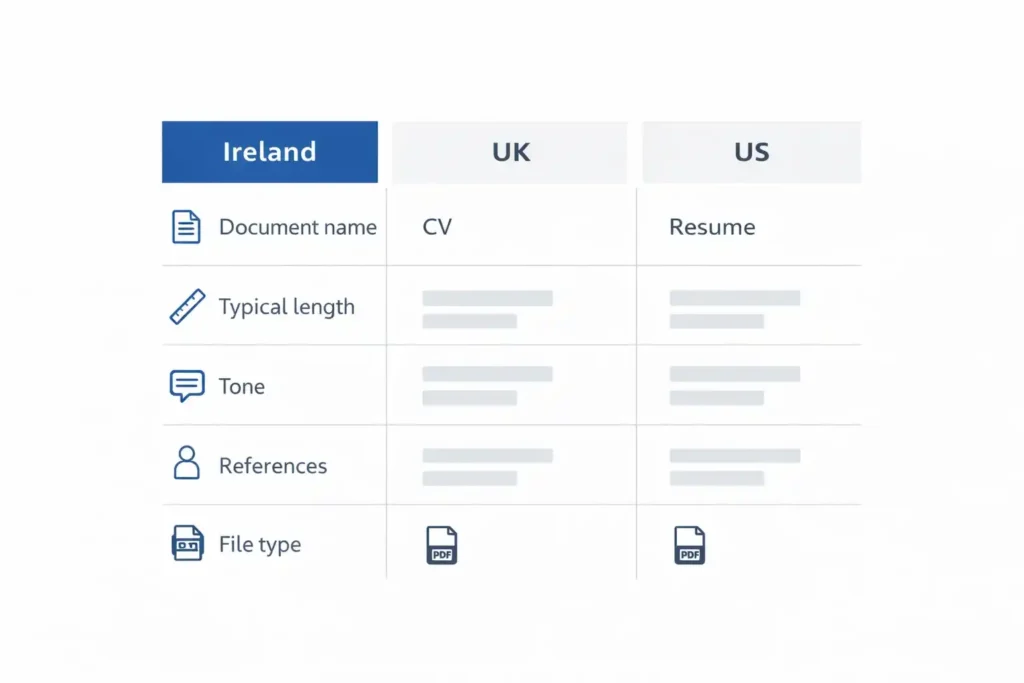
Most confusion comes from wording, not content.
- In Ireland and the UK, “CV” is the standard term for most job applications.
- In the US, “resume” is more common and is often shorter by convention.
If an Irish job advert says “resume”, don’t panic. In many cases they simply mean “CV” in plain language. Your priority is still clarity, relevance, and proof.
For a practical approach to tailoring without burning out, see the BHCVW job search strategy guidance.
How to write a CV in Ireland step by step
You don’t need a “brand new” CV for every role. Build a strong base document, then tailor the top third and your most relevant bullets.
Start with a target role line and a focused profile
UCC Career Services stresses that a CV should be targeted towards the sector/role you’re applying for.
A simple way to do that quickly:
- Target role line (one line): “Target role: Operations Coordinator (Dublin)”
- Profile (3–4 lines): who you are, what you deliver, and what you’re targeting next
Keep it specific. Skip generic claims like “hard-working team player” unless you immediately prove them.
If you want this done to a professional standard, start here: professional CV writing service.
Build a skills section that matches the job advert (without stuffing keywords)
A simple method that works well for Irish applications:
- Pull 8–12 skills directly from the job advert.
- Group them into 2–3 mini clusters, such as:
- Operations & scheduling
- Stakeholder communication
- Reporting & Excel / systems
This keeps your CV readable while still matching the employer’s language (UCC also advises mirroring employer language without copy/paste).
To align your CV and LinkedIn (and reduce mismatches recruiters notice), use LinkedIn profile writing.
Write achievement bullets (not responsibilities)
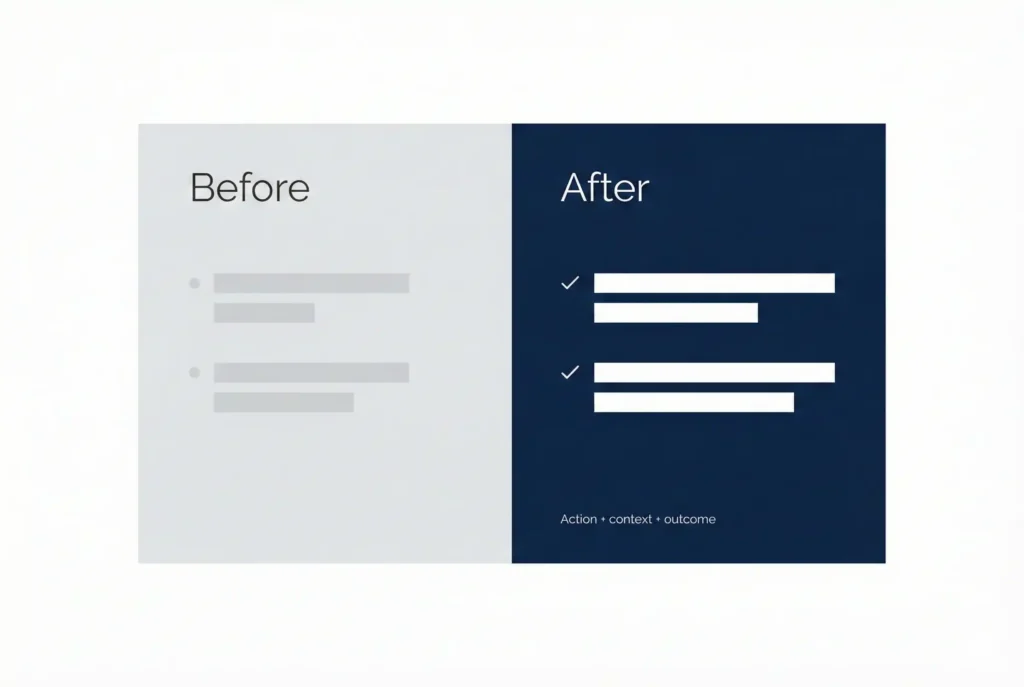
Use this structure:
- Action (what you did)
- Context (what it was for)
- Outcome (what improved)
Example you can adapt:
- Before (duty-led): Managed scheduling for the team.
- After (evidence-led): Managed weekly scheduling for a 12-person team, reducing rota clashes by keeping availability and leave records accurate.
You don’t need huge numbers. You need clear outcomes: fewer errors, faster turnaround, better service, smoother handovers, improved accuracy.
Include a cover letter when the advert asks for it
Citizens Information notes that if the job advert asks for it, you should write a cover letter or complete an application form (and tailor your CV/application to the role).
UCC also frames cover letters as part of a targeted application and recommends customising them per role.
Quick checklist: Ireland CV format essentials (save this)
- Clean layout, clear headings, bullet points (easy to skim)
- Targeted CV: role/sector language + relevant evidence
- Tailor before sending (match the job requirements)
- Export to PDF for electronic submission
Ireland CV sections explained (what to include and how to write each one)
A strong Ireland CV format is less about “fancy design” and more about fast understanding. Irish government-backed guidance is clear that your CV should give a clear summary of your education, work experience, achievements and abilities.
Use the sections below as your base. Then tailor the top third for each role.
Contact details and location (keep it simple)
Include:
- Name
- Mobile number
- Professional email
- Location (city/county is enough for most roles)
- LinkedIn URL (only if it’s up to date)
If you’re applying through online portals, use a clean file name so your CV is easy to find later. The University of Limerick also recommends using your own name in the file name (for example, FirstnameLastname_CV).
Want your CV and LinkedIn to match (so recruiters see a consistent story)? Consider LinkedIn profile writing.
Profile (3–4 lines that do real work)
Your profile should answer three questions quickly:
- What level are you?
- What’s your strongest evidence?
- What roles are you targeting in Ireland?
Avoid vague claims. UCC Career Services warns against jargon and buzzwords and pushes for a professional, targeted CV.
Example profile (credible and adaptable)
Operations professional with 6+ years’ experience supporting scheduling, reporting and stakeholder coordination across busy teams. Known for improving day-to-day processes, keeping data accurate, and communicating clearly with managers and customers. Now targeting Operations Coordinator or Team Support roles in Dublin, with strong Excel and workflow discipline.
If you’d like this rewritten to match a specific Irish job advert, use the free CV review.
Key skills (8–12 skills mapped to the advert)
Keep skills scannable. Group them into 2–3 clusters to help both recruiters and ATS:
- Operations support: scheduling, calendar management, rota planning, documentation
- Communication: stakeholder updates, customer queries, cross-team coordination
- Tools: Excel (pivots/VLOOKUP), CRM, Teams, Outlook
If you’re applying at senior level, your skills section must reflect scope (strategy, governance, transformation). That’s where executive CV writing service support can make a measurable difference.
Work experience (achievement-led, reverse-chronological)
JobsIreland’s guidance frames the CV as a clear summary of your experience and achievements.
So, lead with outcomes, not duties.
Use this structure under each role:
- One-line context (team size, pace, type of work)
- 3–6 bullet points (action + outcome)
- Tools/tech (if relevant)
Example experience entry (realistic, no fake companies)
Operations Assistant | Dublin | 2022–Present
Supported scheduling, reporting and customer coordination in a fast-paced services team.
- Coordinated weekly scheduling for a 12-person team, reducing rota clashes by keeping leave and availability records accurate.
- Produced a simple weekly tracker for open queries, improving response times by creating clearer ownership and follow-up.
- Liaised with internal stakeholders to confirm requirements and update timelines, reducing last-minute changes through clearer handovers.
- Maintained clean records in shared systems and files, improving accuracy and reducing time spent searching for information.
If your CV reads like a job description, it will blend in. For mid-level roles, the fastest upgrade is usually bullet quality, see professional CV writing service.
Education and training (clear, relevant, recent-first)
Include:
- Qualification, subject, institution, location
- Graduation year (or expected date)
- 1–2 relevant modules/projects (only if they strengthen your match)
For students and graduates, education often carries more weight early on. If you’re early-career, the graduate CV writing service is usually the best fit.
Volunteering and community experience (include it when it proves skills)
Volunteering is worth including when it demonstrates job-relevant strengths: responsibility, organisation, communication, reliability.
Write it like experience:
- Role, organisation and dates
- 2–4 bullets showing impact (what you did and the result)
Certifications, tools and languages (keep it employer-friendly)
Add short, skimmable lines for:
- Certifications (first aid, project training, compliance, industry-specific)
- Tools (Excel, Power BI, CRM, scheduling software)
- Languages (only include if you can use them confidently)
References (keep space for stronger evidence)
Unless a job advert explicitly asks for referees on the CV, keep it simple. Many Irish applications request references later in the process, so you can save the space for stronger evidence.
If you are asked for references, include:
- Name, title, organisation, relationship, email/phone (with permission)
What not to include on an Irish CV (common oversharing)
The University of Limerick is direct on this: don’t include your date of birth or a photo of yourself.
That advice keeps your CV more professional, more modern, and easier to scan.
Example CV structure for Ireland (copy this layout)
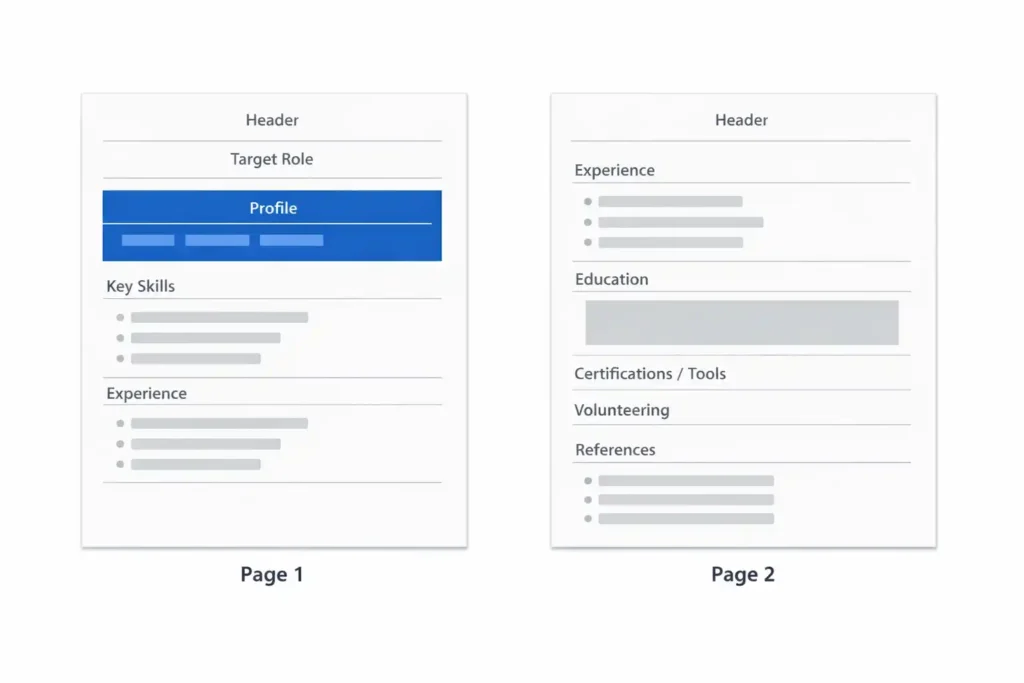
If you’re unsure what an “Irish CV format” looks like in practice, use the structure below. It keeps your CV easy to scan and aligns with what Irish guidance describes as the purpose of a CV: a clear summary of your education, experience, achievements and abilities.
Two-page Ireland CV structure (most experienced candidates)
Use this if you have 3+ years of relevant experience.
- Header: Name, phone, email, LinkedIn, location (city/county)
- Target role line: Target role: [Job Title]
- Profile (3–4 lines): Role level + niche + proof + target
- Key skills (8–12): Grouped into 2–3 clusters
- Selected achievements (optional): 3 bullets only (best for managers/executives)
- Work experience (reverse chronological):
- 1 context line + 3–6 achievement bullets per role
- Education & training (reverse chronological):
- Certifications / tools / languages:
- Volunteering / community (optional):
- References: “Available on request” (unless the advert asks)
If you’d like feedback on whether your sections are in the right order (and which parts recruiters will likely skim past), use my free CV review.
One-page Ireland CV structure (graduates and career changers)
This version works well when experience is limited, as long as it’s still evidence-led.
- Header + target role line
- Profile
- Key skills
- Education (with 2–4 relevant modules/projects)
- Projects (2–3 mini entries with outcomes)
- Work experience (even if part-time)
- Volunteering (if relevant)
- Tools / certifications
If you’re early-career and want a clean one-page document built around evidence, start with the graduate CV writing service.
Example bullet points that feel “real” (and work in Ireland)
These examples stay generic (no fake company names), but they’re written in the style that performs well: action + context + outcome.
Admin / Operations support
- Maintained accurate records across shared systems and spreadsheets, reducing time spent chasing missing information during weekly handovers.
- Coordinated diaries and meeting logistics for a small team, improving attendance by confirming agendas and sending clear reminders.
- Created a simple tracker for open customer queries, improving visibility and follow-up consistency.
Customer-facing / service roles
- Resolved customer issues calmly and professionally, escalating only when needed and recording outcomes clearly for the next contact.
- Improved response quality by using agreed templates and checking key details before replying.
- Supported busy periods by prioritising urgent requests and communicating realistic timelines.
Graduate / project experience
- Delivered a group project to deadline by splitting tasks clearly, tracking progress weekly, and presenting findings in a structured format.
- Analysed a dataset in Excel and summarised insights into practical recommendations, presenting key findings clearly and concisely.
If your CV currently lists duties without outcomes, it’s usually the biggest reason response rates stay low. That’s exactly what the professional CV writing service is designed to fix.
Irish CV templates and examples (without looking generic)
Templates can help, but only if they stay readable and ATS-safe. Irish guidance stresses clarity and professionalism, so avoid designs that sacrifice scannability for style.
ATS-safe template rules (quick and practical)
- Use standard headings: Profile, Key Skills, Experience, Education
- Avoid text boxes, graphics-heavy sidebars, and multi-column layouts if you’re applying through portals
- Use bullet points (not paragraphs) for experience
- Keep formatting consistent (dates, titles, spacing)
Here’s a simple “do/don’t” table you can use while choosing a template:
| Template choice | Do this | Avoid this |
|---|---|---|
| Layout | Single main column, clear headings | Two narrow columns that squeeze content |
| Typography | One readable font, consistent sizing | Multiple fonts and decorative styling |
| Skills | Keyword-matched skill clusters | Long keyword lists with no proof |
| Experience | Achievement bullets + outcomes | Duty lists that read like a job description |
| Design | White space + clean structure | Heavy graphics and icons everywhere |
How to create an “Ireland CV format PDF” (and avoid formatting issues)
When submitting electronically, Irish careers guidance often recommends sending your CV as a PDF to preserve layout.
Use this simple process:
- Finalise the Word/Google Docs version
- Export or “Save as PDF”
- Check it on your phone (quick test)
- Name it clearly: FirstnameLastname_CV.pdf (UL specifically recommends using your own name in the file name).
Also, don’t overshare personal data. UL guidance is direct: don’t include your date of birth or a photo.
Graduate CV format for Ireland (what to prioritise when experience is limited)
If you’re a graduate (or you’ve only had part-time roles), the Ireland CV format still works the same way: clear, tailored, and evidence-led. The difference is where your evidence comes from.
Citizens Information notes that most applications involve a CV or an online application form, and you should tailor your CV/application to match the job requirements. That advice matters even more early-career, because recruiters can’t “infer” your strengths from senior job titles yet.
If you want a graduate CV built around evidence (not filler), start with the graduate CV writing service.
What counts as experience in Ireland (yes, it’s more than “paid work”)
Use any of these if they prove job-relevant skills:
- Part-time work (retail, hospitality, admin, customer service)
- Academic projects (especially group projects with outputs)
- Placements / internships
- Volunteering and community roles
- Societies, committee roles, event support
- Independent projects (portfolio, coding, research, writing)
The key is to write them like real experience: action, context and outcome.
Here’s a quick “priority” guide:
| If you have… | Put this higher up | Why it works |
|---|---|---|
| A relevant internship/placement | Experience section (page 1) | Direct match to the role |
| Strong modules/projects but limited work | Projects section above part-time work | Shows evidence of skills and output |
| Lots of customer-facing part-time work | Experience section (page 1) | Proves reliability and communication |
| Volunteering with responsibility | Volunteering section (mid-page) | Ireland values it when it shows real skills |
Graduate CV structure example (one-page option that still looks professional)
This is a safe, scannable format for most graduate applications:
- Header: name, phone, email, LinkedIn, location (city/county)
- Target role line: Target role: Graduate Business Analyst
- Profile (3–4 lines): degree + strengths + proof + target role
- Key skills (8–12): grouped into 2–3 clusters
- Education (recent first): degree, year, 2–4 relevant modules/projects
- Projects (2–3 mini entries): outcome-based bullets
- Experience (part-time / internship): outcome bullets
- Volunteering (optional): if it strengthens your match
- Tools / certifications / languages
Before you send it, do a quick final check on file name and oversharing. UL Careers explicitly recommends using your own name as the file name and avoiding unnecessary personal details like date of birth or a photo.
If you’d like feedback on your structure and “top third” (the part recruiters scan first), use the free CV review.
Graduate bullet examples you can adapt
Project example (group work)
- Worked in a 4-person team to deliver a research project to deadline, splitting tasks clearly and tracking progress weekly.
- Analysed survey responses and summarised the findings into three practical recommendations, presenting them clearly in a final slide deck.
Part-time work example (customer-facing)
- Resolved customer queries calmly and accurately during busy periods, prioritising urgent issues and keeping records up to date.
- Supported training for new starters by sharing checklists and templates, improving consistency across shifts.
Admin support example (entry-level)
- Maintained accurate spreadsheets and shared files, reducing time spent searching for information during weekly handovers.
- Coordinated meeting logistics and agendas, ensuring materials were shared in advance and actions were captured clearly.
If your bullets still read like duties, that’s usually the fastest upgrade you can make. It’s also what the professional CV writing service focuses on: turning “responsibilities” into proof.
Secondary school student CV (Ireland): simple, credible, one page
If the query is “sample CV for secondary school students Ireland”, the goal is not to pretend you have experience you don’t have. It’s to show:
- reliability
- communication
- willingness to learn
- responsibility (even in small ways)
Simple one-page structure for school-leavers
- Header (name, phone, email, location)
- Short profile (2–3 lines): what you’re looking for + your strengths
- Education (Junior Cycle / Leaving Cert year and subjects if useful)
- Key skills (6–10, aligned to the role)
- Experience (any part-time, babysitting, family business help, etc.)
- Volunteering / activities (teams, clubs, helping at events)
- Awards / achievements (only if relevant)
- References (optional; often better to provide later)
Student bullet examples (realistic and safe)
- Helped organise a school event by welcoming visitors, answering questions politely, and keeping the area tidy and organised.
- Took responsibility for setting up and packing down equipment for weekly club meetings, ensuring everything was stored correctly.
- Completed a group project by dividing tasks clearly and presenting findings in an easy-to-follow format.
If you’re supporting a student applicant (or you want a graduate-ready structure that still feels simple), the graduate CV writing service is usually the closest match.
Public sector applications in Ireland (publicjobs.ie): when the form matters more than the CV
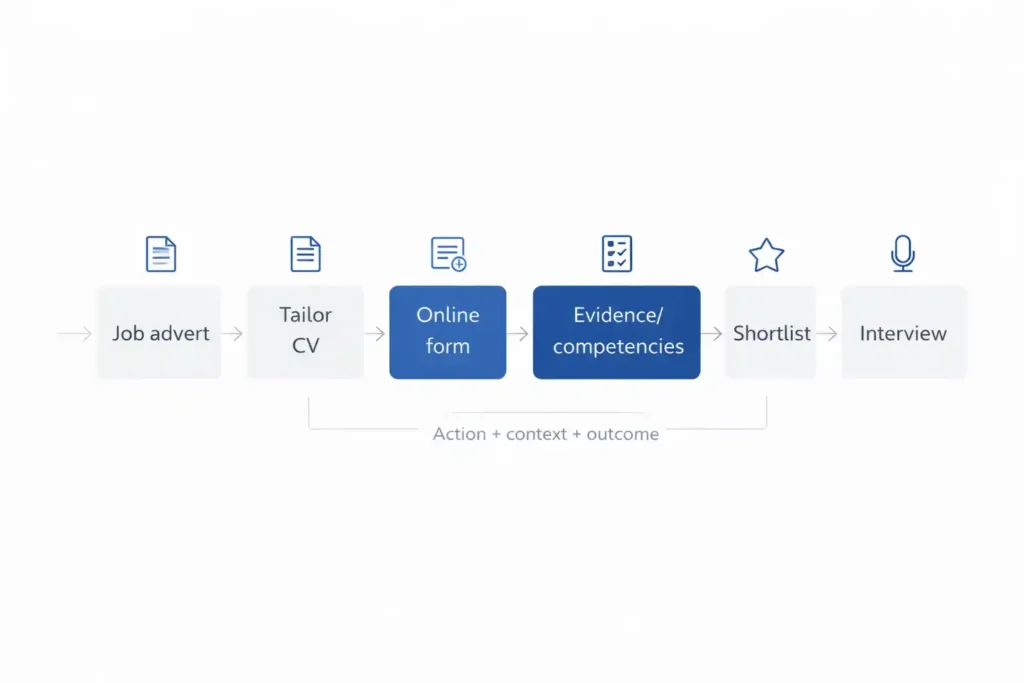
A lot of Irish public sector hiring runs through structured applications. publicjobs.ie is clear that the evidence you provide on the application form may be used for shortlisting and/or interview, and they advise you to proofread and save a copy before submitting.
So if you’re applying via publicjobs:
- Treat the form as the main assessment document.
- Reuse strong achievement bullets from your CV, but rewrite them to match the competency wording.
- Keep examples tight: action, context, outcome.
If you want help turning your evidence into interview-ready answers, see interview preparation.
Right to work in Ireland (what to write on your CV)
If you’re an international candidate, one short line can remove uncertainty for recruiters. Keep it factual and simple.
Ireland’s Department of Enterprise, Trade and Employment notes that most non-EEA nationals must hold a valid employment permit to work in Ireland (unless exempt). That’s why employers often look for clarity early in your CV. (DETE employment permits overview)
Add a single line in your header or profile (not a long paragraph). For example:
| Situation | CV wording example (copy/paste) |
|---|---|
| Irish/EU citizen | Right to work in Ireland: Irish/EU citizen |
| UK citizen with permission | Right to work in Ireland: permission held (details available on request) |
| Permit held | Right to work in Ireland: employment permit held |
| Permit in progress (be careful) | Right to work in Ireland: eligible for employment permit (in progress) |
| Uncertain | Right to work in Ireland: please advise if permit sponsorship is available |
If you’re unsure which wording is safest for your situation, use the free CV review and I’ll tell you what to change.
Common mistakes that stop Irish employers replying
Small issues can kill response rates, even when you’re qualified. Here are the ones I see most often on CVs for Ireland.
Making the CV hard to scan
- Dense paragraphs instead of bullets
- Too many headings, colours, or visual elements
- No clear “top third” (profile + skills + key evidence)
JobsIreland frames the CV as a clear summary of your education, work experience, achievements and abilities, so clarity is the priority.
Submitting the wrong file format
Formatting gets scrambled quickly when a CV is uploaded into portals or opened on different devices. UCC Career Services explicitly advises that if submitting electronically, you should send your CV as a PDF.
Oversharing personal information
This is a big one for candidates moving countries. University of Limerick Careers is direct: don’t include your date of birth or photos of yourself, and don’t overshare.
Using a generic profile and generic skills
If your profile could fit 100 different jobs, it won’t do much for you. Keep it targeted:
- Role level
- Niche/sector
- Evidence (what you’ve delivered)
- Target role/location
If you need help positioning yourself (especially if you’re moving into Ireland or switching sectors), start with a practical job search strategy plan.
Ignoring application forms (especially public sector)
For many public sector roles, the form isn’t a formality. publicjobs.ie states that the evidence you provide on the application form may be used for shortlisting and/or interview, and they advise you to proofread and save a copy before submitting.
If you’re applying to roles that are competency-led, your CV bullets should be “interview-ready” too. That’s where interview preparation can help.
Ireland CV checklist (before you click submit)
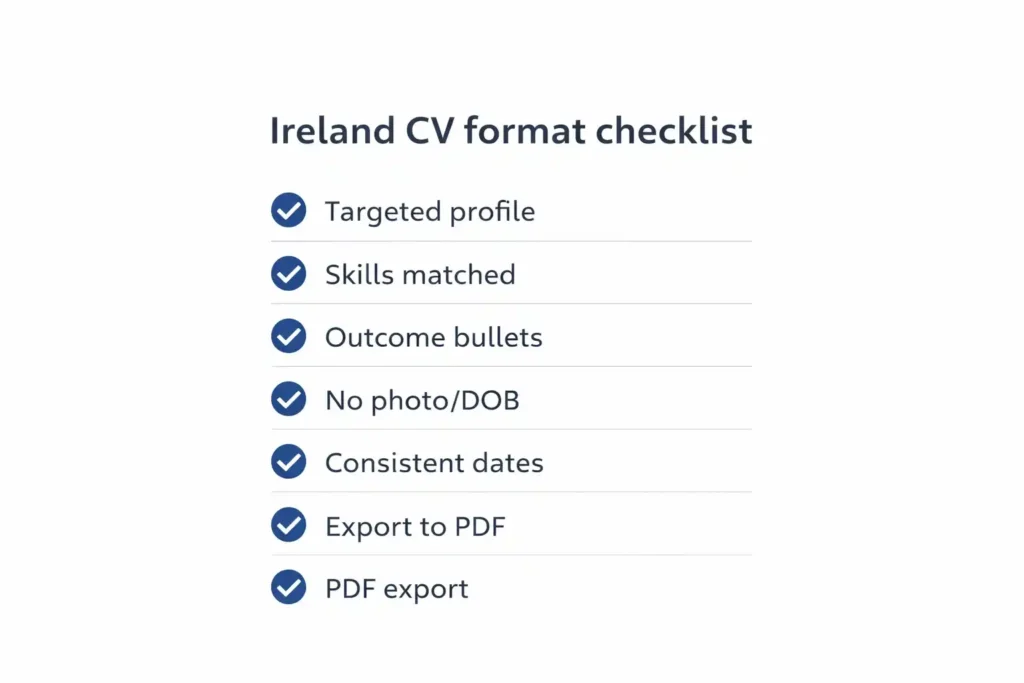
Run this checklist every time. It takes five minutes and saves you from avoidable rejections.
- My CV is 1–2 pages and easy to skim (clear headings, short bullets).
- My profile matches the role I’m applying for (not generic).
- My skills reflect the job advert (8–12 skills, grouped).
- My experience bullets show outcomes, not only responsibilities.
- I’ve removed oversharing (no DOB, no photo).
- I’ve proofread properly (spelling, dates, consistency).
- If submitting electronically, I’ve exported a clean PDF.
- If the advert asks for it, I’ve included a cover letter or completed the form carefully. Citizens Information notes this directly.
Get a free CV review (Ireland-focused feedback)
Before you apply, get a second opinion. I’ll review your CV for structure, targeting, and evidence, then tell you the fastest changes to improve response rates.
FAQs
What is the best Ireland CV format in 2026?
For most roles, use a clean, reverse-chronological CV with clear headings, short bullet points, and evidence-led achievements. Keep it easy to scan and tailor the top third (profile + skills) to the job. JobsIreland describes the goal simply: a CV should clearly summarise your education, experience, achievements and abilities.
How long should a CV be in Ireland?
Most candidates should aim for 1–2 pages. Two pages is fine if page two still adds relevant evidence (not filler). If you’re early-career, a strong one-page CV often performs better than a padded two-page version. (Maynooth guidance references “2 pages maximum”.)
Is it called a CV or resume in Ireland?
“CV” is the most common term. Some employers may say “resume” casually, especially in multinational environments, but they usually still expect a standard Irish/UK-style CV: clear, tailored, and evidence-led.
Should I include a photo on an Irish CV?
Usually, no. University of Limerick careers guidance advises not to include photos on your CV (and not to overshare personal information).
Should I include my date of birth on an Ireland CV?
Generally, no. Again, UL careers guidance is direct: don’t include your date of birth on your CV.
Do I need references on a CV in Ireland?
Not always. Unless the advert specifically asks for referees, you can keep it as “References available upon request” and provide details later. If you do include referees, make sure you have permission and keep it tidy (name, title, organisation, relationship, contact details).
Should I submit my Ireland CV as a PDF?
In most cases, yes, especially for email applications or uploads. UCC Career Services explicitly advises that if you submit electronically, you should send your CV as a PDF to preserve formatting. UCC CV and cover letter guidance.
How do I write a CV for Ireland with no Irish experience?
Focus on transferable evidence, not location. Use outcomes that prove you can do the work: reliability, process discipline, stakeholder communication, problem-solving. Also add one short line if you have the right to work in Ireland (where relevant). Citizens Information recommends researching the job and tailoring your CV/application to the requirements.
What should a graduate CV in Ireland include?
Keep it evidence-led and targeted. Put education + relevant projects higher up, use a tight skills section, and write bullets that show outputs (deadlines met, analysis completed, recommendations made). Avoid padding with long paragraphs. For a CV built around proof (not filler), see the graduate CV writing service.
What should a secondary school student CV in Ireland include?
A simple one-page structure works best: contact details, short profile, education, skills matched to the role, activities/volunteering, and any responsibilities that show reliability. Keep it honest and specific. If you want feedback on a student CV before it’s used for applications, start with the free CV review.
If you’re applying and not getting replies, don’t guess what’s wrong. The fastest fix is usually your top third (profile/skills) and the strength of your achievement bullets.
Start here: Get a free CV review.
Final thoughts: a CV that works in Ireland
If you take one thing from this guide, make it this: in Ireland, your CV needs to be easy to scan, clearly targeted, and evidence-led. A clean layout gets you read. Strong achievements get you shortlisted.
Here’s the simplest way to check your CV before you apply:
- Can a recruiter understand your target role in 10 seconds? (Target role line + focused profile)
- Do your bullets prove impact, not just activity? (Action + context + outcome)
- Does your skills section mirror the job advert without looking “stuffed”? (8–12 skills in clusters)
- Is your CV easy to submit and open? (Consistent formatting + PDF for electronic submission)
- Have you removed oversharing? (No photo, no date of birth)
If you do those things consistently, you’ll immediately stand out from most “default CVs”.
Which CV service is right for you (based on your level)
If you’re getting interviews already, you may only need small tweaks. If you’re applying and hearing nothing back, your structure, targeting, or bullet strength is usually the issue.
- Mid-career professionals who need a stronger, more targeted document: professional CV writing service
- Senior leaders and executives who need enterprise-level impact and positioning: executive CV writing service
- Students, graduates, and early-career candidates building credible evidence: graduate CV writing service
Job-searching actively? Pairing your CV with a repeatable approach helps. That’s why the job search strategy page often makes the difference between “spray and pray” and a controlled process.
A practical next step (before you send your next application)
Do this once, and you’ll be able to tailor your CV in minutes, not hours.
Create a master CV
- Keep all roles, projects, achievements, volunteering, and training in one document.
- Don’t worry about length in the master. It’s your “storage”.
Create your Ireland CV (the one you submit)
- Use the structure in the guide.
- Limit to 1–2 pages.
- Keep the top third targeted (profile + skills + most relevant evidence).
Tailor for each job
- Replace the target role line.
- Adjust the skills clusters to reflect the advert.
- Swap in 2–3 bullets that best match the role (don’t rewrite everything).
Export cleanly
- Save as a PDF for electronic submission where appropriate.
- Re-open the PDF and do a quick scan for spacing, missing characters, or odd formatting.
Get feedback before you apply
If you’re applying and not getting replies, don’t guess what’s wrong. The fastest improvement is usually your top third (profile/skills) and the strength of your achievement bullets.
Recent Comments