

A strong CV profile helps the reader understand who you are, what level you operate at, and what you could bring to the role within a few lines.
That sounds simple, but this is one of the most over-written parts of a UK CV. Too many profiles are full of vague claims, recycled buzzwords, and empty phrases such as “hard-working professional” or “excellent team player”. They take up valuable space without saying anything useful.
A better CV profile is short, specific, and evidence-led. It should give the employer a clear reason to keep reading. Whether you call it a CV profile, a personal profile CV, or a CV personal profile, the goal is the same: a short, evidence-led opening that earns a second look.
This guide explains what a CV profile is, when to use one, how long it should be, and how to write one that sounds credible rather than generic. I’ll also show you how this differs from a CV summary or personal statement, because those terms are often used interchangeably. If you are specifically trying to work out what to write in a CV summary, that guide goes deeper into the wording and content of summary-style openings.
Key takeaways
- A CV profile is the short opening section near the top of your CV that summarises your fit for the role.
- It should usually be around 3 to 6 lines, depending on your level and the relevance of your experience.
- The best CV profiles focus on relevance, evidence, and direction, not personality adjectives.
- In UK usage, CV profile, personal profile, and sometimes CV summary are often used to describe a similar section, but there are still useful distinctions.
- Not every CV needs one. If yours adds no value, it is better to skip it than fill space with clichés.
- Your profile should be tailored to the type of role you want, not copied unchanged into every application.
What a CV profile is
A CV profile is a short introductory paragraph placed near the top of your CV, usually just below your name and contact details. Its job is to give the recruiter or hiring manager a quick sense of your background, strengths, and professional direction before they move into your employment history.
Think of it as your positioning statement, not your life story.
In practical terms, a good CV profile answers a few immediate questions:
- What kind of candidate is this?
- What level are they operating at?
- What are they strongest in?
- Why are they relevant to this type of role?
For broader UK CV guidance, the National Careers Service guide to CV sections is a useful reference point.
A CV profile is not there to repeat obvious facts from the rest of the document. It is there to frame them.
For example, compare these two opening lines:
“I am a motivated individual with excellent communication skills and a passion for success.”
Versus:
“Project coordinator with three years’ experience supporting change, operations, and stakeholder communication in fast-paced professional-services environments.”
The second version tells the reader far more. It signals level, focus, and context. It sounds like a candidate with real experience rather than someone trying to sound employable.
That is the standard to aim for throughout this article.
CV profile vs CV summary vs personal statement
This is where a lot of people get tangled up.
In everyday CV advice, the terms CV profile, personal profile, professional profile, and CV summary are often used to describe broadly the same thing: a short section near the top of the CV that introduces you and highlights your relevance. That is one reason jobseekers often search for all of these terms interchangeably.
Even so, there are still some useful distinctions.
In most UK CVs, CV profile and personal profile are usually the safest labels for the opening paragraph. They suggest a concise, targeted overview of your professional background and strengths.
Whatever label you use, the CV profile section should do the same job: give the reader a fast, accurate sense of your level and relevance before they reach your employment history.
CV summary tends to imply a slightly more direct summary of experience, results, and focus. In practice, the writing may look very similar, but the intent often leans more towards “here is what I bring” than “here is who I am as a candidate”. If that is the exact angle you are working on, my guide on what to write in a CV summary goes into that in more detail.
Personal statement is the trickiest term. In CV conversations, some people use it as a synonym for profile. But in other contexts, especially academic or application-based ones, a personal statement can mean something more reflective, narrative, or motivation-led. That is one reason the label can create confusion. Prospects is a useful reference if you want to see how that overlap is discussed more broadly.
A simple way to think about it is this:
| Term | What it usually means on a UK CV | Where overlap happens | Best use here |
|---|---|---|---|
| CV profile | A short introduction at the top of the CV | Often overlaps with personal profile and summary | Main term for this guide |
| Personal profile | Very similar to CV profile | Often used interchangeably with CV profile | Also covered by this guide |
| CV summary | A concise summary of relevant background, strengths, and fit | Often overlaps with CV profile | Better treated as a closely related supporting topic |
| Personal statement | Sometimes used as another name for a CV profile, but can sound broader or more reflective | Overlaps heavily, but can mean something different in other contexts | Use carefully and define clearly |
The key point is not the label. The key point is the job the section is doing.
If the section is helping the employer understand your level, relevance, strengths, and direction in a few lines, you are in the right territory.
If it drifts into a personal essay, generic soft-skills list, or broad statement of ambition with no evidence behind it, it is probably doing the wrong job.
That is also why I would not get too hung up on whether your heading says Profile, Personal profile, or nothing at all. Many strong CVs do not use a heading for this section. What matters is that the content is sharp, relevant, and easy to scan.
For this article, I am treating CV profile as the main term because it is clear, practical, and widely understood. But the advice here is equally useful if you think of the section as your personal profile.
When you should use a CV profile, and when you can skip it
A CV profile is useful when it helps the reader understand your fit more quickly than the rest of the CV would on its own.
That is the real test.
In practice, a CV profile is often most useful when:
- you have relevant experience and want to position it clearly
- you are changing sector and need to connect transferable strengths to a new target role
- you have a mixed background and need to show the common thread
- you are applying for competitive roles where the opening lines need to do more work
- you want to signal level, specialism, or direction before the recruiter reaches your employment history
For example, someone with five years of operations experience moving into project coordination may benefit from a profile that quickly connects stakeholder communication, scheduling, reporting, and process improvement to the role they now want. Without that framing, the CV may look more scattered than it really is.
A profile can also help more experienced candidates. If you are applying for management, specialist, or leadership roles, the opening paragraph gives you a chance to signal scope, sector knowledge, and commercial relevance early. That is often far more useful than leaving the recruiter to piece it together line by line.
That said, you do not have to force a profile into every CV.
You can usually skip a CV profile if:
- it only repeats obvious facts from the rest of the CV
- it is full of vague claims such as “motivated”, “hard-working”, or “excellent communicator”
- you are very early in your career and the section adds no real evidence or direction
- your CV would be stronger using the space for education, projects, placements, or key skills instead
- you are writing a highly compressed one-page CV and every line needs to earn its place
If your version cannot quickly show why you are relevant, it is better omitted than padded.
So the decision is simple:
Use a CV profile when it helps the employer understand your relevance faster. Skip it when it is only there because you think a CV is supposed to have one.
A short, evidence-led profile can strengthen a CV. A generic one can weaken it.
How long a CV profile should be
In most cases, a CV profile should be around 3 to 6 lines.
That is usually enough space to show your level, your core relevance, and a few specifics that help the employer understand why you are worth reading further. A profile is meant to open the CV well, not dominate the first page.
For most candidates, the sweet spot looks something like this:
- Graduate or early-career candidate: 2 to 4 lines
- Professional with relevant experience: 3 to 5 lines
- Manager, specialist, or executive: 4 to 6 lines
The more senior you are, the more likely you are to need slightly more room, not because senior people should automatically write more, but because scope, industry context, leadership level, and commercial responsibility often need a little more explanation. Even then, the profile should still feel controlled.
A useful rule is this:
If your profile looks like a paragraph from a cover letter, it is probably too long.
If it only contains generic adjectives, it is probably too short on substance.
Length should be driven by relevance, not by habit.
For example, this is too long:
“A highly motivated, hard-working, enthusiastic and dedicated professional with a proven track record of working well both independently and as part of a team, now seeking a challenging opportunity within a progressive organisation where I can continue to develop my skills and contribute positively to the company’s long-term success.”
It takes a lot of words to say very little.
This is much better:
“Operations administrator with four years’ experience supporting scheduling, reporting, supplier coordination, and process improvement in fast-paced service environments. Strong track record of improving accuracy, keeping workflows on track, and supporting teams under pressure.”
The second version is not only shorter. It is clearer.
If you are struggling to cut your profile down, trim anything that falls into one of these categories:
- obvious filler
- broad personality claims
- repeated information from elsewhere on the CV
- career aims that say nothing specific
- unsupported superlatives
A recruiter should be able to read your profile quickly and move straight into the rest of the CV with a clear sense of who you are and what you bring.
A simple formula for writing a strong CV profile
A strong CV profile does not need to be clever. It needs to be clear.
The easiest way to write one is to build it from five parts:
Who you are + your level or context + your strongest relevant strengths + evidence + the value you offer
That sounds abstract, so here is the same formula in plain English:
[Job identity or professional level] with [experience, sector, or context], strong in [2–3 relevant strengths], with evidence of [results, scope, or credibility]. Brings [clear value aligned to the target role].
Some UK jobseekers call this opening paragraph a CV profile statement rather than a CV profile — the formula above works the same way whichever label you use.
This works because it forces you to move beyond empty adjectives and towards relevance.
Here is a simple example using the formula:
“Marketing executive with four years’ experience across content, email campaigns, and digital reporting in B2B environments. Strong in campaign coordination, copy development, and stakeholder liaison, with a track record of supporting lead-generation activity and improving content consistency. Brings a commercially aware, organised approach to fast-moving marketing teams.”
And here is a graduate-level version:
“Business and Management graduate with internship and part-time experience in customer service, administration, and team support. Strong in communication, organisation, and handling competing priorities, with practical exposure to client-facing work and day-to-day operations. Now seeking an entry-level role where these strengths can be applied in a structured professional environment.”
Notice what both examples avoid:
- no clichés like “hard-working professional”
- no first-person writing
- no vague career aim with no context
- no long list of soft skills detached from evidence
The formula is not there to make every profile sound the same. It is there to stop you rambling and help you include the right ingredients.
How to write a CV profile in 4 steps
Once you stop treating a CV profile as a piece of self-promotion and start treating it as a positioning tool, it becomes much easier to write.
The goal is not to sound impressive in a vague way. The goal is to help the employer understand your relevance quickly.
Here is a simple four-step process that works well for most UK CVs. If you’re wondering how to write a profile for a CV from a blank page, start with these four steps.
1. Start with your professional identity
Open with the clearest accurate description of who you are professionally.
That might be your current role, your target role, or a category that captures your level and focus. For example:
- Customer service adviser
- Graduate civil engineer
- Operations manager
- Finance administrator
- Marketing executive
If you are changing career direction, you do not need to pretend you already hold the target title. Instead, position yourself honestly using transferable context.
For example:
“Administrator with three years’ experience in education support, now targeting entry-level HR roles.”
That is far more credible than forcing a label that has not yet been earned.
2. Add relevant context
Next, give the reader a sense of where your experience sits.
This could include:
- years of experience
- sector exposure
- type of environment
- level of responsibility
- client or stakeholder context
For example:
“Project coordinator with four years’ experience supporting change and operations projects in regulated environments.”
That tells the reader much more than:
“Experienced project professional with a strong work ethic.”
Specific context improves credibility. It also helps recruiters decide more quickly whether your background is relevant to the role in front of them.
3. Choose two or three strengths that actually matter for the job
This is where many profiles go wrong. Candidates often list broad traits rather than job-relevant capabilities.
Avoid default phrases such as:
- hard-working
- motivated
- team player
- go-getter
- people person
Those words are not always false. They are just rarely useful.
Instead, identify two or three strengths that the target role genuinely requires. These should sound more like capabilities than personality labels.
Examples:
- stakeholder coordination
- client relationship management
- financial reporting
- scheduling and logistics
- process improvement
- data analysis
- bid support
- content creation
- complaint resolution
If you need help replacing empty language with stronger, more specific wording, my guide to CV power words can help you tighten the language without tipping into cliché.
4. Add evidence or value
This is the step that turns a weak profile into a strong one.
Once you have stated your level and strengths, show some proof. That proof does not have to be a major quantified achievement every time, but it should give the reader something more solid than assertion.
That could be:
- the kind of outcomes you support
- the scale or pace of the environment
- the type of work you are trusted with
- the value you bring to teams or clients
For example:
“Sales support coordinator with three years’ experience in fast-paced B2B environments, strong in account support, order processing, and client communication. Known for maintaining accuracy under pressure and helping keep customer relationships running smoothly.”
That profile works because it is grounded. It sounds like a real candidate with real experience.
As you draft, keep checking your wording against three simple questions:
- Is this specific?
- Is this relevant to the target role?
- Could I support this elsewhere on the CV?
If the answer to any of those is no, rewrite it.
The writing should also align with the rest of your CV. If your profile promises one thing and the employment history shows another, the document feels disjointed. That is also why broader CV structure still matters. If your layout, keyword use, or organisation is working against you, it is worth reviewing common ATS CV formatting mistakes in the UK so the profile sits within a document that is readable as a whole.
CV profile examples by level and situation

Examples are useful, but only if you read them the right way. These CV profile examples cover different levels and situations, so find the one closest to yours before adapting it.
Do not treat them as lines to copy into your own CV. Use them to understand the balance you are aiming for: level, relevance, strengths, and evidence. That is what makes a profile sound credible.
Below are example CV profiles for different stages and situations.
Graduate / early-career example
Recent Business Management graduate with internship and part-time customer-facing experience across administration, retail, and team support. Strong in communication, organisation, and handling competing priorities, with practical exposure to scheduling, customer queries, and day-to-day operations. Now seeking an entry-level role where these strengths can be applied in a structured professional environment.
Why it works:
- It does not pretend the candidate has years of experience.
- It uses real context rather than vague ambition.
- It shows readiness for work without overselling.
If you are earlier in your career and need help with the wider document, these CV examples for students will give you more complete guidance on how the profile fits into the rest of the CV.
Early-career professional example
Customer service adviser with two years’ experience handling high-volume enquiries, complaint resolution, and account support in fast-paced service environments. Strong in communication, problem-solving, and maintaining accuracy under pressure, with a track record of supporting positive customer outcomes. Now looking to bring these strengths into a more progression-focused client support role.
Why it works:
- It clearly states the current level.
- It includes relevant strengths for the next step.
- It hints at direction without becoming a generic career objective.
Career-change example
Administrator with three years’ experience in education support, strong in record-keeping, stakeholder communication, scheduling, and process coordination. Used to working accurately in busy environments and supporting multiple priorities at once. Now seeking to transfer these strengths into an entry-level HR or people-support role.
Why it works:
- It is honest about the current background.
- It translates transferable skills rather than forcing a new identity.
- It links the past to the target role in a believable way.
Professional / specialist example
Marketing executive with four years’ experience across content, email campaigns, reporting, and cross-functional coordination in B2B environments. Strong in campaign delivery, copy development, and stakeholder liaison, with experience supporting lead-generation activity and improving content consistency. Brings a commercially aware, organised approach to fast-moving marketing teams.
Why it works:
- It shows clear functional focus.
- It includes evidence of contribution without cramming in metrics unnecessarily.
- It sounds professional without using inflated language.
If you are already operating at this level and want expert help sharpening your positioning, the Professional CV Writing service is the most relevant support page.
Manager example
Operations manager with seven years’ experience leading teams, improving processes, and overseeing service delivery in deadline-driven environments. Strong in workflow management, stakeholder coordination, and performance improvement, with a track record of increasing efficiency and maintaining standards under pressure. Brings a practical, commercially aware leadership style focused on execution and consistency.
Why it works:
- It signals leadership level early.
- It focuses on operational value, not just responsibility.
- It stays concise while still sounding senior.
Executive example
Commercial leader with extensive experience driving operational performance, team leadership, and business growth across multi-site service environments. Strong in strategic planning, stakeholder management, and performance improvement, with accountability for revenue, operational standards, and cross-functional delivery. Brings a commercially focused leadership approach grounded in execution, people management, and sustainable growth.
Why it works:
- It sounds senior without becoming bloated.
- It focuses on scope and commercial relevance.
- It avoids turning the profile into a long executive biography.
If you are already operating at this level and want expert help sharpening this section, the Executive CV Writing service is the most relevant support page.
For additional external examples, the Indeed UK personal profile guide is a useful reference point.
Weak vs strong CV profile lines
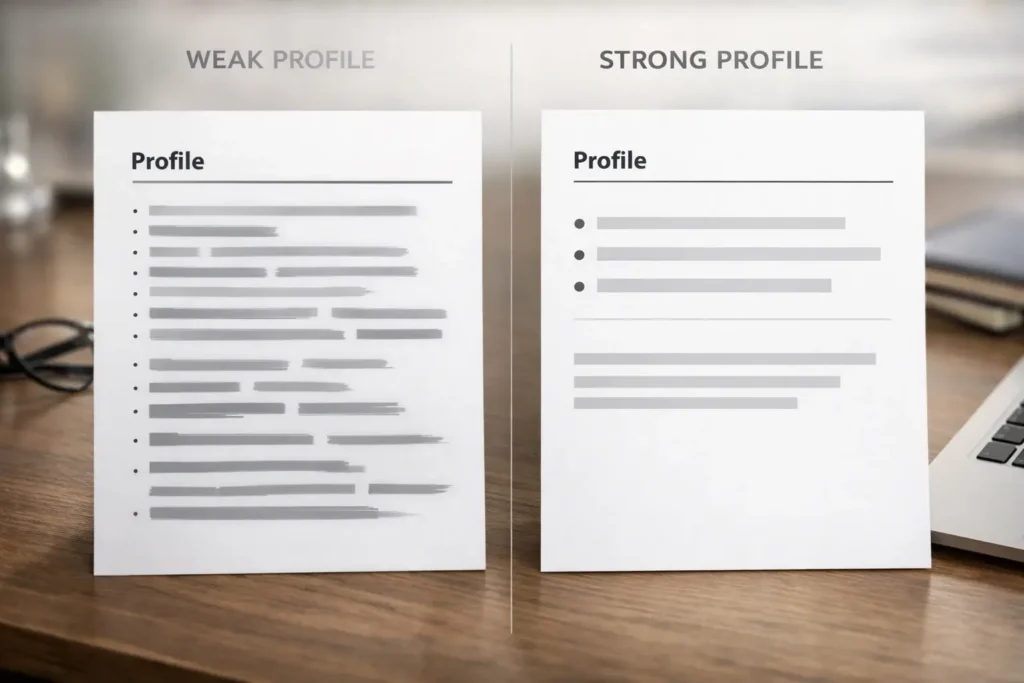
One of the quickest ways to improve a CV profile is to stop asking, “Does this sound professional?” and start asking, “Does this actually tell the employer anything useful?”
A weak profile usually relies on broad claims, empty adjectives, and generic ambition. It may sound polished at first glance, but it gives the recruiter very little to work with.
A stronger profile is more concrete. It gives a clearer sense of level, relevance, and value.
Here are a few examples.
Example 1: Generic opener
Weak
“I am a hard-working, motivated individual with excellent communication skills and a passion for success.”
Why it falls flat:
- It could apply to almost anyone.
- It uses personality claims instead of professional relevance.
- It gives no clue about level, background, or target role.
Stronger
“Customer service adviser with two years’ experience handling high-volume enquiries, complaint resolution, and account support in fast-paced environments. Strong in communication, problem-solving, and maintaining accuracy under pressure.”
Why it works:
- It states the candidate’s level clearly.
- It replaces vague claims with job-relevant strengths.
- It sounds more credible because it is grounded in real work.
Example 2: Empty career objective
Weak
“Seeking a challenging opportunity within a progressive organisation where I can develop my skills and make a positive contribution.”
Why it falls flat:
- It is employer-facing in the wrong way.
- It focuses on what the candidate wants, not what they offer.
- It says nothing specific about the role or the fit.
Stronger
“Administrative professional with experience in scheduling, document control, and stakeholder support across busy office environments. Brings strong organisational skills, attention to detail, and the ability to keep priorities moving smoothly.”
Why it works:
- It focuses on contribution rather than vague aspiration.
- It shows practical value.
- It gives the employer a reason to keep reading.
Example 3: Overwritten graduate profile
Weak
“A recent graduate with a strong academic background and a proven ability to work both independently and as part of a team, now looking to secure a position where I can grow and utilise my transferable skills.”
Why it falls flat:
- It leans on stock graduate language.
- “Transferable skills” is too broad on its own.
- It still does not explain what the candidate can actually do.
Stronger
“Recent Business Management graduate with internship and part-time experience in administration, retail, and customer-facing support. Strong in communication, organisation, and handling competing priorities, now seeking an entry-level business support role.”
Why it works:
- It sounds realistic.
- It uses evidence, even if the candidate is early-career.
- It connects background to direction more clearly.
Example 4: Buzzword-heavy manager profile
Weak
“Dynamic strategic leader with a results-driven mindset and a passion for excellence, innovation, and high-performance team culture.”
Why it falls flat:
- It is full of executive-sounding language but short on substance.
- It does not show scope, function, or evidence.
- It risks sounding inflated.
Stronger
“Operations manager with seven years’ experience leading teams, improving workflows, and overseeing service delivery in deadline-driven environments. Strong in process improvement, stakeholder coordination, and performance management, with a track record of maintaining standards under pressure.”
Why it works:
- It sounds senior without exaggeration.
- It gives the reader a clearer picture of what the manager actually does.
- It balances authority with specificity.
The pattern is consistent: weak profiles describe personality; strong profiles describe professional relevance.
That does not mean every profile needs numbers, jargon, or dramatic claims. It means the writing should earn trust quickly. If a line feels generic, rewrite it until it sounds like something only a candidate with your background could reasonably say.
That is also where stronger verb choice helps. If your wording still feels flat, this guide to CV power words can help you sharpen the language without slipping into cliché.
Common CV profile mistakes
A CV profile does not usually fail because the candidate has nothing to offer. It fails because the writing hides whatever is useful.
Most weak profiles follow the same patterns. Once you know what those patterns are, they become much easier to fix.
1. Using vague, over-familiar language
This is the most common problem by far.
Phrases such as “hard-working professional”, “excellent communicator”, “results-driven individual”, and “team player” are so widely used that they have lost most of their value. They do not help the employer understand what kind of candidate you are or why you are relevant.
That does not mean communication, reliability, or teamwork are unimportant. It means those qualities are more convincing when they are shown through context.
For example, instead of:
“A motivated team player with excellent communication skills”
write something closer to:
“Client support professional with experience handling complex enquiries, resolving issues, and maintaining service standards in fast-paced environments.”
The second version still implies communication and teamwork, but it does so through real work.
2. Writing a profile that could belong to anyone
A strong CV profile should sound like it belongs to you, or at least to someone with your kind of background.
If you remove your job title and industry context and the line still sounds generic, that is usually a warning sign.
For example:
“Seeking a challenging role in a progressive organisation”
could sit on thousands of CVs.
A better question is: what do you want the reader to know about your background within five seconds? That answer should shape the profile.
3. Repeating the rest of the CV without adding value
Some profiles simply list information that will immediately appear again in the employment history, skills section, or education section.
If your profile only says:
“Experienced administrator with skills in Microsoft Office, communication, and organisation”
and the rest of the CV then repeats those same points with no extra framing, the profile is not doing much work.
A better profile frames the rest of the CV. It helps the reader interpret what follows.
4. Making it too long
A profile is an introduction, not a cover letter paragraph.
Once it becomes a dense block of text, it starts working against readability. Recruiters tend to scan first, then decide whether to read more closely. A long, overwritten profile can make the CV feel heavy before the employer has even reached your experience.
If your opening section is drifting, cut anything that is:
- repetitive
- self-congratulatory
- vague
- not directly relevant to the target role
5. Overloading it with keywords unnaturally
Tailoring matters, and relevant keywords do matter, especially if your CV may be screened digitally. But a profile should still read like natural English.
If you cram in too many target terms, the writing starts to sound mechanical. That can make the CV harder to read and less persuasive. This is one reason broader structure still matters. If you are trying to make your CV more searchable without damaging readability, it is worth reviewing these common ATS CV formatting mistakes in the UK.
6. Saying things you cannot support
Your profile should match the evidence in the rest of the CV.
If you describe yourself as a strategic leader, commercial specialist, or high-performing change professional, the rest of the document needs to back that up. If it does not, the profile feels inflated.
A good rule is simple: if you cannot support the claim elsewhere on the CV, soften it or remove it.
7. Using the same profile for every application
Even a decent profile becomes weaker when it is reused unchanged across different roles.
The best profiles are tailored. That does not mean rewriting from scratch every time, but it does mean adjusting the wording, emphasis, and strengths so the opening lines match the role you are targeting.
A strong CV profile is not memorable because it sounds grand. It is memorable because it makes immediate sense.
Fix your CV profile in 10 minutes
If your current CV profile feels vague, over-written, or generic, you do not necessarily need to rewrite the whole CV. Often, you can improve the opening section quite quickly by tightening the wording and cutting what is not pulling its weight.
Use this checklist.
A 10-minute CV profile checklist
- Check the first line: does it clearly say what kind of candidate you are?
- Remove empty adjectives: cut phrases such as “hard-working”, “motivated”, and “results-driven” unless they are backed up by context.
- Add relevant context: include your level, sector, or type of experience.
- Keep only 2 to 3 core strengths: choose the ones most relevant to the role.
- Add proof: show value through scope, contribution, or evidence rather than broad claims.
- Cut repetition: remove anything already obvious elsewhere on the CV.
- Check the length: aim for roughly 3 to 6 lines in most cases.
- Tailor the wording: make sure the profile matches the role you are applying for now, not the one you applied for six months ago.
- Read it aloud: if it sounds stiff, inflated, or unnatural, rewrite it.
- Ask one final question: could this profile belong to anyone, or does it sound like a credible summary of your background?
A useful final test is this:
If you delete your name from the CV and read only the profile, does it still sound specific enough to place you in the right kind of role?
If the answer is no, the wording probably needs more substance.
A strong CV profile is not about sounding impressive. It is about making your relevance easy to understand.
If you have tightened the section as far as you can and it still feels weak, the issue may not be the profile alone. It may be the overall positioning of the CV. In that case, a full CV writing service review is often faster than continuing to rewrite the profile in isolation.
Need help strengthening your CV profile?
If you are struggling to make your CV profile sound clear, credible, and tailored to the roles you want, it may be worth getting a second opinion before you keep editing in circles.
A weak profile is often a symptom of a wider issue with positioning. The problem is not always the paragraph itself. Sometimes the CV is underselling your level, burying the strongest evidence, or presenting your experience in a way that does not align well with the market you are targeting.
If you want practical feedback on what is and is not working, you can request a Free CV Review. That is the best starting point if you want expert input before deciding on the next step.
If you already know you need more hands-on support refining the wording, structure, and positioning of the document as a whole, you can also look at the Professional CV Writing service.
Either way, the aim should be the same: a CV profile that feels specific, accurate, and convincing, not generic or overworked.
FAQs
What is a good CV profile?
A good CV profile is short, relevant, and specific. It should quickly show your level, the kind of work you do, and the strengths most relevant to the role, rather than relying on generic phrases or personality adjectives.
What is a personal profile on a CV?
A personal profile on a CV is the same short introductory section covered throughout this guide — usually 3 to 6 lines near the top of the CV that summarise your professional level, background, and key strengths before the reader reaches your work history.
Should every CV have a profile?
No. A CV profile is useful when it adds context and helps the reader understand your relevance faster, but it is not compulsory. If the section would only repeat obvious information, sound generic, or take space away from stronger content such as experience, education, or projects, it is usually better to leave it out.
How long should a CV profile be?
In most cases, around 3 to 6 lines is a sensible range. It should be long enough to establish your level, relevance, and a few strengths, but short enough to remain easy to scan.
Is a CV profile the same as a CV summary?
Often, yes in practice, but not always in emphasis. In UK job-search language, CV profile, personal profile, and CV summary are frequently used for the same short opening section at the top of the CV. The difference is usually more about nuance than structure: “CV summary” often leans slightly more towards summarising experience and value, while “CV profile” or “personal profile” is the broader term. If your main sticking point is the exact content to include, this guide on what to write in a CV summary is the more focused companion piece. The same wording is also often reused as the opening lines of a LinkedIn profile “About” section, so it is worth getting right once.
Should graduates include a CV profile?
Sometimes, but only if it adds value. For graduates and early-career candidates, a profile can help connect education, placements, part-time work, projects, and transferable strengths to the target role. But if it becomes a generic paragraph full of ambition and buzzwords, it is often better to use the space elsewhere.
Can I use the same CV profile for every job?
Usually not. You do not need to rewrite it from scratch every time, but you should adapt the emphasis, wording, and strengths so the profile fits the role you are applying for.
Should I call it “Profile”, “Personal profile”, or leave it untitled?
Any of those can work. In many UK CVs, the heading is either Profile, Personal profile, or omitted altogether. The content matters far more than the label. What matters is that the section is clear, concise, and doing a useful job for the reader. Some CVs also label it Profile Statement or simply About Me — all describe the same section.
Recent Comments