

If you’re searching for executive CV examples, you’re probably not looking for generic “CV tips”. You want to see what actually gets interviews at the director and C-suite level, and you want a structure you can use immediately.
In this guide, you’ll get:
- Executive CV examples (realistic, UK tone, outcome-led)
- A 2-page executive CV template (copy/paste layout)
- A practical approach to executive CV keywords (so your CV reads well and passes screening)
If you want quick, specific feedback before you apply, request a free CV review.
What counts as an “executive CV” in the UK?
In the UK hiring market, an executive CV isn’t just “a more senior CV”. It’s a positioning document with a clear job:
- It proves scope (size, complexity, accountability)
- It shows commercial impact (growth, savings, risk reduction, delivery)
- It signals leadership maturity (stakeholders, governance, influence)
- It targets a specific role family (not “open to opportunities”)
Most director-level CVs still perform best at two pages. The difference isn’t page count, it’s how quickly you make your level and value obvious.
If you’re not sure whether your CV currently reads “executive”, start with the free CV review.
Executive CV examples: what “good” looks like (UK director/C-suite)
Use these examples as patterns. They’re written in a UK tone: direct, factual, commercial.
Example 1: Operations Director / COO (turnaround & delivery)
Executive profile (short example):
Operations leader with 12+ years in multi-site delivery across manufacturing and logistics. Trusted to stabilise underperformance, improve margin, and strengthen service levels. Known for building high-accountability teams, fixing end-to-end process, and delivering measurable change at pace.
Achievement-led bullets (example):
- Led a 9-site operating model redesign, improving OTIF from 82% to 96% in 6 months while reducing agency dependency by £420k p.a.
- Delivered a cost-to-serve programme across warehousing and transport, cutting total logistics cost by 8.1% without service deterioration.
- Rebuilt performance cadence (KPIs, daily management, root cause routines), reducing backlog by 38% and improving safety near-miss reporting by 2.4x.
Why it works: it anchors scope (“9-site”), shows outcomes (OTIF, cost, backlog), and implies leadership systems — not just effort.
Example 2: Finance Director / CFO (controls & commercial outcomes)
Executive profile (short example):
Finance Director with experience in PE-backed and listed environments, combining robust controls with commercial partnership. Strong track record in cash, forecasting, and board-ready reporting, with a focus on scaling financial discipline during growth.
Achievement-led bullets (example):
- Implemented a rolling 13-week cashflow model and working-capital governance, improving cash conversion by 11 days and releasing £3.2m in 2 quarters.
- Reduced month-end close from 8 days to 4, improving reporting accuracy and enabling faster decision-making for the exec team.
- Led due diligence and finance workstream for an acquisition, integrating reporting and controls within 90 days post-close.
Why it works: it balances credibility (controls, governance) with value (cash released, faster decisions).
Example 3: Transformation Director (programme scale & measurable change)
Executive profile (short example):
Transformation leader specialising in operating model change, service redesign, and benefits realisation. Experienced in leading cross-functional programmes, aligning leadership teams, and translating strategy into measurable delivery.
Achievement-led bullets (example):
- Led a transformation portfolio across customer operations and digital, delivering £5.6m annualised benefit and reducing complaint volumes by 22%.
- Consolidated three teams into one operating model, improving SLA adherence from 71% to 93% while increasing employee engagement by +9 points.
- Built programme governance (RACI, RAID, benefits tracking), improving delivery predictability and reducing initiative slippage by 34%.
Why it works: it’s not vague “change leadership”, it’s benefit-led, operational, and governance-aware.
A quick note on “executive resume template” searches
You’ll see “executive resume template” because people use US terminology. In the UK, employers still expect a CV (typically no photo, no full address, and no personal details that add bias). This guide follows UK best practice while still working for international screening.
If you’d rather not wrestle with positioning and wording alone, here’s the executive CV writing service (writer-led, UK-rooted).
Executive CV template (UK, 2 pages): copy/paste structure
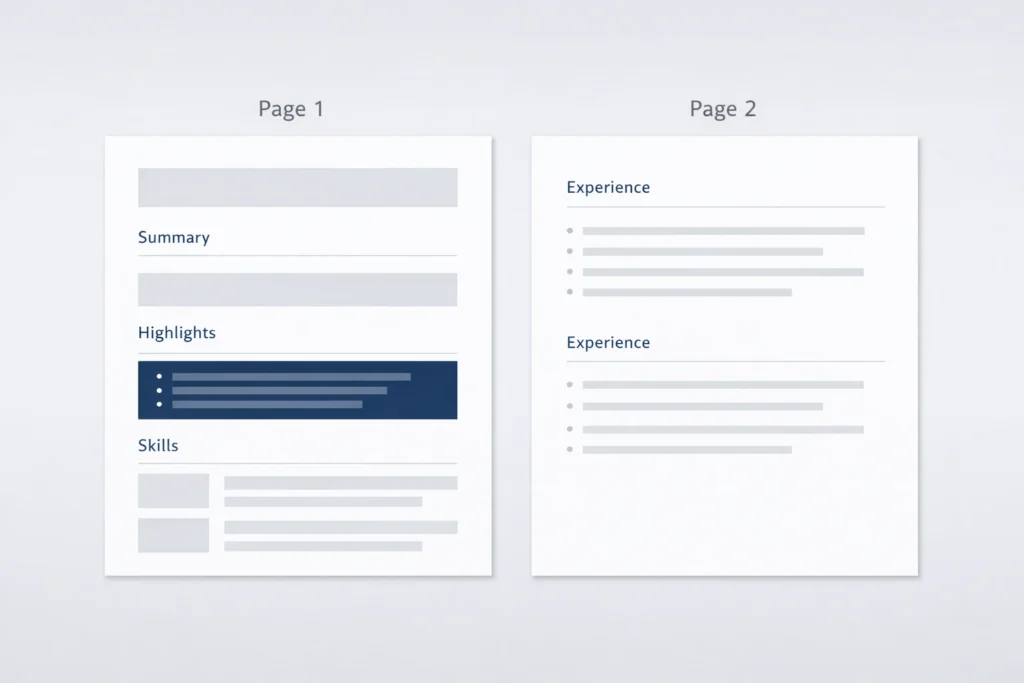
Use this as your starting point. Keep it ATS-safe, scannable, and evidence-led.
Page 1: Header & positioning
[NAME]
Target role (e.g., Operations Director | Commercial Director | Finance Director)
City, UK | Phone | Email | LinkedIn URL
EXECUTIVE SUMMARY (4–6 lines)
- Who you are and level (director / VP / C-suite)
- Your lane (function & environment)
- Your signature outcomes (growth, margin, transformation, delivery)
- Your leadership strengths (stakeholders, governance, building teams)
- The role family you’re targeting (keep it tight)
SELECTED HIGHLIGHTS (3–5 bullets)
- One line per proof point
- Include a number where possible
- Write these as your “screening bullets” — they need to land in 10 seconds
CORE SKILLS (keyword-friendly, grouped)
Group skills so it reads like a leadership profile, not a word dump. For example:
- Commercial: P&L, margin improvement, forecasting, pricing, cost-to-serve
- Leadership: stakeholder management, senior influence, operating cadence
- Delivery: transformation, operating model, governance, process redesign
Page 1 (bottom) & Page 2: Experience that proves scope
PROFESSIONAL EXPERIENCE
Company | Location — Job Title | Dates
One-line context: what the business is and scale (revenue, headcount, footprint)
Optional: brief remit line (what you owned)
Key achievements (4–6 bullets)
Start with outcomes. Then add the “how”. Avoid “responsible for” unless you follow it with proof.
Earlier roles / progression (if internal promotions)
Company | Titles | Dates
Use a short progression block so the reader sees growth without you rewriting your entire history.
EDUCATION & PROFESSIONAL DEVELOPMENT
Degree / qualification | Institution
Relevant exec programmes (keep it credible; don’t pad)
BOARD / ADVISORY / MEMBERSHIPS (optional but strong if true)
Board member, NED, advisory roles, committee work
OPTIONAL: Additional information
Languages, publications, speaking (only if it supports the target role)
Executive CV vs Senior Manager vs Professional CV (UK)
A lot of “executive CVs” underperform because they read like a strong senior manager CV, detailed, busy, but light on scale and outcomes.
| Feature | Professional CV | Senior Manager CV | Executive CV (Director/C-suite) |
|---|---|---|---|
| Primary goal | Show capability & fit | Prove leadership delivery | Prove strategic value & scope fast |
| Typical length (UK) | 1–2 pages | 2 pages | 2 pages (occasionally 3 for complex portfolios) |
| Tone | Competent & clear | Confident & results-led | Commercial, decisive, board-facing |
| Proof style | Tasks & wins | Ownership & outcomes | Outcomes plus scale, governance, stakeholders |
| Metrics | Nice-to-have | Expected | Non-negotiable (where possible) |
| Stakeholders | Team / manager level | Cross-functional & senior | Exec peers, board, investors, regulators, unions |
| Keyword density | Moderate | Higher | High, but natural and role-specific |
If you want a quick steer on where your CV currently sits, request a free CV review.
Executive CV keywords (UK): how to choose them and where to put them
Keywords matter at executive level for two reasons:
- Screening is still fast (human or software-assisted).
- Executives get judged on “signal”: commercial outcomes, scope, governance, stakeholder complexity.
Step 1: Build a keyword list from the right sources
Start with:
- 3–5 job descriptions for your target role
- The employer’s strategy language (priorities, operating model terms)
- Public materials where relevant (annual report / investor updates)
- 10–20 LinkedIn profiles of people doing the job (headlines & About)
Then group terms into clusters so your CV stays readable.
Example keyword clusters (executive-level):
- Commercial / growth: P&L, margin improvement, revenue growth, pricing, forecasting, cost-to-serve
- Transformation: operating model, change portfolio, benefits realisation, governance, TOM, process redesign
- Leadership / people: leadership cadence, capability building, succession, performance management
- Stakeholders: board reporting, investor relations, regulators, unions, strategic partners
- Risk / controls: compliance, audit, control environment, risk framework (where relevant)
Step 2: Place keywords where they do the most work
Put keywords in scanning zones, then prove them with outcomes.
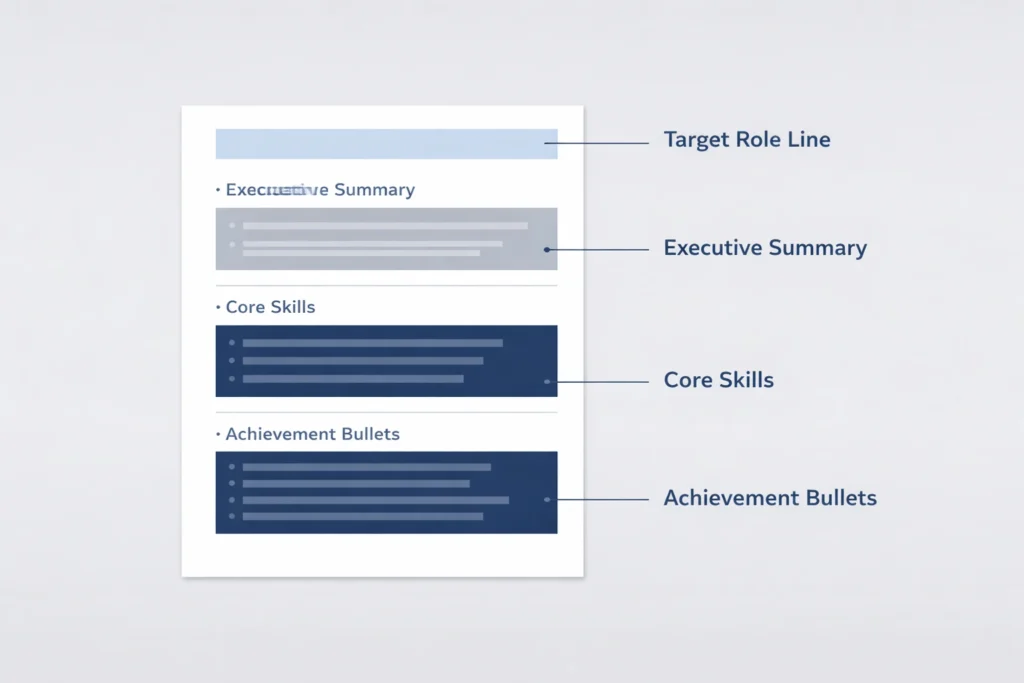
Best places for executive keywords:
- Target role line under your name
- Executive summary (2–3 role-defining phrases)
- Core skills (clustered)
- Role headers (one-line context under job title)
- Achievement bullets (the most credible place)
Avoid: hiding your best keywords only in a skills list. It looks like padding unless experience proves it.
Step 3: Align your CV and LinkedIn
At exec level, recruiters often check LinkedIn after scanning the CV. Make sure your headline, About section, and recent outcomes match.
If you want a sanity-check on keyword targeting and ATS-readability, start here: free CV review.
How to write an executive CV (step-by-step)
The executive version is simpler, but it demands sharper thinking.
- Pick a target role (or tight family of roles)
Otherwise your summary becomes bland and your keywords scatter. - Define your positioning in one sentence
Think: “I lead X in Y environment, delivering Z outcomes.” - Create 3–5 headline proof points
These become your “Selected Highlights”. - Write achievements using a consistent formula
Scope, action, result and proof. - Reduce detail, increase signal
Executives don’t win by listing tasks. They win by proving impact and leadership maturity. - Tailor the top third for each application
Usually: target line, summary, highlights and skills clusters.
If your application process needs tightening as well, this is the supporting hub: job-search strategy support.
Executive summary / personal profile examples (UK tone)
Your summary isn’t a “statement”. It’s a positioning tool.
Aim for 4–6 lines. Keep it factual. Avoid buzzwords unless you support them with proof immediately.
Summary template you can reuse
Executive leader with [X] years in [sector/type of organisation]. Known for delivering [2–3 outcomes]. Trusted by [board/PE/exec team] to lead [scope]. Strengths include [2–3 strengths] with a track record of [proof theme].
Example A: Board-ready, steady-state leadership
Executive leader with 15+ years in regulated and complex environments, building high-performing teams and strengthening delivery discipline. Proven in translating strategy into measurable outcomes across operations, customer service and governance. Trusted partner to exec teams and boards, with a track record improving performance, reducing risk and raising standards at scale.
Example B: Growth / scale / commercial focus
Commercially-minded director with experience scaling multi-site and multi-channel operations through disciplined execution and clear performance systems. Strong track record improving margin, increasing service performance and building leadership capability. Comfortable operating across exec stakeholders, using data-led decision making to deliver measurable results.
Example C: Transformation / turnaround
Transformation leader specialising in operating model change, service redesign and benefits realisation. Known for stabilising underperformance, aligning senior stakeholders and delivering change portfolios that improve cost, customer outcomes and delivery predictability. Brings strong governance, clear communication and pace.
If you want help choosing the strongest version for your target roles, request a free CV review.
Executive achievements: the formula that makes your CV credible
Most executives have strong experience. The difference is how clearly it’s evidenced.
Use this formula consistently:
Scope, Action, Result and Proof
- Scope: team size, budget, footprint, portfolio/programme scale
- Action: what you led, changed, built, negotiated, redesigned
- Result: what improved (growth, margin, delivery, risk, engagement, customer outcomes)
- Proof: numbers, timeframe, benchmark, KPIs
Generic: executive example
Too vague:
- Responsible for improving operational performance across multiple sites.
Executive-level:
- Led a 6-site performance programme, improving OTIF from 84% to 96% in 5 months and reducing premium freight spend by £310k p.a.
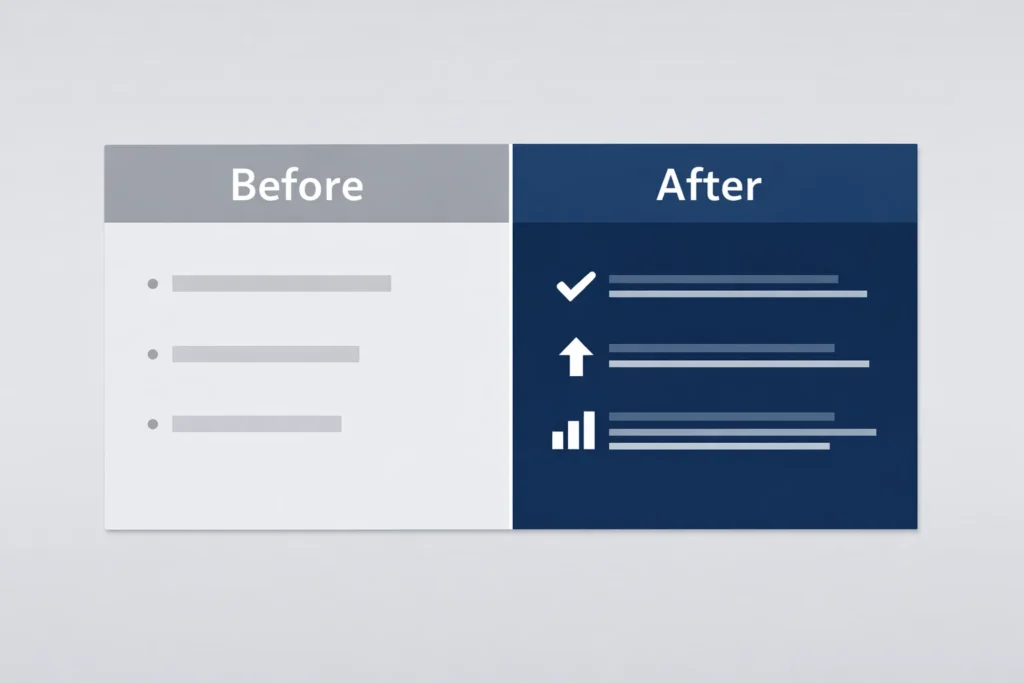
Before/after rewrites (responsibility & impact)
Use these as patterns.
Rewrite 1: “Strategic leadership”
Before: Provided strategic leadership to improve business performance.
After: Set and delivered a 12-month performance plan across [function], improving [metric] by X% and achieving £X benefit, governed through a weekly exec steering group.
Rewrite 2: “Stakeholder management”
Before: Managed key stakeholders across the organisation.
After: Partnered with COO, Finance and Sales to agree priorities and trade-offs, enabling delivery of [programme] on time and reducing escalations by X%.
Rewrite 3: “Cost reduction”
Before: Drove cost reduction initiatives across the department.
After: Delivered an £X cost-out programme across [area], reducing cost-to-serve by X% while keeping SLA performance above X%.
Rewrite 4: “Team leadership”
Before: Managed a high-performing team.
After: Led a team of X (including X direct reports), introducing clear performance routines and capability development, improving engagement by +X points and reducing regretted attrition by X%.
Rewrite 5: “Transformation”
Before: Led transformation projects to improve efficiency.
After: Led a transformation portfolio of £X across X initiatives, delivering £X annualised benefits and improving [SLA/complaints/cycle time] by X% through benefits tracking and governance.
Experience section: what to include (and what to cut) at executive level
Senior leaders often include too much operational detail and too little proof of scale.
Include (executive proof signals)
- A business context line under each role (scale and environment)
- Your scope (P&L/budget, team, regions, portfolio size)
- A short theme for the role (“turnaround”, “scale”, “stabilise”, “transform”)
- 4–6 achievements with measurable outcomes
- Governance / stakeholder complexity (only if true and relevant)
Cut or compress
- Long responsibility lists (keep 2–3 lines max)
- Generic claims without numbers (“strategic”, “innovative”, “results-driven”)
- Project lists with no outcomes
- Older roles written at the same length as recent roles
Handling internal promotions
If you’ve progressed in one organisation:
- Use one company header with brief context
- Show role progression (titles & dates)
- Put your strongest achievements under the most senior role
ATS-safe executive CV formatting (UK): keep it clean
Design doesn’t win interviews. Clarity does.
Do this
- Keep it two pages where possible
- Use a single-column layout
- Use standard headings: Executive Summary, Selected Highlights, Core Skills, Experience, Education
- Make dates easy to scan (month/year is fine)
- Put your best proof in the top third
Avoid this
- Text boxes, multi-column layouts, heavy graphics
- Icons that replace words
- Skill bars
- Dense paragraphs that hide outcomes
For feedback on format, keywords, and overall positioning: free CV review.
Common executive CV mistakes (that block interviews)
These are the problems that usually stop strong leaders getting shortlisted.
1) “Strategic” with no proof
If you say strategic, show the plan, the decisions, and the measurable change.
2) No scale (or scale is hidden)
At executive level, scale is selection criteria. Make it visible.
3) Responsibilities dominate; outcomes are too light
Keep responsibilities short. Make achievements do the heavy lifting.
4) Jargon clouds
Replace internal language with business language: margin, cost-to-serve, delivery performance, risk, customer outcomes.
5) Too broad (“open to opportunities”)
Generic positioning produces generic shortlists. Target a role family and tailor the top third.
If you’re getting interviews but not offers, use: interview preparation support.
FAQs
How long should an executive CV be in the UK?
Most executive CVs should be two pages. Move to three only when your scope is genuinely complex and you keep it evidence-led.
What should an executive CV include that a senior manager CV doesn’t?
Clear scale, governance, and commercial outcomes: P&L/budget, stakeholder complexity, strategic delivery, and leadership systems that drive results.
Do I need an executive summary on my executive CV?
Yes. It’s your positioning tool. Keep it factual, then back it up with proof in Selected Highlights.
What are the best executive CV keywords?
The best keywords come from multiple job descriptions for your target role, plus the employer’s strategy language. Then prove them in achievements.
Where should keywords go on an executive CV?
Use keywords in the target role line, executive summary, core skills, and achievement bullets. Avoid keyword dumping.
Should an executive CV be ATS-friendly?
Yes. Even senior roles often go through ATS or internal systems. Keep the format simple and readable.
Do I need a cover letter for executive roles in the UK?
Sometimes. It helps when the move needs context (sector change, step-up, non-linear path). See: cover letter writing tips.
Should my LinkedIn match my executive CV?
Yes. Recruiters often cross-reference. Support here: LinkedIn profile writing.
What if I don’t have strong metrics?
Use operational measures (cycle time, quality, throughput), delivery performance, customer metrics, engagement scores, budget ranges, and scale indicators (sites, regions, headcount).
Can I use a template and still stand out as an executive?
Yes. At this level, your advantage comes from positioning and evidence, not design.
2026 UK hiring context (keep it grounded)
If you want a quick snapshot of the broader backdrop, these are solid references:
- CIPD Labour Market Outlook (latest) for employer sentiment and hiring intentions
- ONS Labour market overview (latest) for official UK labour market indicators
- Korn Ferry on AI in recruiting for how screening and recruitment workflows are evolving
Use these as context, not as an excuse to go vague. In a tighter market, clarity and proof matter even more.
Next steps
If you’ve read this and thought, “Mine doesn’t look like that yet,” keep the next move simple:
- Request a free CV review (format, keywords, positioning)
- Want director/C-suite positioning and writing support? Executive CV writing service
- #Need broader support at a different level? Professional CV writing service
- Want to talk it through? Book an introductory call
Recent Comments