
Summary
Brendan Hope CV Writing has published updated UK guidance for senior professionals, directors and executives applying in the UK. The message is simple: executive CVs perform better when they make seniority easy to place at a glance — by leading with scope, outcomes and leadership proof, rather than long lists of responsibilities.
GRANTHAM, LINCOLNSHIRE, UK — Senior jobseekers rarely struggle because they lack experience. More often, they struggle because their CV doesn’t communicate their level at speed.
Recruiters and hiring panels typically scan page one to answer five questions quickly, including:
• what level you’re operating at
• the size, scope and complexity you’ve owned
• what changed as a result of your leadership
• how closely your experience matches the priorities and language of the role
• whether you come across as credible, consistent and easy to shortlist
When those answers are hard to find, even strong candidates can be overlooked, not because they aren’t capable, but because the document is “busy but unclear”.
Brendan Hope CV Writing has published updated UK guidance for executive and director-level CVs to help senior professionals present their experience in a way that reads fast and signals leadership impact clearly.
Why executive CVs get overlooked (even with strong experience)
A common pattern in underperforming executive CVs is an overload of activity and an under-supply of clarity. Many senior CVs read like job descriptions: long responsibility lists with limited outcomes, weak scope, and leadership claims without evidence.
Typical issues include:
• Long lists of responsibilities with little evidence of outcomes
• Unclear scope (team size, budgets, geography, portfolio, transformation scale)
• Mixed seniority signals (too tactical, not strategic enough)
• Leadership claims without proof (stakeholders, governance, decision-making)
• Achievements that are vague, unquantified, or hard to validate in interview
• Weak first pages that bury the value
At senior level, detail is not the differentiator. Clarity is.
Key insights: what improves executive CV shortlisting fastest
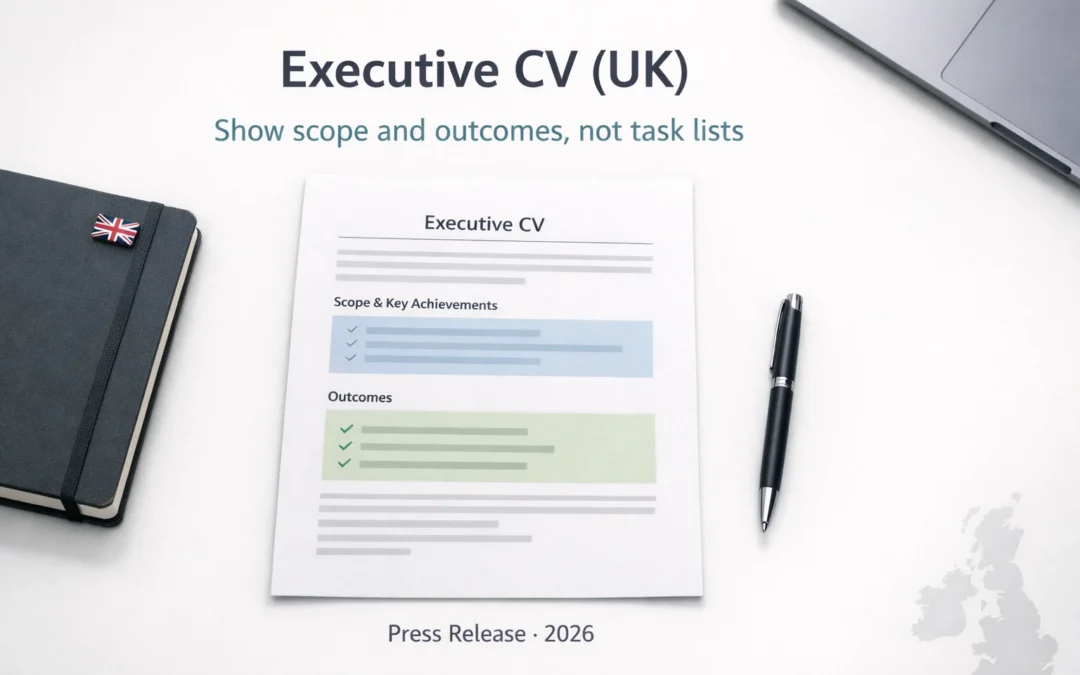
Lead with scope so your level is obvious
Scope is context. It helps recruiters place you quickly. Depending on what’s appropriate to share, scope can include team size, budgets, regions, portfolio complexity, operational footprint, transformation scale, regulated environments, risk accountability, or revenue ownership.
Prioritise outcomes over activity
Recruiters want the “so what”. What improved? changed? moved? Risk reduced? And what growth was delivered? Outcomes can be measurable (cost, time, margin, revenue) or specific and defensible (stabilised performance, improved audit outcomes, reduced delivery delays, strengthened governance).
Make leadership proof visible
Leadership proof is what separates senior candidates. It shows how you influenced decisions, led through others, and operated at the right level: stakeholder influence, governance, operating model change, capability building, and delivery through teams and partners.
Build a CV that scans fast under pressure
A clean structure and strong first page usually outperform clever design and dense text. Executive shortlisting is often time-constrained, so readability matters.
Tailor through prioritisation, not expansion
Tailoring doesn’t mean adding more. It means elevating the most relevant proof so your CV mirrors the role’s priorities and language.
Clear definitions for executive CVs (UK)
What is an “executive CV” in the UK?
An executive CV is a senior-level CV used for Head of, Director, VP and C-suite roles. It focuses on leadership scope, strategic outcomes and evidence of influence, rather than listing every responsibility.
What does “scope” mean on an executive CV?
Scope is the context that makes your seniority obvious. It shows what you owned, how big, how complex, and at what decision level you operated.
What counts as “leadership proof”?
Leadership proof shows how you operated at a senior level: stakeholder influence, governance, decision-making, operating model changes, people leadership, risk management, and outcomes delivered through others, not just personal output.
What do “outcomes” look like if you can’t share numbers?
Numbers help, but outcomes don’t need to be “stats-only”. Outcomes can be specific, credible changes such as:
• improved sign-off speed by changing governance
• stabilised delivery by fixing planning and dependencies
• improved audit outcomes by tightening controls
• reduced operational risk by redesigning processes
• improved customer retention by enhancing service performance
The key is clarity and defensibility.
Practical advice: the “scope first” executive CV blueprint (UK)
The goal is a document that places level quickly and makes value easy to scan.
1) Start with a leadership headline and target role level
Make your level unmistakable and align the document to the role family you’re pursuing (e.g., Operations Director, Transformation Leader, Marketing Director). Avoid vague labels.
2) Write a short executive profile (4–6 lines)
Plain-spoken summary of your leadership domain, your operating style, and two to three proof points that demonstrate outcomes.
3) Add “Scope at a glance” near the top
Use a compact block to show the context. Examples (choose what applies): teams, budgets, regions, portfolios, transformation scale, regulated environment, risk/compliance scope, key stakeholders, supplier/partner landscape.
4) Use a focused leadership strengths section
Avoid generic skill lists. Choose strengths you can evidence later (commercial judgement, stakeholder influence, operating model design, governance, transformation delivery, talent development).
5) Experience: lead with outcomes, not duties
For each role, keep it tight (often 4–6 bullets). Start with the highest-value outcomes and include scope where it helps.
Recommended bullet format: Action + scope + result
Example (format only): “Led X across Y scope, delivering Z outcome.”
6) Make achievements defensible
Where you can quantify, do. Where you can’t, be specific about what changed and why it mattered. Use language that would stand up in interview.
7) Tighten supporting sections
Education, certifications, board/committee work and affiliations should be clear and concise. Remove content that adds noise or confuses seniority.
Common mistakes to avoid (executive CVs)
• Overloading the first page with dense paragraphs
• Writing a profile that sounds generic (or reads like a job advert)
• Listing responsibilities without outcomes
• Using senior-sounding words without concrete proof
• Mixing tactical detail with no strategic thread
• Hiding scale and accountability
• Using formatting that makes the CV harder to scan
Expert quote
“Recruiters don’t need every task, they need a leadership record they can place in seconds,” says Brendan Hope, founder of Brendan Hope CV Writing. “When you lead with scope and outcomes, then show leadership proof, you stop looking ‘busy’ and start looking accountable. That clarity is what gets you shortlisted.”
Read the executive CV guide (UK)
For executive CV examples, structure guidance, and practical writing principles, see:
https://brendanhope.com/blog/executive-cv-writing-guide/
Call to action: request a free CV review
Senior professionals can request a free CV review to check clarity, seniority signals, and leadership proof:
https://brendanhope.com/free-cv-review/
Optional support for executive-level CV writing:
https://brendanhope.com/cv-services/cv-writing-service/executive/
About Brendan Hope CV Writing
Brendan Hope CV Writing is a UK-focused, human-led CV and career support service helping jobseekers from graduates to senior leaders present their experience with clarity, credibility and results. Services include CV writing, cover letters, LinkedIn profile optimisation, job-search strategy coaching and interview preparation. The recommended first step for most candidates is a Free CV Review to identify quick wins and the most suitable level of support.
Recent Comments