

A strong director CV does not just show that you have managed teams or held a senior title. It needs to make your level obvious quickly. That means showing the size of what you lead, the commercial outcomes you influence, the stakeholders you work with, and the judgement you bring when the business needs direction rather than supervision.
That is where many director CVs fall short. They read like polished senior manager CVs: long on responsibilities, light on scale, and unclear on impact. If you are targeting director-level roles in the UK, your CV needs to signal authority, credibility and relevance within the first few seconds.
This guide will show you how to do that. You will see how to structure a director CV, what recruiters scan first, how to strengthen your profile, and how to turn vague leadership claims into evidence-led achievements. If you want specific feedback on your own draft before you apply, you can request a Free CV Review.
Director CV: key takeaways
- A strong director CV shows scope, commercial impact, leadership credibility, governance awareness and stakeholder influence.
- Your title alone is not enough. Recruiters want fast evidence of scale, accountability and outcomes.
- The strongest director CVs are achievement-led, not duty-led.
- Page one should make your level clear through your profile, key skills and the first part of your experience section.
- Generic phrases such as “results-driven leader” carry very little weight unless backed by numbers, complexity or strategic outcomes.
- For UK roles, it often helps to show evidence of board reporting, risk ownership, transformation, cross-functional leadership or P&L responsibility, where relevant.
- Your format should stay clean and ATS-safe. Substance matters far more than design flourishes.
What makes a strong director CV in the UK?
A strong director CV is a CV that makes seniority believable.
That sounds obvious, but it is the real test. At director level, employers are not only looking for experience. They are looking for proof that you can operate at the level where decisions affect performance, risk, people, reputation and direction.
In practice, that usually means your CV should answer five questions quickly:
Five CV Questions to Answer
- What level have you operated at?
Have you led a function, division, region, business unit or multi-site operation? Have you reported into the board, CEO, MD or executive team? - What commercial value have you created or protected?
This could include revenue growth, margin improvement, cost reduction, turnaround work, contract wins, operational improvement, service performance or strategic delivery. - What complexity have you handled?
Strong director CVs show more than line management. They show complexity: restructures, acquisitions, transformation programmes, regulated environments, large budgets, difficult stakeholders or competing priorities. - What decisions have you owned?
Director-level CVs should reflect judgement and accountability, not just execution. Depending on the role, that may include governance, risk, compliance, board reporting or broader business leadership. If your target roles genuinely involve statutory or governance-facing responsibility, it is sensible to understand the wider context of directors’ duties in the UK. - Why are you credible for this next move?
Your CV needs a clear story. It should help the reader see not only what you have done, but why your background fits the director role you are targeting now.
This is also where a director CV differs from a broader executive CV. A general executive guide may cover everything from senior leadership through to C-suite positioning. This page is narrower. It is about how to present yourself specifically for director-level opportunities. If you need a wider view of senior executive positioning, read the Executive CV Writing Guide.
The strongest director CVs also avoid a common mistake: they do not try to sound senior by becoming vague. Real authority on a CV comes from clarity. A good director CV names the scale, shows the outcomes, and makes the reader trust that you have operated close enough to strategic decision-making to justify the level you are targeting.
What recruiters scan first on a director CV
At director level, your CV is not read in a slow, linear way on first pass. It is scanned for signals of level.
That means a recruiter, hiring manager or internal talent lead is usually asking a small set of fast questions:
1. Does this person look like a genuine director candidate?
Your title helps, but it is not enough on its own. A recruiter will look for evidence that your remit matches the level.
That might include:
- ownership of a function, region, division or business unit
- responsibility for a sizeable budget, revenue line or cost base
- leadership of senior teams or cross-functional departments
- exposure to board reporting, executive stakeholders or investors
- accountability for strategy, performance, risk or transformation
This is why weak director CVs often underperform. They may list impressive responsibilities, but they do not make the level visible quickly enough.
2. Is the top third of the CV doing enough work?
The top third matters disproportionately.
Before the reader gets deep into your employment history, they are usually looking at four things:
- your headline or target positioning
- your profile
- your core skills or key strengths
- the opening lines of your most recent role
Those elements should make your operating level and value proposition clear. If the top of your CV is vague, the rest of the document has to work too hard.
A strong director profile usually signals three things early:
- what you lead
- what outcomes you influence
- what context you do it in
For example, “Board-facing Operations Director leading multi-site service delivery across regulated environments” lands more clearly than “Results-driven senior leader with extensive management experience”.
If you want a broader view of how senior candidates should lead with evidence rather than task lists, see Executive CV UK: show scope and outcomes, not task lists.
3. Is there clear commercial or organisational impact?
At director level, the reader is rarely impressed by activity alone.
They are looking for signals such as:
- revenue growth
- margin improvement
- cost reduction
- turnaround delivery
- contract wins
- efficiency gains
- service improvement
- transformation outcomes
- risk reduction
- team or function performance uplift
Even in roles that are not overtly commercial, there still needs to be visible value. That value may be operational, strategic, regulatory, reputational or service-led.
4. Does the CV show complexity, not just seniority language?
Many director CVs sound senior without proving complexity.
Recruiters will look for clues that you have handled environments where judgement matters. That could include:
- multi-site or international operations
- restructuring or post-merger integration
- board-level reporting
- regulated or high-risk environments
- difficult stakeholder landscapes
- major change programmes
- underperforming functions that needed stabilising
- leadership across multiple disciplines
In other words, they are scanning for evidence that you have operated where trade-offs, pressure and accountability are real.
5. Is this CV targeted to the role, or just generally senior?
This is where strong director candidates often separate themselves.
A broad, generic senior CV may sound polished, but it will not always shortlist well. A better director CV aligns the evidence to the role family. An operations director CV should show service delivery, productivity, process improvement and operational control. A commercial director CV should show growth, client strategy, market expansion and commercial performance. A finance director CV should show financial leadership, controls, reporting, planning and business support.
That does not mean rewriting the entire document for every application. It means making sure the most relevant evidence is easy to spot.
A recruiter should not have to infer your fit. Your CV should do that work for them.
Director CV structure (copy-and-adapt template)
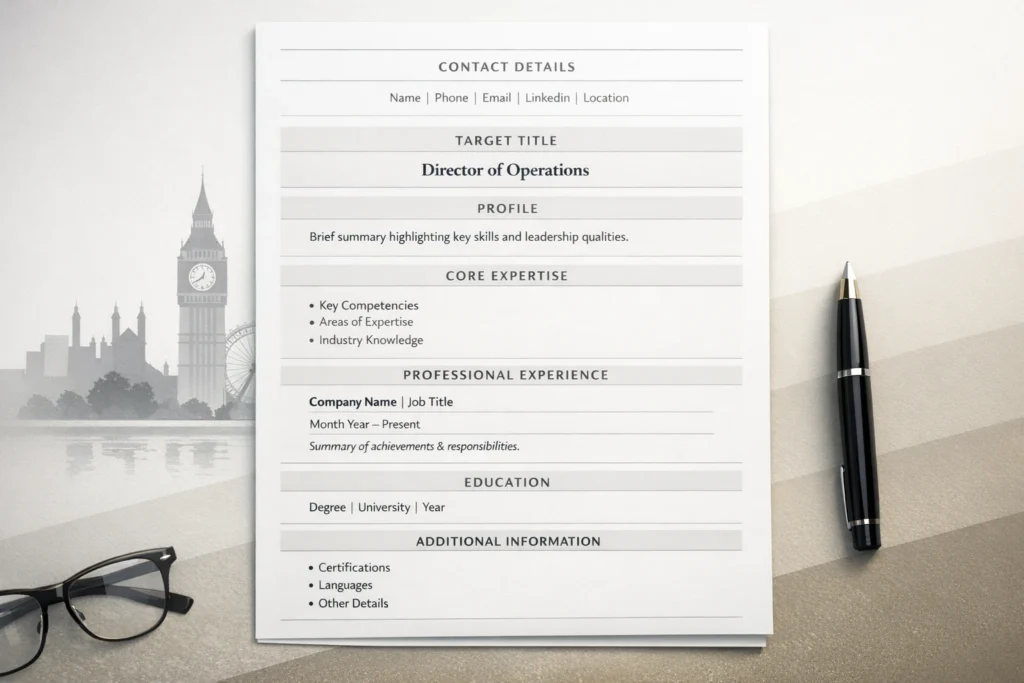
A director CV should feel focused, commercially credible and easy to scan.
That does not mean it needs to look flashy. In most cases, a clean, ATS-safe layout will outperform an over-designed document. Your priority is to make your level, remit and results easy to understand quickly. If you want a broader formatting reference, this CV template guide is a useful companion piece.
A strong director CV structure usually looks like this:
| Section | What to include | What to avoid |
|---|---|---|
| Contact details | Name, phone, email, LinkedIn, location | Full postal address, unnecessary personal details |
| Headline / target title | Clear target such as “Operations Director” or “Commercial Director” | Generic labels such as “Senior Professional” |
| Profile | 4–6 lines covering remit, sector context, leadership scope and commercial value | Vague claims with no evidence of scale |
| Key skills / expertise | 8–12 relevant keywords aligned to the target role | Long shopping lists with no clear focus |
| Professional experience | Reverse-chronological career history with scope + outcomes | Dense paragraphs and responsibility-only bullets |
| Education / qualifications | Degrees, professional qualifications, leadership training if relevant | Basic or outdated detail that adds little value |
| Optional extras | Board appointments, selected achievements, languages, memberships | Weak extras added just to fill space |
A practical order that works well
For most director-level applications in the UK, I would recommend this order:
- Name and contact details
- Target title or headline
- Profile
- Key skills / core expertise
- Professional experience
- Education and qualifications
- Additional information if genuinely relevant
That order works because it helps the reader understand your level before they reach the detail. The top of the CV should already answer the question: What kind of director is this, and why are they credible?
Copy-and-adapt structure
You can use the following as a starting point:
Name
Phone | Email | LinkedIn | Town/City
Target title
Operations Director | Commercial Director | Managing Director | Finance Director
Profile
A concise 4–6 line summary covering your leadership remit, sector background, scale of responsibility, and strongest commercial or strategic outcomes.
Core expertise
P&L management | Business transformation | Multi-site leadership | Board reporting | Commercial strategy | Cost optimisation | Operational improvement | Stakeholder management
Professional experience
Job title – Employer | Dates
One short positioning line explaining the size, scope or context of the role.
- Achievement-led bullet
- Achievement-led bullet
- Achievement-led bullet
- Achievement-led bullet
Repeat for earlier roles, with the most space given to the most relevant and recent positions.
Education and qualifications
Degree / MBA / ACCA / CIMA / sector qualifications / executive education
Additional information
Non-executive responsibilities, industry memberships, languages, selected speaking engagements, or board exposure where relevant
How much detail should go into the experience section?
This is where director CVs often go wrong.
The experience section should not become a long chronology of everything you have done. It should be weighted towards the evidence most relevant to your next move. Your most recent and most relevant roles should carry the most detail. Earlier roles can usually be more compressed unless they add something important to your positioning.
A simple way to think about it is this:
- your profile introduces your case
- your skills section supports the target role
- your experience section proves it
That proof should combine scope and results. One without the other is rarely enough at director level.
Length and formatting notes
In most cases, a director CV should still feel disciplined. Strong candidates sometimes weaken their CV by adding too much narrative, too many keywords, or oversized skills sections. The aim is not to tell your whole story. The aim is to make the shortlist case easy to follow.
Keep formatting clean, headings clear, and bullet points sharp. A recruiter should be able to move down page one and understand your seniority, relevance and value without effort.
Director CV profile examples
Your profile is not there to repeat your job title or pad the top of the page with broad leadership language.
It should do three things quickly:
- show the level you operate at
- show the type of value you bring
- show the context in which you have delivered it
For most director CVs, that means a short paragraph of around 4 to 6 lines. Long enough to establish credibility, but tight enough to stay sharp.
A strong profile usually covers:
- your functional or commercial remit
- the environment you work in
- the scale or complexity of your leadership
- the outcomes you are known for
Below are a few examples you can adapt.
Example 1: broad director profile
Commercially focused Director with experience leading business units, functions and cross-functional teams in complex, fast-moving environments. Track record of improving performance, leading change and strengthening operational delivery while maintaining a clear focus on margin, customer outcomes and organisational goals. Credible at board and senior stakeholder level, with experience translating strategy into measurable business results.
Why this works
This profile does not try to do too much. It establishes level, signals commercial awareness, and hints at both delivery and stakeholder credibility. It would suit someone applying across broader director roles where the target title may vary.
Example 2: managing director profile
Managing Director with responsibility for business performance, commercial strategy and operational leadership within growth-focused organisations. Experience leading multi-disciplinary teams, improving profitability, driving market expansion and building stronger internal accountability across sales, operations and service functions. Known for combining strategic oversight with decisive execution in periods of change, growth and performance improvement.
Why this works
This version is stronger on full-business accountability. It suits readers targeting MD roles or director roles with broad commercial ownership.
Example 3: operations director profile
Operations Director with a track record of leading multi-site operations, improving service performance and delivering measurable efficiency gains in complex delivery environments. Experienced in process improvement, workforce leadership, cost control and change implementation, with a strong focus on performance, compliance and customer outcomes. Trusted by senior stakeholders to stabilise underperforming areas, improve operational control and deliver sustainable improvement at scale.
Why this works
This profile makes the function clear immediately. It also uses the kind of evidence signals recruiters expect in operations leadership: scale, performance, efficiency, compliance and improvement.
Example 4: commercial or finance-focused director profile
Strategic Director with experience shaping commercial performance, strengthening decision-making and improving business outcomes through clear financial and operational leadership. Brings credibility in budgeting, planning, performance analysis, stakeholder engagement and growth strategy, with a track record of supporting business direction through robust insight, disciplined execution and strong cross-functional influence.
Why this works
This version is useful for commercial directors, finance directors, or broader functional directors whose value sits in performance, insight and business leadership rather than pure operational delivery.
How to improve a weak director profile
Many director profiles fail because they rely on familiar phrases that sound senior but prove very little.
For example:
Weak:
Results-driven leader with extensive experience managing teams and delivering strategic objectives.
That sounds polished, but it does not tell the reader enough. What teams? level? strategy? results?
A stronger version would be:
Stronger:
Board-facing Operations Director leading multi-site teams in regulated environments, with a track record of improving service performance, reducing operating costs and delivering transformation across complex stakeholder settings.
The second version works better because it gives the reader something concrete to trust.
A simple profile formula
A useful formula is:
Who you are + what you lead + where you add value + what outcomes you are known for
For example:
Commercial Director leading growth, pricing and client strategy across B2B markets, with a track record of improving revenue performance, strengthening market position and building high-performing commercial teams.
That is a much stronger starting point than a generic summary full of leadership clichés.
Your profile should make the rest of the CV easier to believe. It should not try to tell your full story. Its job is to frame the evidence that follows.
The director proof framework: scope, commercial impact, governance, stakeholders and change
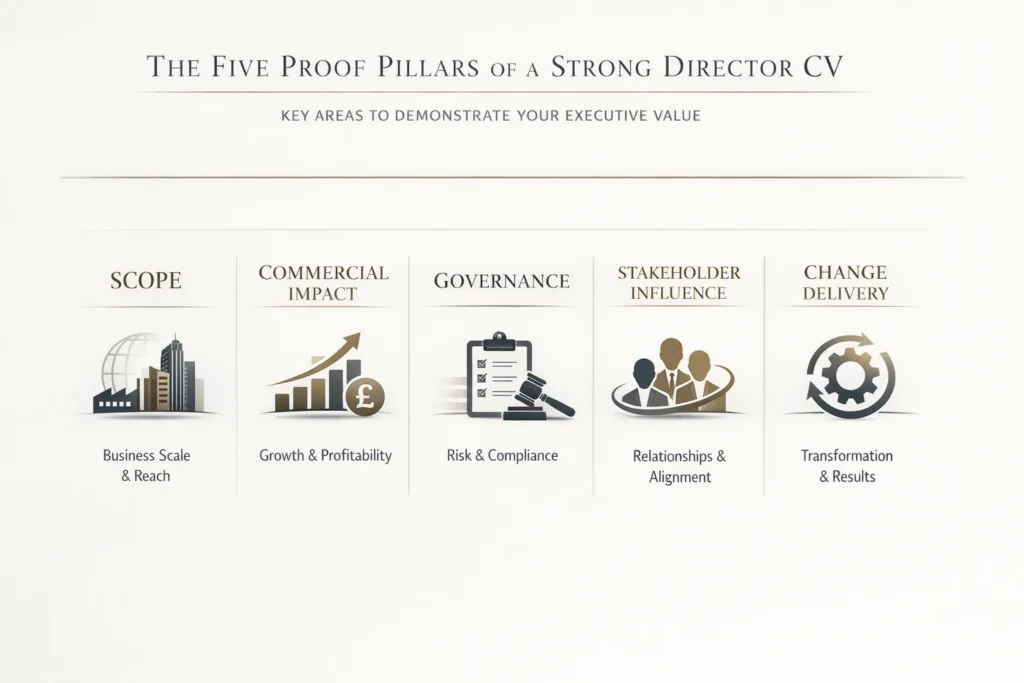
A strong director CV needs more than polished wording. It needs a proof structure.
One of the clearest ways to strengthen a director CV is to test your content against five areas that recruiters and hiring managers tend to associate with credible director-level performance:
- scope
- commercial impact
- governance
- stakeholder influence
- change delivery
If your CV is thin in two or three of those areas, it can easily read as “senior” without fully reading as “director”.
1. Scope
Scope helps the reader understand the size and weight of your remit.
This can include:
- number of sites, regions or business units
- team size or leadership span
- budget, revenue or cost base
- customer volume or service scale
- geographic coverage
- breadth of functional responsibility
The mistake many candidates make is assuming their title already conveys this. It usually does not.
Compare these two examples:
Weak:
Led operations across the business.
Stronger:
Led multi-site operations across 18 UK locations, with accountability for service performance, labour planning, compliance and cost control across a £42m operating budget.
The second version gives the reader something tangible. It turns a broad responsibility into a credible director-level remit.
2. Commercial impact
Director CVs should not stop at responsibility. They should show value.
That value might be expressed through revenue growth, margin improvement, cost reduction, productivity gains, improved service levels, stronger retention, reduced risk exposure or better strategic delivery. The exact measures will vary by role, but some form of business impact should usually be visible.
For example:
Weak:
Responsible for improving operational performance.
Stronger:
Improved operational performance across a national service division, reducing cost-to-serve by 11% while increasing on-time delivery and customer satisfaction scores within 12 months.
This is especially important if you want the CV to feel commercially credible rather than administratively senior.
3. Governance
Governance is one of the areas that often separates stronger director CVs from strong senior manager CVs.
Not every director role carries the same governance exposure, but many do involve some combination of board reporting, risk ownership, regulatory accountability, policy oversight, audit readiness or strategic decision support. Where that is relevant, your CV should reflect it clearly. For UK context, the wider framework around directors’ duties and responsibilities and the Institute of Directors’ overview of director responsibilities can be useful reference points when thinking about the language of accountability.
That does not mean your CV should become legalistic. It means it should signal judgement and accountability.
For example:
Weak:
Reported performance updates to senior leadership.
Stronger:
Produced board-level performance reporting, strengthened risk and control oversight, and supported strategic decision-making across growth, compliance and operational performance priorities.
4. Stakeholder influence
At director level, influence matters almost as much as delivery.
Your CV should show that you can work across functions and upwards into senior stakeholders, not just down into teams. Depending on your role, that could mean board members, investors, regulators, unions, clients, partner organisations, senior clinicians, heads of function, or cross-functional leadership teams.
A strong director CV makes stakeholder complexity visible.
For example:
Weak:
Worked closely with internal and external stakeholders.
Stronger:
Partnered with executive leadership, regional heads and external partners to align transformation priorities, resolve delivery risks and improve decision-making across multiple business functions.
If you want more ideas on how to evidence leadership more convincingly, this Leadership CV guide is a useful companion.
5. Change and delivery
Most director roles involve some combination of improvement, stabilisation, growth, turnaround or transformation.
That means your CV should not just describe a steady-state remit. It should show where you changed something important.
Examples might include:
- integrating teams after acquisition
- restructuring an underperforming function
- leading digital or operational transformation
- resetting commercial strategy
- improving governance or controls
- building a new team capability
- scaling delivery in response to growth
When these five elements are visible, the CV feels more credible. It gives the reader a reason to believe your level. That is the real aim: not to sound impressive, but to make the case obvious.
Before-and-after bullet rewrites for director CVs
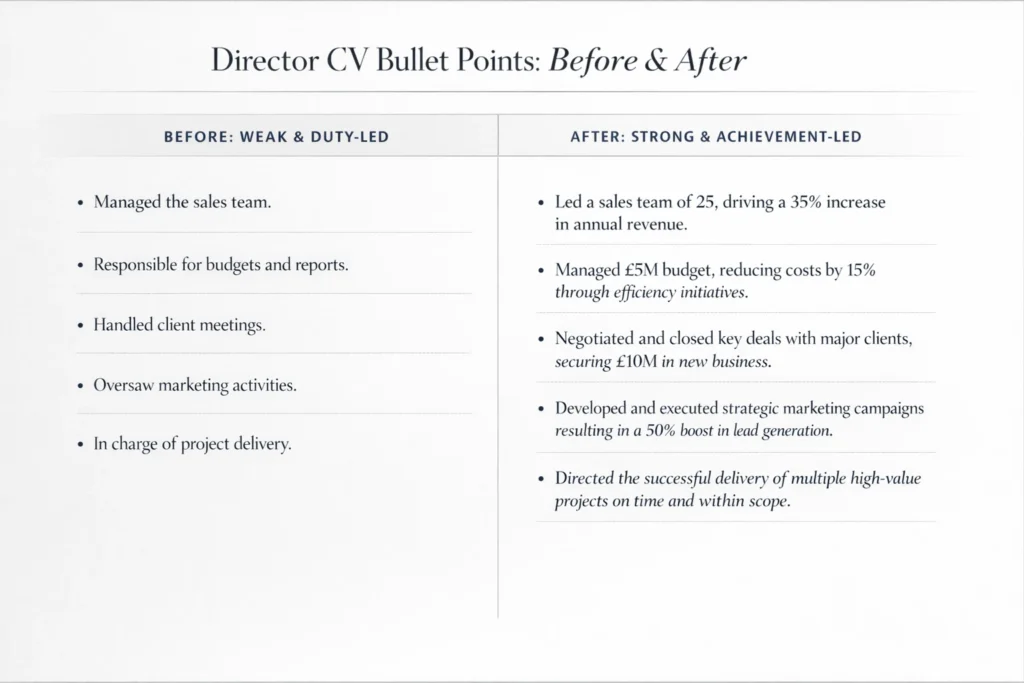
One of the quickest ways to improve a director CV is to rewrite bullets that describe responsibilities and turn them into bullets that show level, judgement and business impact.
At director level, bland bullets are costly. They make substantial roles look ordinary.
The goal is not to force a number into every line. It is to make each bullet answer a more useful question:
- What did you actually own?
- What changed because of your input?
- How large or complex was the remit?
- Why does this sound like director-level work rather than capable middle management?
Below are examples you can adapt.
1. Commercial performance
Before
Responsible for sales performance and business growth across the region.
After
Led regional commercial performance across a £28m portfolio, strengthening pipeline discipline, pricing decisions and team execution to increase year-on-year revenue by 14%.
Why the rewrite works
The second version introduces scale, shows levers of influence, and ends with an outcome. It reads as accountable, not merely involved.
2. Operations and service delivery
Before
Managed operational teams and improved service delivery.
After
Directed multi-site operations across 12 locations, improving service consistency, workforce planning and operational control while reducing complaints and lifting service KPIs within nine months.
Why the rewrite works
This version shows scope, complexity and results. It also sounds closer to director-level operational ownership.
3. Transformation
Before
Led a business transformation programme.
After
Led a cross-functional transformation programme spanning operations, systems and people processes, improving reporting visibility, reducing duplication and supporting a more scalable delivery model across the business.
Why the rewrite works
The revised version shows breadth and gives the reader a clearer sense of what changed. Even without a number, it is more believable and more useful.
4. Governance and reporting
Before
Reported on performance to senior management.
After
Produced board-facing performance and risk reporting, enabling sharper oversight of operational delivery, cost pressures and compliance priorities across the function.
Why the rewrite works
This rewrite signals level. “Board-facing” and “risk reporting” tell the reader this is not just routine management information.
5. Team leadership
Before
Led and developed a high-performing team.
After
Led senior managers across operations and support functions, clarifying accountability, strengthening performance management and improving leadership consistency during a period of restructure.
Why the rewrite works
Instead of relying on the phrase “high-performing team”, the stronger version shows what leadership looked like in practice and why it mattered.
6. Stakeholder management
Before
Worked with key stakeholders to deliver strategic objectives.
After
Partnered with executive stakeholders, functional leads and external partners to align delivery priorities, resolve barriers and maintain momentum on a business-critical improvement programme.
Why the rewrite works
The stronger bullet makes the stakeholder landscape clearer and ties the collaboration to a meaningful outcome.
A simple rewrite formula
A useful formula is:
Action + scope/context + what you changed, improved or influenced + outcome
For example:
- Directed regional service operations across a regulated environment, improving workforce deployment and performance visibility to support cost control and stronger service outcomes.
- Led commercial planning across key accounts, improving forecasting accuracy and helping protect margin during a volatile trading period.
- Strengthened governance and board reporting across the function, giving senior leadership clearer oversight of risk, performance and delivery.
That formula keeps your bullets focused on proof rather than activity.
What to remove from weak bullets
When reviewing your own CV, watch for bullets that:
- begin with “responsible for”
- only describe duties
- contain no scale, context or consequence
- overuse vague phrases such as “results-driven”, “strategic” or “dynamic”
- sound senior but could apply to almost any management role
A director CV should help the reader see not just what you did, but why your work mattered at the level you are targeting.
Director CV keyword bank and skills bank
Keywords can help a director CV in two ways.
First, they help recruiters and hiring managers spot relevance quickly. Second, they can help your CV align more closely with the language used in job descriptions and applicant tracking systems.
What keywords do not do is rescue a weak CV on their own. If the document is vague, poorly structured or light on evidence, adding more terms will not fix the underlying problem. The strongest director CVs use keywords to support a clear case, not replace one.
Universal director-level keywords
These are the kinds of terms that often appear across director-level roles in the UK, especially where leadership, performance and accountability matter:
- Strategic leadership
- Business transformation
- Operational excellence
- Commercial performance
- P&L responsibility
- Revenue growth
- Margin improvement
- Cost optimisation
- Board reporting
- Governance
- Risk management
- Stakeholder management
- Cross-functional leadership
- Change management
- Organisational design
- Performance improvement
- Budget ownership
- Regulatory compliance
- Team leadership
- Business planning
You do not need to force all of these into your CV. Use the ones that genuinely reflect your remit and the roles you are targeting.
Functional keyword examples by director type
A broader “director CV” still needs to feel relevant to the specific role family.
Managing Director keywords
- Business leadership
- Growth strategy
- Profitability
- Market expansion
- Commercial strategy
- Organisational performance
- Executive leadership
- Strategic planning
- Business development
- Investor or board engagement
Operations Director keywords
- Multi-site operations
- Service delivery
- Operational control
- Process improvement
- Workforce planning
- Lean improvement
- Supply chain
- Health and safety
- Productivity
- Continuous improvement
Commercial Director keywords
- Revenue strategy
- Client growth
- Pricing strategy
- Bid leadership
- Key account development
- Market penetration
- Contract negotiation
- Sales leadership
- Commercial delivery
- Customer retention
Finance Director keywords
- Financial leadership
- Forecasting
- Budgeting
- Cash flow
- Financial controls
- Management reporting
- Audit
- Business partnering
- Statutory reporting
- Financial planning and analysis
Skills bank: what to include near the top of the CV
Your key skills section should not become a long block of buzzwords.
At director level, it works best when it is selective and aligned to the target role. In most cases, around 8 to 12 well-chosen skills is enough.
A stronger list might look like this:
- P&L management
- Business transformation
- Multi-site leadership
- Board reporting
- Commercial strategy
- Cost optimisation
- Stakeholder engagement
- Governance and risk
- Team and leadership development
- Operational improvement
That is more effective than a long list filled with broad terms that do little to differentiate you.
How to use keywords properly
A simple rule helps here:
Use keywords in the profile, skills section and experience section, but support them with proof.
For example:
- Weak: Commercial strategy, leadership, stakeholder management, change management
- Stronger: Led commercial strategy across key B2B accounts, improving retention and margin while aligning sales, operations and service teams around growth priorities.
The second version still contains keywords, but now they are doing useful work.
Where keyword use often goes wrong
Common problems include:
- copying too many terms directly from a job advert
- building an oversized skills section with no clear focus
- using executive-sounding language with no evidence behind it
- repeating the same terms throughout the CV
- trying to optimise for ATS at the expense of readability
The better approach is to use the language the market recognises, then make sure the rest of the CV proves you have operated at that level.
Common director CV mistakes
A director CV can look polished and still underperform.
That usually happens when the document sounds senior, but does not make seniority believable. At this level, small weaknesses carry more weight because the reader is not only judging experience. They are judging judgement, credibility, fit and level.
Here are some of the most common mistakes.
1. A profile that sounds impressive but says very little
This is one of the biggest issues.
Phrases such as “results-driven leader”, “strategic thinker” and “proven track record” are common, but they are too broad to do much work on their own. They do not tell the reader what you lead, what context you operate in, or what kind of value you bring.
A stronger profile should make your level clearer within a few lines. It should say enough for the reader to understand your remit, your environment and your strengths without wading through vague leadership language.
2. Too much responsibility, not enough evidence
Many director CVs are still built like job descriptions.
They explain what the candidate was responsible for, but not what changed, improved, grew or stabilised because of their input. That makes it harder for the reader to separate genuine director-level impact from broad senior management experience.
This is especially damaging at director level, where employers want to see:
- scale of responsibility
- commercial or operational outcomes
- leadership influence
- strategic or governance exposure
- evidence of change, improvement or control
If most of your bullets begin with “responsible for”, “managed”, or “oversaw”, the CV probably needs sharper evidence.
3. The CV does not make the target role obvious
A generic senior CV often struggles at director level.
If you are targeting operations director roles, the document should clearly foreground operational control, service performance, efficiency, compliance or transformation. If you are targeting commercial director roles, it should show growth, client strategy, pricing, revenue performance or market development.
When the CV stays too broad, the reader has to do too much interpretation. That slows down trust.
4. Weak top-third positioning
The top third of page one should do a lot of work.
If the headline is generic, the profile is vague, and the skills section is unfocused, the strongest evidence may sit too far down the page to influence the first scan. That is often where shortlist momentum is lost.
This is one reason director CVs benefit from a disciplined structure and clear front-loading of scope and outcomes. If you need the broader context for how senior candidates should position themselves at the top of the page, the Executive CV Writing Guide is worth reading alongside this article.
5. Leadership claims that are not properly evidenced
Saying you are a strong leader is easy. Proving it is harder.
At director level, leadership proof often looks like:
- leading senior teams or multiple functions
- creating accountability in underperforming areas
- influencing peers and executives
- building capability
- leading through change
- improving performance through people, systems or structure
Without that kind of evidence, leadership language can feel inflated rather than credible.
6. Too little governance, risk or board-facing context
Not every director role needs heavy governance language, but many do need more than operational or commercial evidence alone.
Where relevant, your CV should show that you understand accountability as well as delivery. That might include board reporting, control environments, audit readiness, regulatory compliance, risk ownership or strategic decision support.
If those elements are central to your target roles, leaving them out can make the CV read one level lower than intended.
7. Over-designed formatting
Director CVs do not need gimmicks.
Complex layouts, graphics-heavy designs, text boxes, oversized skill charts and decorative features often create more problems than they solve. They can weaken readability, frustrate ATS parsing and distract from the actual case you are trying to make.
A clean layout with clear headings and strong content will usually serve you better.
If your formatting needs work, keep it simple and practical rather than trying to make the CV feel senior through design.
8. Trying to include everything
Senior candidates often have long, varied careers. The temptation is to include too much.
The problem is that more detail does not always create more authority. Sometimes it does the opposite. Dense paragraphs, over-explained early roles, bloated skills sections and too many weak bullets can make the strongest evidence harder to find.
A better director CV is selective. It gives more space to the most relevant and recent evidence, then compresses what matters less.
A useful test
When you review your CV, ask this:
Does this document clearly show the size of my remit, the value I created, the complexity I handled and the level at which I operated?
If the answer is not obvious within the first page, the CV probably needs tightening.
Stepping up to director: how to position a Head of or senior manager CV
You do not need to already hold the word Director in your title to build a credible director CV.
What matters more is whether your evidence shows you have already been operating close to that level.
If you are moving up from Head of, senior manager or departmental leadership roles, the key is to position the CV around director-adjacent proof, not title inflation. In other words, do not try to sound bigger than your role. Show where your remit already overlaps with director-level expectations.
That usually means bringing out evidence such as:
- ownership of a whole function or major area of delivery
- budget, revenue or cost accountability
- senior stakeholder or board exposure
- cross-functional influence beyond your own team
- leadership through change, growth, turnaround or restructure
- wider business impact, not just departmental performance
For example, a weak step-up CV might say:
Head of Operations managing day-to-day service delivery and team performance.
A stronger version might say:
Head of Operations leading a multi-site service function, with accountability for performance, workforce planning, budget control and operational improvement, and regular reporting into executive leadership.
That second version does not pretend the candidate is already a director. It simply makes the level more visible.
This matters because employers hiring at director level are often looking for signs that you can already think and operate beyond functional supervision. They want to see judgement, influence and business perspective.
So if you are stepping up, focus less on sounding senior and more on proving that your scope, complexity and commercial awareness are already moving in that direction.
Fix your director CV in 15 minutes
If your CV is broadly sound but not landing as strongly as it should, a short targeted edit can make a real difference.
Use this quick checklist:
1. Tighten the headline
Replace a generic label such as Senior Leader with the role you are targeting, such as Operations Director, Commercial Director or Managing Director.
2. Rewrite the profile for level
Check whether the profile clearly shows:
- what you lead
- the scale or context
- the value you bring
- the outcomes you are known for
If it could apply to almost any senior manager, it is too broad.
3. Add scope to your most recent role
Make sure the first lines of your latest role show the size of your remit. That could be sites, budget, revenue, team size, region, customer base or business unit scope.
4. Upgrade two weak bullets
Find two bullets that are too duty-led and rewrite them using this structure:
action + scope/context + improvement/change + outcome
5. Remove soft leadership filler
Cut phrases such as:
- results-driven leader
- strategic thinker
- dynamic professional
- proven track record
Unless they are backed by evidence, they add very little.
6. Check for director-level keywords
Make sure the CV naturally includes the right language for your target roles, such as P&L responsibility, board reporting, commercial performance, governance, transformation or multi-site leadership, where relevant.
7. Cut anything that weakens focus
Reduce older detail, repetitive bullets and oversized skills lists. Give more space to the evidence that best supports your next move.
8. Review the top third again
When you scan the first third of page one, ask:
Does this look like a genuine director candidate within 10 seconds?
If the answer is “not quite”, that is the part to fix first.
Get a clearer view of how your director CV is landing
If your CV is underselling your level, it is worth fixing that before you send more applications.
A strong director CV should make your scope, commercial value and leadership credibility clear quickly. If that is not happening yet, an outside review can usually spot the gaps fast, whether the issue is your profile, your evidence, your structure or the way your achievements are being framed.
You can request a Free CV Review for practical feedback on what is helping and what is holding the document back.
If you would rather get specialist one-to-one support with a more senior-level document, you can also explore the Executive CV Writing Service.
Director CV FAQs
How long should a director CV be in the UK?
In most cases, a director CV should be two pages.
That gives you enough space to show leadership scope, commercial outcomes and relevant career history without letting the document become heavy or unfocused. A one-page CV is usually too restrictive for a genuine director-level application, while a CV that runs well beyond two pages often loses discipline unless the role or career history genuinely justifies it.
The aim is not to fit everything in. The aim is to give the strongest evidence enough space.
Should a director CV always be two pages?
Not automatically, but it often works best.
If your experience is clearly director-level and you have enough relevant evidence to support that, two pages is usually the most practical length. If your CV is drifting beyond that, the problem is often not that you have “too much experience”, but that the document is carrying too much detail from earlier or less relevant roles.
A strong director CV is selective. It gives most space to the evidence that supports the role you want next.
What should a director CV profile include?
A director CV profile should usually include four things:
- the level you operate at
- the type of remit you lead
- the context or environment you work in
- the value or outcomes you are known for
For example, a stronger profile might show that you lead multi-site operations, own commercial performance, report into senior stakeholders, or deliver change in complex environments. A weaker profile tends to stay broad and generic.
If your profile is full of phrases such as “results-driven leader” but says little about scale, context or impact, it probably needs rewriting.
How is a director CV different from an executive CV?
A director CV is usually narrower and more role-focused.
A broader executive CV may cover senior leadership positioning across director, executive director and C-suite pathways. A director CV should stay closer to the level and remit of the roles you are targeting now. That means clearer emphasis on functional leadership, commercial outcomes, governance exposure, stakeholder management and the kind of evidence expected at director level.
If you want the wider senior-leadership context beyond this article, the Executive CV Writing Guide is the better place to start.
Should I mention governance and board reporting on a director CV?
Yes, where it is relevant to the role you are targeting.
Governance, board reporting, risk ownership, control environments and strategic oversight can be important signals of level. They help show that you have operated with accountability, not just delivery responsibility.
That said, they should only be included where they genuinely reflect your background. Do not bolt on governance language simply because it sounds senior. It needs to be credible and tied to your actual remit.
What keywords should I include on a director CV?
Use keywords that reflect both your level and your target role.
Common director-level terms include:
- strategic leadership
- commercial performance
- P&L responsibility
- business transformation
- board reporting
- governance
- stakeholder management
- operational improvement
- cost optimisation
- change management
Then add more specific terms based on the roles you are targeting, such as multi-site operations, pricing strategy, financial controls, client growth or regulatory compliance.
The key is to use those terms naturally and support them with evidence. Keywords help, but they should never do all the work. If you also want a cleaner underlying format for those sections, this CV template guide is a useful reference.
Recent Comments