

If you’re a UK student trying to write a CV and thinking “I don’t have enough experience”, you’re exactly who this guide is for. You’ll find CV examples for students in five common situations (school leaver, university student with no experience, part-time job, internship/placement, and leadership/volunteering-heavy) plus copy/paste templates and a quick checklist you can use to improve your CV in minutes.
This is UK-focused (GCSE/A-level and university-friendly), written for what recruiters actually expect. It’s also ATS-aware (Applicant Tracking Systems), so you don’t accidentally format your CV in a way that makes it harder to read or keyword-match.
If you want extra inspiration from a UK university careers service, the University of Manchester’s example CV hub is worth a look for sector-specific sample documents.
And if you’d like official UK guidance on typical CV sections and best practice, you can cross-check your structure against Prospects’ CV advice.
Before we get into the examples, here’s the big idea: a strong student CV isn’t “work experience first”. It’s evidence first, proof you can show up reliably, learn quickly, and get results, even if your experience comes from school projects, volunteering, clubs, sport, caring responsibilities, or part-time work.
For more sector-specific inspiration, browse the University of Manchester CV examples hub.
Update: We’ve also published a short press release summarising the evidence-led approach for students.
Section 2: Key takeaways (box)
Key takeaways: CV examples for students (UK)
- A strong student CV is evidence-led, not job-title-led: use projects, volunteering, clubs, sport, caring responsibilities and part-time work to prove skills.
- If you have little or no work history, a skills-based (targeted) CV can work well, as long as every skill has proof underneath it.
- Keep it simple and ATS-friendly: single column, clear headings, normal fonts, and clean bullet points (no icons/graphics-heavy layouts).
- For most UK student applications, aim for one page unless the role or sector explicitly expects more. (Some sectors may ask for one page; “industry norm” matters.)
- Recruiters scan fast: your personal profile, skills, education and most relevant evidence should be visible in under 30 seconds.
- Use achievement bullets, not duties: “did X” to “did X, resulting in Y” (we’ll give plug-and-play formulas).
- Use the examples and templates below to match your situation (school leaver / uni no experience / part-time job / internship / leadership-heavy).
What a UK student CV is (and how it differs from a graduate CV)
A student CV and a graduate CV are not the same thing, and mixing the two up is one of the biggest reasons students get rejected early.
Here’s the clean UK distinction recruiters actually use.
What counts as a student CV (UK)
A student CV is written when you are:
- A school leaver (GCSEs or A-levels)
- A college or university student
- Applying for part-time work, internships, placements, entry-level roles, or graduate schemes before you’ve built full-time professional experience
A student CV focuses on:
- Education first (because it’s your strongest, most recent evidence)
- Transferable skills, backed by proof
- Projects, volunteering, clubs, sport, caring responsibilities, and part-time work
- Clear potential, reliability, and learning ability
What makes a graduate CV different
A graduate CV assumes you have:
- One or more relevant internships, placements, or graduate-level roles
- Clear exposure to a professional environment
- Outcomes you can quantify in a workplace context
Graduate CVs usually:
- Lead with experience, not education
- Expect stronger industry language and metrics
- Are often tailored tightly to a specific role or sector
If you’re unsure which you’re writing, this rule helps:
If your strongest evidence comes from education, projects, or non-professional roles, you’re writing a student CV; even if you’ve graduated.
Skills-based student CVs (when they work, and when they don’t)
Many UK students are advised to use a skills-based CV. This can work, but only if done properly.
A skills-based student CV works best when:
- You genuinely have very little formal work experience
- Each skill is followed by specific proof (what you did, where, and the result)
It fails when:
- Skills are listed without evidence (“teamwork”, “communication”, “hard-working”)
- The CV reads like a personality list rather than a capability document
We’ll show you skills-based examples done correctly later in this guide.
ATS basics (in plain English)
Most large UK employers use Applicant Tracking Systems (ATS) to filter CVs before a human sees them. For students, this means:
- Stick to simple layouts (single column, clear headings)
- Use standard section titles (Profile, Education, Experience, Skills)
- Mirror key words from the job description naturally
If you want a deeper explanation of how ATS systems work in the UK (and how to avoid common mistakes), this guide breaks it down clearly:
https://brendanhope.com/blog/ats-cv-optimisation-uk-guide/
UK structure expectations (quick note)
UK employers are conservative about CV structure. Unless the job advert says otherwise:
- One page is usually enough for students
- Education sits above experience
- “References available on request” is still acceptable
We’ll cover formatting in more detail next, including section order and layout rules you should stick to.
For a full overview of current UK CV structure expectations, see:
https://brendanhope.com/blog/how-to-write-uk-cv-2025/
And for official UK careers guidance on CV purpose and sections, Prospects provides a useful cross-check:
https://www.prospects.ac.uk/careers-advice/cvs-and-cover-letters/how-to-write-a-cv
Recruiter scan in 30 seconds: what they actually look for
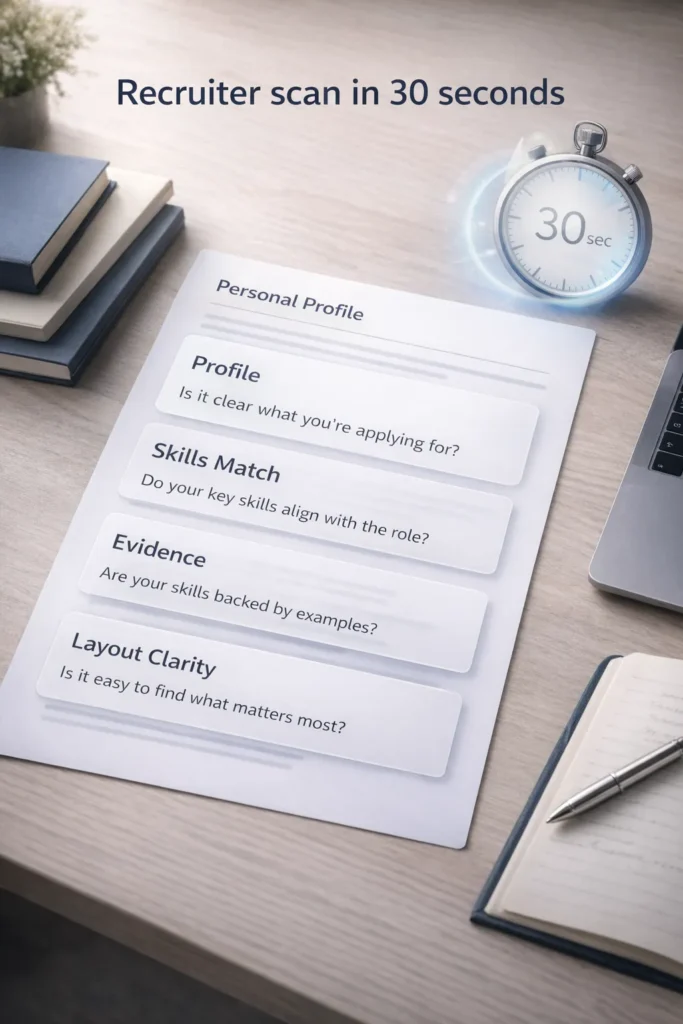
Most UK recruiters don’t read a student CV first, they scan it. You usually have 20–30 seconds to convince them you’re worth a closer look.
Here’s what they check, in order.
1) Can I immediately see who this is for?
At the top of the CV, recruiters want to know:
- What level you’re at (school leaver / university student)
- What you’re applying for (part-time role, internship, placement, graduate scheme)
- Whether the CV feels relevant to this role, not generic
That’s the job of your personal profile (2–3 lines, max). If it’s vague or missing, many CVs don’t make it past the first scan.
2) Do the skills match the role?
Recruiters quickly scan for:
- Core skills mentioned in the job description
- Evidence that those skills are used, not just claimed
This is why lists like “teamwork, communication, problem-solving” don’t work on their own. They need proof; which we’ll show you how to add later.
3) Is there believable evidence?
For students, evidence can come from:
- School or university projects
- Coursework with outcomes
- Part-time jobs
- Volunteering, clubs, societies, sport
- Caring responsibilities or informal work
Recruiters are asking:
“Has this person shown responsibility, reliability, and follow-through anywhere?”
4) Is the CV easy to read?
If your CV is:
- Two columns
- Full of icons, graphics, or charts
- Hard to skim
…it’s already at a disadvantage, especially in ATS-filtered applications.
Clean layout = faster decisions in your favour.
5) Does this look like a low-risk hire?
For student roles, recruiters are often thinking:
- Will they turn up on time?
- Can they follow instructions?
- Will they represent us well?
Your CV should quietly answer yes to all three.
Quick self-check (do this now)
If a recruiter skimmed your CV for 30 seconds, could they immediately answer:
- What role you’re aiming for?
- What skills you bring that match it?
- Where you’ve already used those skills?
If you’re unsure, it’s worth getting a second pair of eyes on it.
👉 Free CV Review (UK students welcome)
A human-led, honest review highlighting what’s working, what’s hurting your chances, and what to fix first:
https://brendanhope.com/free-cv-review/
UK student CV formatting norms (what recruiters expect)
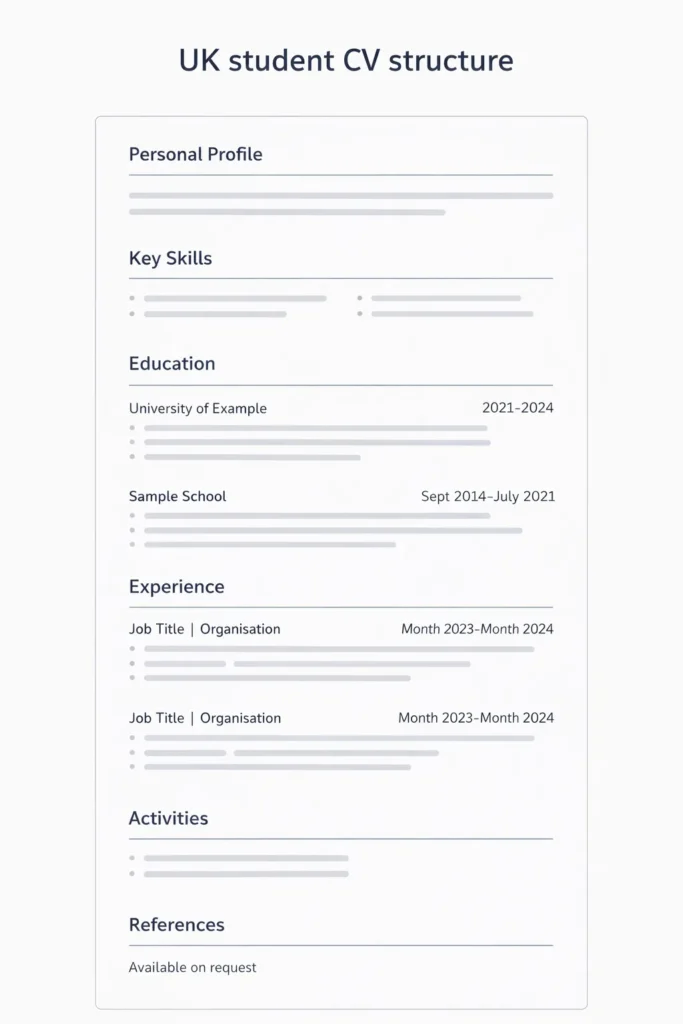
Good formatting won’t get you hired on its own; but bad formatting can get you rejected, especially for student and entry-level roles where recruiters are scanning quickly.
Here’s what’s considered “safe” and expected for a UK student CV.
Length: keep it to one page
For most UK students:
- One page is the norm
- Two pages only make sense if you have substantial, directly relevant experience (unusual for students)
If you’re struggling to fit everything on one page, the issue is usually relevance, not space. Trim anything that doesn’t support the role you’re applying for.
Layout: simple beats creative
Stick to:
- Single-column layout
- Clear section headings
- Standard fonts (Calibri, Arial, Helvetica, or similar)
- Normal bullet points (• or –)
Avoid:
- Two-column designs
- Icons, charts, progress bars, or logos
- Infographics or “visual CVs”
These often cause problems with ATS systems and slow down human scanning. If you want a deeper explanation of why simple layouts perform better in the UK, this guide explains it clearly:
https://brendanhope.com/blog/ats-cv-optimisation-uk-guide/
Section order (most common for students)
For UK student CVs, this order works best in most cases:
- Name and contact details
- Personal profile (2–3 lines)
- Key skills (targeted to the role)
- Education (GCSEs, A-levels, degree; most recent first)
- Experience (part-time work, volunteering, projects, placements)
- Additional activities (clubs, sport, leadership; if relevant)
- References (one line only)
Education usually sits above experience for students because it’s your strongest, most recent evidence.
Education placement: what to include
For each qualification, include:
- Qualification name (e.g. GCSEs, A-levels, BA/BSc)
- Subject(s)
- Institution
- Dates (or expected completion date)
Grades matter most when:
- You’re a school leaver
- The employer explicitly asks for them
- You’re applying for competitive internships or graduate schemes
Otherwise, you can be selective.
References: keep it simple
In the UK, it’s still perfectly acceptable to write:
References available on request
You don’t need to list referees unless the job advert specifically asks for them.
File format: small but important
Unless told otherwise:
- Submit your CV as a PDF
- Name the file clearly:
Firstname_Surname_CV.pdf
Word documents are sometimes requested by recruiters or agencies, but PDFs reduce formatting issues.
For an official UK benchmark on CV structure and expectations, you can cross-check against Prospects’ guidance here:
https://www.prospects.ac.uk/careers-advice/cvs-and-cover-letters/how-to-write-a-cv
And for a full, up-to-date walkthrough of UK CV structure (with examples), see:
https://brendanhope.com/blog/how-to-write-uk-cv-2025/
Student CV sections (with quick examples)
Before jumping into full CV examples, it helps to understand what each section is for, and what good looks like for students. This is where many CVs fall down: sections exist, but they don’t actually prove anything.
Below is the standard UK student CV structure, with short, realistic examples you can adapt.
Personal profile (2–3 lines)
This is your positioning statement. It answers:
- Who are you (student level)?
- What are you aiming for?
- What do you bring that’s relevant?
Good student profile example
Motivated second-year Business Management student seeking a summer internship in marketing. Strong research and data-handling skills developed through coursework and group projects, with part-time retail experience in customer-facing roles.
Common mistakes
- Too long (a paragraph)
- Too vague (“hard-working and enthusiastic student”)
- No role focus
If you’re unsure what to include here, this breakdown explains it clearly with examples:
https://brendanhope.com/blog/what-to-write-in-cv-summary/
Key skills (targeted, not generic)
Your skills section should be tailored to the role, not a personality list.
Better approach
- 6–10 skills max
- Mix of technical, transferable, and role-specific skills
- Every skill should be backed up somewhere else on the CV
Example (student, customer-facing role)
- Customer service
- Cash handling
- Team communication
- Time management
- Problem-solving
- Basic Excel
We’ll show you how to prove these skills later using bullet formulas.
Education (your strongest evidence as a student)
For students, education usually comes before experience.
Example
BSc Psychology (Expected 2027)
University of Leeds
Relevant modules: Research Methods, Statistics, Cognitive PsychologyA-levels: Psychology (A), Sociology (B), English (B)
GCSEs: 9 GCSEs including Maths and English
Include:
- Qualification
- Institution
- Dates (or “Expected”)
- Relevant modules/projects if helpful
Experience (yes, even if it’s not “professional”)
Experience doesn’t have to be a full-time office job.
Valid student experience includes:
- Part-time work
- Volunteering
- School/university projects
- Clubs, societies, sport
- Informal work or caring responsibilities
Example (part-time role)
Sales Assistant (Part-time)
High Street Retailer | 2024–Present
- Assisted customers during peak trading periods, handling up to 100 transactions per shift
- Maintained stock accuracy and visual standards
- Resolved basic customer issues independently
If you have no work experience at all, this guide walks you through how to build evidence from scratch:
https://brendanhope.com/blog/how-to-write-a-cv-with-no-work-experience/
Projects, volunteering & activities (often overlooked)
This section is especially powerful for:
- School leavers
- University students with limited work history
- Students applying for internships or placements
Example
Student Fundraising Project
- Planned and promoted a campus fundraising event raising £750 for charity
- Coordinated a team of 5 students and managed timelines
References
One line is enough:
References available on request
No contact details needed unless requested.
CV examples for students (ATS-friendly, UK scenarios)
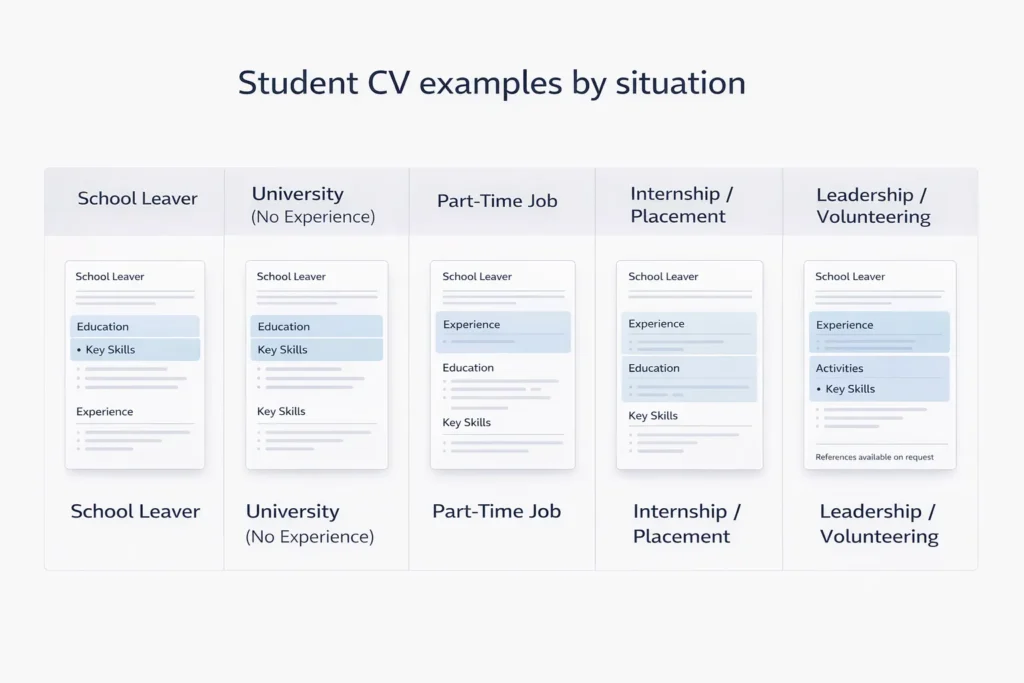
Below are five ATS-friendly CV examples for students. Each is written in a simple, single-column layout (no icons, no tables, no columns) so it scans cleanly for both humans and ATS systems.
Use these as patterns, not scripts. Swap the details to match your situation and the role you’re applying for.
Tip: If you want extra sector-specific inspiration beyond these student scenarios, the University of Manchester careers service has a strong set of example CVs (many aimed at internships and graduate-level applications).
https://www.careers.manchester.ac.uk/applicationsinterviews/cv/examplecvs/
Example 1: School leaver CV (GCSE/A-level): applying for part-time work
FIRSTNAME SURNAME
Town/City, UK | Phone | Email | LinkedIn (optional)
PERSONAL PROFILE
Reliable A-level student seeking a part-time customer service role. Strong communication skills developed through school group projects and volunteering, with a consistent record of punctuality and teamwork in busy environments.
KEY SKILLS
Customer service • Communication • Teamwork • Time management • Organisation • Cash handling (if relevant) • Problem-solving
EDUCATION
A-levels (Expected 2026), School/College Name
Subjects: Business, English, Sociology
Highlights: Team project lead for business presentation; achieved 95% attendance
GCSEs (2024), School Name
9 GCSEs including English and Maths
EXPERIENCE / RESPONSIBILITY
Volunteering Help, Community Event / Charity | 2024–Present
- Welcomed visitors, answered basic questions, and directed people to the right areas
- Supported set-up and pack-down to deadlines, including lifting and organising equipment
- Worked as part of a small team during busy periods, staying calm and helpful
School Project: Group Presentation (Business) | 2025
- Led a team of 4, assigned tasks, and kept the group on schedule
- Presented findings to a class of 25, responding to questions confidently
INTERESTS (optional)
Team sport / gym / coding / music, include only if it supports the role (e.g., teamwork, discipline)
REFERENCES
References available on request
Example 2: University student CV: no experience (skills-based, with proof)
This is the situation that causes the most stress: “I have no experience.” You can still build a strong CV by proving skills through education, projects, volunteering and responsibilities.
If you want this built for you (and you’re starting from zero), here’s the relevant service page (useful if you’re short on time or applying for something competitive):
https://brendanhope.com/cv-services/cv-writing-service/no-experience/
FIRSTNAME SURNAME
Town/City, UK | Phone | Email | LinkedIn (optional)
PERSONAL PROFILE
First-year Computer Science student seeking an internship or entry-level role in IT support. Strong problem-solving and customer communication skills demonstrated through coursework, self-led projects and university group work.
KEY SKILLS
IT troubleshooting • Customer support • Written communication • Team collaboration • Time management • Research • Basic Excel
SKILLS WITH PROOF
Problem-solving
- Debugged and improved a coursework program after test failures, achieving a higher grade on resubmission
- Built a small personal project to practise error handling and documentation
Communication
- Delivered a short presentation on a technical topic to a seminar group
- Wrote clear step-by-step instructions for classmates during group work
Organisation
- Managed multiple deadlines across modules by planning weekly tasks and prioritising high-impact work
EDUCATION
BSc Computer Science (Expected 2029), University Name
Relevant modules: Programming Fundamentals, Systems, Data
PROJECTS
Personal project: Simple task tracker | 2025
- Built a basic task tracker to practise logic, input validation and user flows
- Documented setup steps to make it easy for someone else to run
ADDITIONAL ACTIVITIES
University society member / course rep / study group organiser (if true)
REFERENCES
References available on request
Example 3: Student CV with part-time job: applying for internships / entry-level roles
FIRSTNAME SURNAME
Town/City, UK | Phone | Email | LinkedIn (optional)
PERSONAL PROFILE
Second-year Sociology student seeking a summer internship. Strong customer-facing and admin skills from part-time hospitality work, plus strong written analysis and research skills from academic projects.
KEY SKILLS
Customer service • Handling complaints • Teamwork • Attention to detail • Research • MS Office (Word/Excel) • Time management
EDUCATION
BA Sociology (Expected 2027), University Name
Relevant modules: Research Methods, Social Policy
EXPERIENCE
Front of House Team Member (Part-time), Hospitality Venue | 2023–Present
- Delivered friendly customer service during peak periods, balancing speed and accuracy
- Resolved basic customer issues and escalated appropriately when needed
- Maintained high hygiene and safety standards; supported opening/closing tasks
- Worked flexibly around university commitments, consistently covering agreed shifts
University Research Task (Module project) | 2025
- Designed a short survey, collected responses and summarised findings clearly
- Presented results in a structured report with clear recommendations
REFERENCES
References available on request
Example 4: Student with internship / placement: more “graduate-style”, still student-friendly
FIRSTNAME SURNAME
Town/City, UK | Phone | Email | LinkedIn (optional)
PERSONAL PROFILE
Final-year Accounting and Finance student seeking a graduate role. Completed a summer placement in a finance team, with hands-on experience supporting reporting tasks and improving spreadsheet accuracy.
KEY SKILLS
Excel • Data accuracy • Reporting support • Stakeholder communication • Organisation • Confidentiality
EDUCATION
BSc Accounting & Finance (Expected 2026), University Name
Relevant modules: Financial Reporting, Management Accounting
EXPERIENCE
Finance Intern (Summer Placement), Company Name | Summer 2025
- Supported monthly reporting by updating spreadsheets and checking figures for accuracy
- Produced clear notes on anomalies and flagged issues early to the team
- Improved a recurring spreadsheet process by standardising inputs and reducing errors
- Maintained confidentiality when handling sensitive financial information
ADDITIONAL EXPERIENCE
Part-time role / volunteering (if relevant)
REFERENCES
References available on request
Example 5: Leadership / volunteering-heavy student: minimal paid work, strong evidence
FIRSTNAME SURNAME
Town/City, UK | Phone | Email | LinkedIn (optional)
PERSONAL PROFILE
Motivated student seeking an internship in events or project support. Strong planning, teamwork and leadership skills developed through committee roles and volunteering, with proven ability to organise people and deliver to deadlines.
KEY SKILLS
Planning • Team coordination • Communication • Budget awareness • Event support • Problem-solving • Reliability
EDUCATION
BA Event Management (Expected 2027), University Name
LEADERSHIP & VOLUNTEERING
Society Committee Member, University Society | 2024–Present
- Coordinated event logistics including timings, roles and communications
- Helped promote events to members and supported attendance growth
- Worked with other committee members to deliver events smoothly and safely
Volunteer Team Lead, Charity / Community Group | 2024
- Organised a small volunteer rota to ensure coverage across a busy weekend
- Briefed volunteers and supported problem-solving on the day
PROJECTS
Group project: Event proposal | 2025
- Created a structured event plan with budget outline, risk considerations and marketing ideas
- Presented proposal clearly and responded to questions
REFERENCES
References available on request
Want a quick sense: check before you submit?
If you’re applying soon, it’s easy to miss the thing that makes your CV feel vague, especially as a student. If you want a quick human review (what to fix first, what to cut, what to rewrite), use the Free CV Review:
https://brendanhope.com/free-cv-review/
Student CV templates (copy/paste, ATS-friendly)
These student CV templates are deliberately simple. They’re designed to:
- Work cleanly with ATS systems
- Be easy for recruiters to scan
- Let your evidence do the talking
You can copy and paste these into Word or Google Docs and adapt them to your role.
School leaver CV (GCSE / A-level)
FIRSTNAME SURNAME
Town/City, UK | Phone | Email | LinkedIn (optional)

PERSONAL PROFILE
Motivated school leaver seeking a part-time role. Reliable and organised, with strong communication skills developed through school projects, volunteering and teamwork.

KEY SKILLS
• Customer service
• Communication
• Teamwork
• Time management
• Organisation
• Problem-solving

EDUCATION
A-levels (Expected YYYY), School / College Name
Subjects: …

GCSEs (YYYY), School Name
X GCSEs including English and Maths

EXPERIENCE / RESPONSIBILITY
Role, Organisation, Dates
• What you did
• How you did it
• Result or responsibility

PROJECTS / ACTIVITIES (optional)
Project or activity | Year
• What you were responsible for

REFERENCES
References available on request
University student CV: no experience (skills-based)
Use this if you genuinely have no formal work history.
FIRSTNAME SURNAME
Town/City, UK | Phone | Email | LinkedIn (optional)

PERSONAL PROFILE
University student seeking an internship or entry-level role. Strong [key skills] developed through coursework, projects and independent learning.

KEY SKILLS
• Skill 1
• Skill 2
• Skill 3
• Skill 4

SKILLS WITH EVIDENCE
Skill 1
• Where you used it
• What you achieved or learned

Skill 2
• Where you used it
• Outcome or result

EDUCATION
Degree (Expected YYYY), University Name
Relevant modules: …

PROJECTS
Project name | Year
• What you did
• Tools or methods used
• Outcome

ADDITIONAL ACTIVITIES (optional)
Clubs, societies, volunteering, caring responsibilities

REFERENCES
References available on request
Student CV with part-time job
FIRSTNAME SURNAME
Town/City, UK | Phone | Email | LinkedIn (optional)

PERSONAL PROFILE
Student seeking [role type]. Strong customer-facing and organisational skills developed through part-time work alongside studies.

KEY SKILLS
• Customer service
• Teamwork
• Time management
• Communication
• Attention to detail

EDUCATION
Degree / A-levels, Institution | Dates

EXPERIENCE
Job title (Part-time), Employer | Dates
• Key responsibility
• Example of reliability or performance
• Skill used or result

PROJECTS / ADDITIONAL EXPERIENCE (optional)
Project or activity | Year
• Brief description

REFERENCES
References available on request
Student CV with internship / placement
FIRSTNAME SURNAME
Town/City, UK | Phone | Email | LinkedIn (optional)

PERSONAL PROFILE
Final-year student seeking a graduate or entry-level role. Completed a relevant internship with hands-on experience in [area].

KEY SKILLS
• Technical skill
• Analysis
• Communication
• Organisation

EDUCATION
Degree (Expected YYYY), University Name

EXPERIENCE
Internship title, Organisation, Dates
• Task or responsibility
• Skill applied
• Outcome or improvement

ADDITIONAL EXPERIENCE
Part-time work / volunteering (if relevant)

REFERENCES
References available on request
Leadership / volunteering-focused student CV
FIRSTNAME SURNAME
Town/City, UK | Phone | Email | LinkedIn (optional)

PERSONAL PROFILE
Student seeking [role type]. Strong leadership and planning skills developed through committee roles and volunteering.

KEY SKILLS
• Leadership
• Planning
• Team coordination
• Communication
• Problem-solving

EDUCATION
Degree / A-levels, Institution | Dates

LEADERSHIP & VOLUNTEERING
Role, Organisation, Dates
• Responsibility
• What you organised or improved
• Result

PROJECTS (optional)
Project name | Year
• Brief description

REFERENCES
References available on request
Which template should you choose?
- School leaver: Template 1
- No experience at all: Template 2
- Part-time job: Template 3
- Internship / placement: Template 4
- Leadership / volunteering-heavy: Template 5
If you’re unsure, start with the simplest structure and add complexity only when you have evidence to support it.
Skills & keyword bank for students (what to include, and how to prove it)
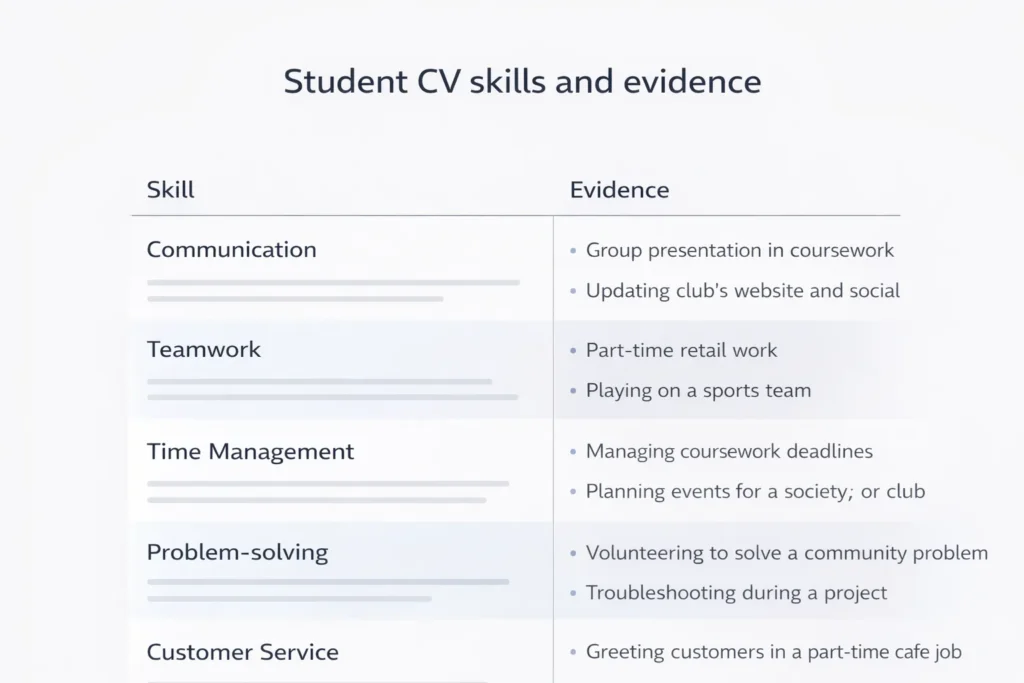
One of the fastest ways student CVs get rejected is through unproven skills. Recruiters don’t mind that you’re early-career, but they do expect you to show where your skills come from.
Below is a UK-relevant skills and keyword bank for students, plus ideas on how to prove each skill using education, part-time work, projects or activities.
Tip: If an employer uses ATS software, these skills (and close variants) are often what the system is scanning for first. Keep wording natural, but aligned to the job description.
For a deeper look at how keywords work in UK ATS systems, see:
https://brendanhope.com/blog/ats-cv-optimisation-uk-guide/
Core transferable skills (with proof ideas)
| Skill / keyword | Where students usually get it | How to prove it on your CV |
|---|---|---|
| Communication | Presentations, group work, customer service | “Presented findings to a group of 25”; “Handled customer queries during busy periods” |
| Teamwork | Group projects, sport, part-time work | “Worked as part of a 5-person team”; “Supported colleagues during peak shifts” |
| Time management | Balancing study and work | “Managed coursework deadlines alongside part-time work without missed shifts” |
| Organisation | Coursework, events, admin tasks | “Planned tasks using weekly schedules”; “Kept records up to date” |
| Problem-solving | Projects, coursework, customer issues | “Resolved basic customer issues independently”; “Improved approach after feedback” |
| Reliability | Attendance, shift work, volunteering | “Maintained consistent attendance”; “Trusted to open/close independently” |
Customer-facing & part-time job skills (common in student roles)
These are especially valuable for retail, hospitality, admin, and internships.
| Skill / keyword | Proof ideas |
|---|---|
| Customer service | Assisted customers, handled queries, resolved complaints |
| Cash handling | Processed transactions accurately, balanced tills |
| Attention to detail | Followed procedures, reduced errors, checked information |
| Working under pressure | Peak periods, deadlines, busy shifts |
| Flexibility | Covered shifts, adapted to changing priorities |
Academic & project-based skills (often underused)
Students often overlook these; recruiters don’t.
| Skill / keyword | Proof ideas |
|---|---|
| Research | Designed surveys, reviewed sources, analysed findings |
| Data handling | Used Excel, collected results, summarised trends |
| Written communication | Reports, essays, proposals |
| Presentation skills | Seminar presentations, assessed talks |
| Critical thinking | Evaluated options, justified decisions |
Tools & software (only list what you can actually use)
Examples commonly accepted on UK student CVs:
- MS Word, Excel, PowerPoint
- Google Docs / Sheets
- Basic data analysis tools (if relevant)
- Subject-specific tools (only if role-relevant)
Avoid listing software unless you’re comfortable explaining how you used it.
Where skills should appear on your CV
To be taken seriously, skills should appear in at least two places:
- Skills section (quick scan)
- Evidence elsewhere (education, experience, projects)
If a skill appears only once, as a standalone word, it’s weak.
Turning weak skills into strong evidence (quick example)
Weak
- Teamwork
- Communication
Stronger
- Worked as part of a 4-person group project, coordinating tasks and meeting weekly deadlines
- Communicated clearly with customers during busy shifts, resolving basic issues independently
Achievements & bullet formulas (STAR / CAR made simple)
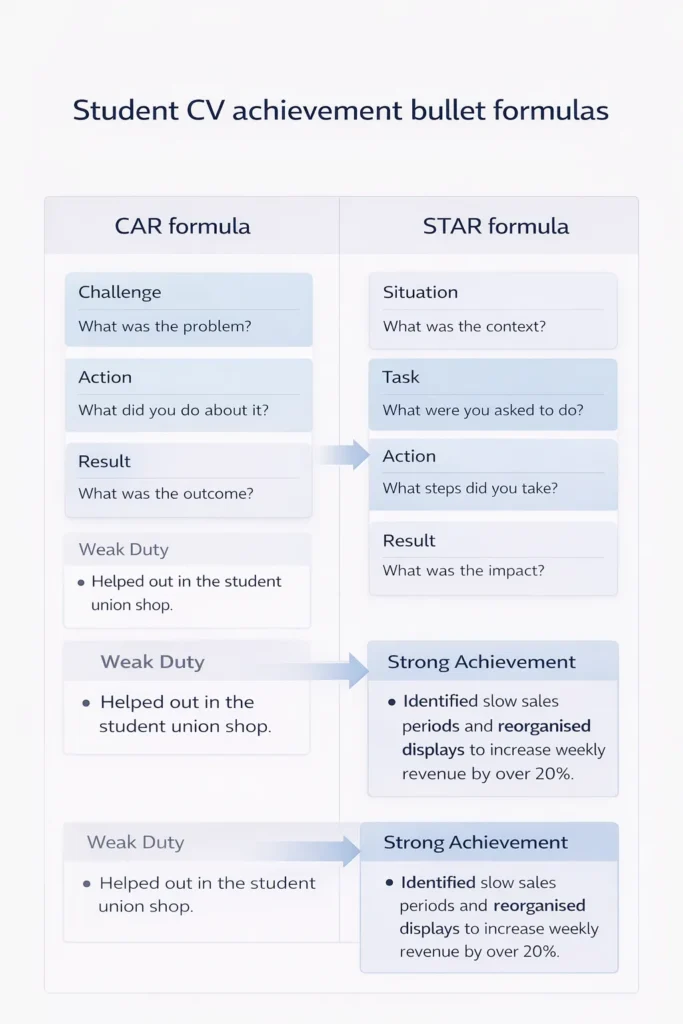
Recruiters don’t want a list of duties. They want evidence that you did something, handled responsibility, or made an impact, even at student level.
That’s where achievement-focused bullets come in.
You don’t need big numbers or fancy job titles. You just need structure.
The two easiest frameworks for students
You’ll see STAR mentioned a lot. For CVs, a lighter version works better.
CAR method (best for CVs)
- C — Context: Where or when did this happen?
- A — Action: What did you do?
- R — Result: What changed, improved, or was achieved?
STAR method (slightly more detailed)
- S — Situation
- T — Task
- A — Action
- R — Result
For CV bullets, CAR is usually enough.
Simple bullet formula you can reuse
Use this pattern:
Action verb, what you did, how you did it and the outcome (if possible)
You don’t need all four every time, but aim for at least action and evidence.
Before and after examples (student-friendly)
Weak duty-style bullet
- Worked on a group project
Stronger achievement bullet
- Contributed to a 4-person group project by researching sources and presenting findings, helping the team meet assessment deadlines
Weak
- Helped customers in a shop
Stronger
- Assisted customers during busy periods, answering queries and resolving basic issues independently
Weak
- Responsible for organising events
Stronger
- Helped organise a student society event by coordinating timings and roles, contributing to smooth delivery on the day
Action verbs that work well for students
Start bullets with clear, plain-English verbs. You don’t need corporate jargon.
Good options include:
- Assisted
- Supported
- Coordinated
- Organised
- Delivered
- Managed
- Prepared
- Communicated
- Researched
- Presented
- Improved
- Resolved
If you want a broader list (with UK-appropriate wording), this guide is useful:
https://brendanhope.com/blog/cv-power-words-uk-2025/
How many bullets should students use?
As a rough guide:
- Part-time jobs: 3–5 bullets
- Projects / volunteering: 2–4 bullets
- School activities: 1–3 bullets
Quality beats quantity every time.
A quick self-check
After writing a bullet, ask:
- Could any student write this?
- Or does it clearly describe what I did?
If it’s the first one, add context or outcome.
Fix it in 15 minutes: student CV checklist
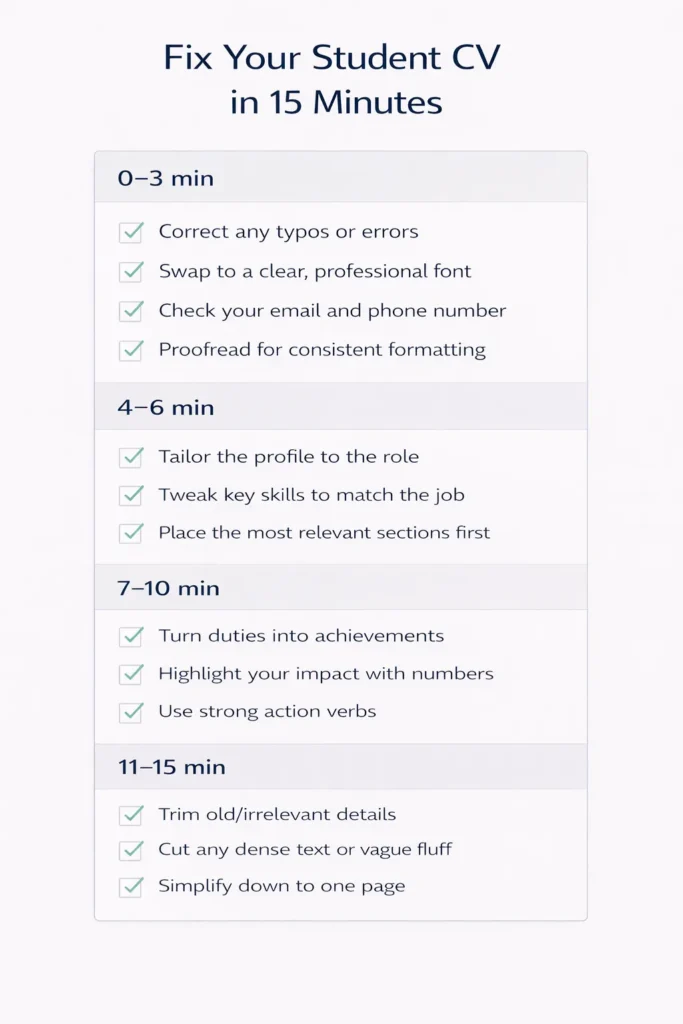
If you’re short on time, use this 15-minute checklist to tighten your CV before you submit it. These are the fixes that make the biggest difference for UK student applications.
1–3 Minutes: Clarify your direction
- Does your personal profile clearly say what you’re applying for?
- Is it obvious whether you’re a school leaver or university student?
- Have you removed vague phrases like “hard-working” unless they’re backed by evidence?
4–6 Minutes: Match the role
- Re-read the job description and highlight skills they ask for
- Make sure at least 3–5 of those skills appear on your CV
- Check that each skill has proof somewhere else (experience, projects, education)
7–9 Minutes: Strengthen your bullets
- Replace at least one weak duty with an achievement-style bullet
- Start bullets with clear action verbs
- Cut anything that doesn’t support this role
10–12 Minutes: Check structure & formatting
- One page
- Single column
- Clear headings
- Consistent dates and spacing
- Education above experience (for students)
If you’re unsure about UK structure, this guide is a good benchmark:
https://brendanhope.com/blog/how-to-write-uk-cv-2025/
13–15 Minutes: Final polish
- Remove spelling errors and inconsistent capitalisation
- Save as PDF with a clear filename
- Read it once as a recruiter, not as yourself
Want a quick professional sense-check?
If you’d like a human review before you submit, what’s working, what’s vague, and what to fix first, you can use the Free CV Review here:
👉 https://brendanhope.com/free-cv-review/
FAQs: student CVs (UK)
How long should a student CV be in the UK?
For most UK students, one page is ideal. Recruiters expect concise, relevant information. Two pages are only appropriate if you have substantial, directly relevant experience (which is rare at student level).
Do I need work experience to write a student CV?
No. UK recruiters are used to reviewing student CVs with little or no formal work experience. What matters is evidence. Projects, volunteering, part-time work, clubs, sport, and even caring responsibilities all count if you explain what you did and what skills you used.
If you’re starting from zero, this guide may help you build evidence confidently:
https://brendanhope.com/blog/how-to-write-a-cv-with-no-work-experience/
Should I include grades on my student CV?
Include grades if:
- You’re a school leaver
- The employer asks for them
- You’re applying for competitive internships or graduate schemes
Otherwise, you can be selective and focus on relevant modules, projects, or achievements instead.
Is a skills-based CV okay for students?
Yes, if done properly. A skills-based CV works best when:
- You genuinely lack work experience, and
- Every skill is backed by specific proof
A skills list without evidence will weaken your application.
Final thought
A good student CV doesn’t try to look “experienced”. It tries to look credible, clear, and relevant. Use the examples and templates above to match your situation, and keep the focus on evidence, not job titles.
If you want reassurance before submitting, you can still use the Free CV Review for a quick, human-led check:
👉 https://brendanhope.com/free-cv-review/
Recent Comments