
Looking for straight answers to curriculum vitae questions? You’re in the right place. This guide covers the questions UK recruiters see every day.
Most people don’t struggle because they can’t write a CV. They struggle because they answer the wrong questions. They also hide their best work. As a result, the CV reads as vague.
Use this page like a reference. Scan the quick answers first. Then jump to the exact CV questions you need today.
Last updated: January 2026
If you want tailored feedback (not generic tips), request a free CV review.
Curriculum Vitae Questions UK Jobseekers Ask Most (2026)
This Q&A hub is for UK jobseekers who want clarity. It’s ideal if you’re:
- updating an older CV
- applying through an ATS (Applicant Tracking System)
- returning after a career break
- switching sectors
- aiming for more interviews with fewer applications
Here’s how to use it. Read the quick answers first. They help you sense-check your CV. Then jump to the questions that fit your situation. Make the changes. After that, re-read your top section.
Quick answers first (so you don’t have to scroll)
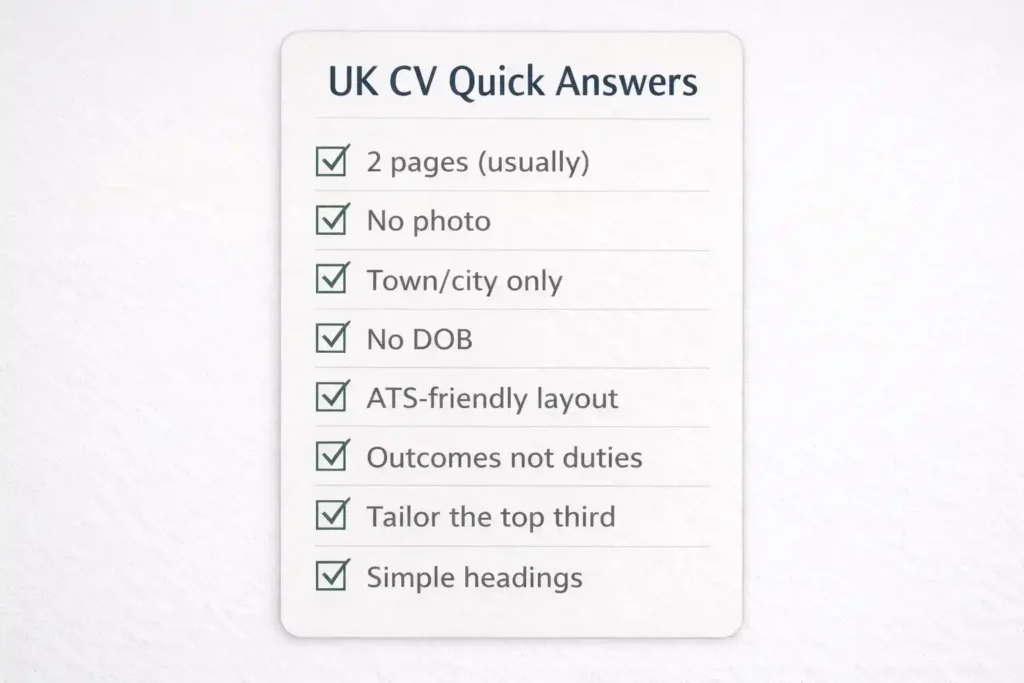
- CV length (UK): Aim for two pages. One page can work early-career.
- Photo on a UK CV: Usually no. Only add one when the role requires it.
- Address: Use your town/city and postcode area. Skip the full address.
- Date of birth: Leave it off in most UK applications.
- References: Write “References available on request” or remove the line.
- Education order: Put experience first (if you have it).
- Gaps: Explain briefly. Then show what you did and what you learned.
- ATS: Keep formatting simple. Avoid tables, columns, and text boxes.
- Achievements: Lead with outcomes. Add numbers where you can.
- Tailoring: Mirror the job advert’s wording, but stay honest and specific.
The most asked curriculum vitae questions (with clear answers)
1) How long should a UK CV be in 2026?
For most UK roles, two pages is the sweet spot. It’s long enough to show proof, but short enough to scan quickly. One page can work for graduates or early careers, especially if experience is limited. Three pages is rare outside academia or specialist roles. Therefore, cut repetition first. Remove generic claims and duplicated duties. Then tighten older roles into fewer bullets. For general CV structure, the National Careers Service guidance is a solid benchmark (link it here).
2) What’s the difference between a CV and a résumé in the UK?
In the UK, “CV” is the normal term for job applications. “Résumé” often suggests a shorter, US-style document. However, the hiring goal stays the same: a clear pitch, backed by evidence. In practice, you should focus on relevance and readability. Use a short profile, a tight skills list, and achievement-led bullets. If an employer asks for a résumé, a targeted UK CV still works in many cases. Just keep it clean and role-focused.
3) Do I need a personal statement at the top of my CV?
In most cases, yes. A strong personal statement frames your value fast. Keep it to 4–6 lines, not a full paragraph. Start with your target role and specialism. Then add two proof points, such as outcomes, tools, sectors, or scale. Finally, say what you want next. Avoid soft claims like “hard-working” unless you prove them. Instead, use specifics. For example, mention stakeholder level, project size, or measurable results. As a result, recruiters “get you” quickly.
4) Should I include a photo on a UK CV?
Usually, no. Most UK employers don’t expect photos. A photo can also distract from your evidence. Only add one when the industry expects it (for example, acting) or when the employer requests it. If you’re unsure, leave it out. Use the space to strengthen your profile or add a key achievement. Meanwhile, keep your formatting ATS-friendly. Simple layouts travel better across portals and devices. Your goal is clarity, not decoration.
5) What personal details should I include on a UK CV?
Keep it simple: name, mobile number, email, and location. “London” or “Grantham, Lincolnshire” is usually enough. Add a LinkedIn URL only if it’s up to date and consistent. Avoid full address, date of birth, marital status, nationality, or a photo. Those details rarely help and can add risk. If an employer needs right-to-work confirmation, they’ll ask later in the process. You can link to GOV.UK right-to-work guidance here for reassurance.
6) Where should education go on a CV?
Put your strongest evidence near the top. If you have solid work experience, lead with experience. Then place education below. If you’re a graduate, switching careers, or early in your journey, education can come first. On the other hand, if a certification is essential, surface it earlier even if you’re experienced. In practice, recruiters look for “fit signals” quickly. Therefore, let the job advert decide the order. Make the key qualification easy to find without hunting.
7) Should I list every job I’ve ever had?
No. List what supports the role you want now. Most people only need the last 10–15 years in detail. Older roles can sit under “Earlier Career” with one-line summaries. If a short role needs context, add a brief note and move on. Don’t over-explain. Also, avoid long lists of unrelated duties. Instead, highlight transferable outcomes that match the advert. As a result, your CV reads like a focused story, not a timeline dump.
8) How do I write achievements (not just responsibilities)?
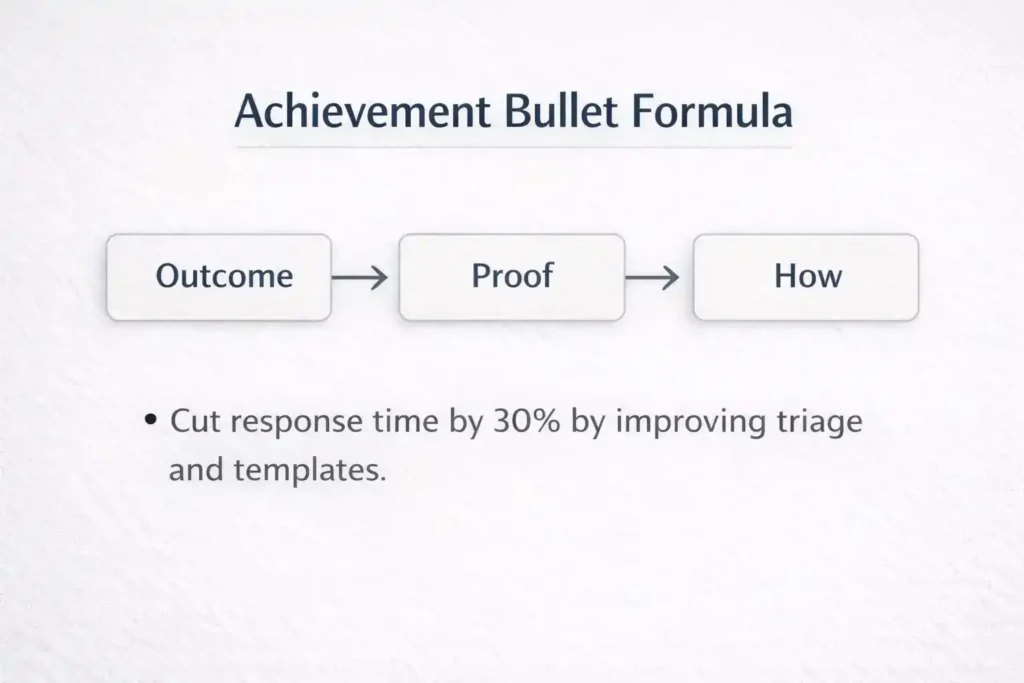
Start with the outcome, then add the “how”. For example: “Reduced response time by 30% by improving triage and templates.” Numbers help, but they’re not the only proof. If you lack metrics, use scope and complexity. Mention volume, risk, stakeholders, or turnaround time. Swap “responsible for” with action verbs like delivered, improved, led, built, resolved, or increased. Finally, choose achievements that match the employer’s priorities. Relevance beats variety every time.
9) What makes a CV ATS-friendly in 2026?
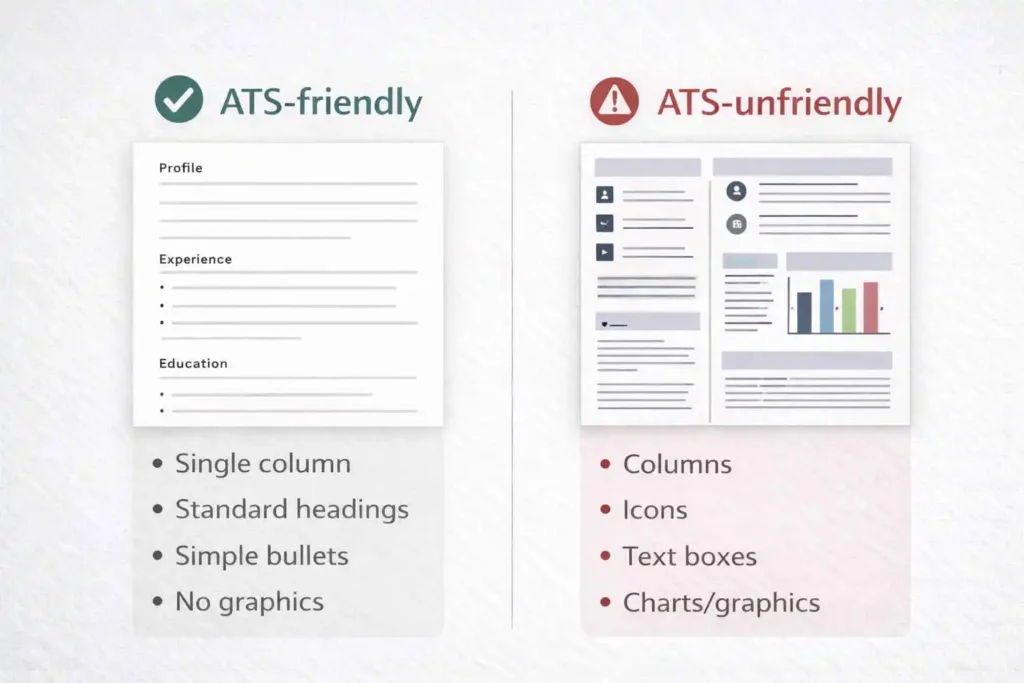
Use a simple layout with standard headings. Avoid tables, columns, text boxes, icons, and heavy graphics. Those features often break ATS parsing. Keep bullets clean and consistent. Use a normal font and clear spacing. Save the file with a sensible name, such as “Firstname-Lastname-CV”. If the portal shows a messy preview, switch format and re-check. If you want a deeper checklist, you can link internally to your ATS guide: https://brendanhope.com/blog/ats-cv-optimisation-uk-guide/
10) How much should I tailor my CV for each job?
Tailor the parts recruiters read first. That means your headline, personal statement, and top skills. Then reorder bullets so the most relevant evidence sits near the top of each role. You don’t need a full rewrite each time. However, you do need alignment. Mirror the advert’s wording naturally, especially tools, role tasks, and keywords. Stay honest and specific. As a result, your CV reads like a match, not a generic broadcast. It also helps ATS pick up the right signals.
11) How should I explain employment gaps on my CV?
Label the gap briefly and confidently. For example: “Career break (family care)” or “Redundancy and job search.” Then show what you did, even if it wasn’t paid work. Training, volunteering, projects, and short courses all count. Keep health detail private if you prefer. Focus on readiness now. Meanwhile, strengthen your profile so the reader anchors on your direction, not the gap. A short, calm explanation usually lands better than a long defence.
12) Should I include hobbies and interests?
Only if they add value. Leadership, volunteering, sport, or side projects can support your story. Generic hobbies rarely help, especially if space is tight. Keep it to one or two lines near the end. If you’re early career, interests can show initiative and character. If you’re senior, outcomes matter more than personality cues. Therefore, prioritise evidence first. Add interests only when they genuinely reinforce fit for the role or show relevant skills in action.
13) Should I write “References available on request”?
You can, but you don’t have to. Many UK recruiters assume references come later. Therefore, you can remove the line and use the space for stronger content. Never list referee contact details on your CV unless the employer asks. That protects your referees and keeps things tidy. If you want an external reference point, ACAS has guidance on providing job references. In practice, employers care more about your proof of impact than a references line.
14) What should I put in a “Key Skills” section?
Choose 8–12 skills that match the job advert. Mix hard skills (tools, systems, methods) with role skills (stakeholder management, analysis, delivery). Keep each skill short, not a sentence. Then prove the skills in your bullets. That proof matters more than the list. Avoid vague skills like “communication” unless you show how you use it. For example, “Executive stakeholder reporting” is clearer. Meanwhile, keep the skills section near the top. It helps scanning and ATS matching.
15) How do I use keywords without sounding robotic?
Pull keywords from the job advert and place them where they feel natural. Use them in your profile, skills list, and experience bullets. However, always add context. Don’t dump a block of terms. Instead, show the keyword inside a result. For example, “Implemented Salesforce dashboards to improve pipeline accuracy.” That reads like real work, not stuffing. Also, use variations of the same phrase. This helps you match different wording styles. As a result, both ATS and humans can follow your story.
16) How do I show promotions or internal moves?
Stack roles under one employer. Keep the company name once, then list each role with its own dates. Use bullets that show progression, such as bigger scope, higher targets, or wider stakeholders. If a restructure changed titles, add a short note, not a paragraph. Make the growth obvious. Recruiters like clear trajectory. Therefore, don’t hide promotions inside one blended role. Separate them and lead with your strongest outcomes. It signals trust, momentum, and capability.
17) How do I write a CV for a career change?
Start with a clear target title and direction. Then build a skills section that mirrors the advert. Next, rewrite bullets to show transferable outcomes, not old job labels. Add a short “Relevant Projects” section if it helps you bridge the gap. Show commitment with recent training, certifications, or portfolio work. Keep the tone confident and practical. Avoid apologies or over-explaining. In practice, career-change CVs win when they show proof and clarity. The reader must see “why you” quickly.
18) Should I send a CV as PDF or Word?
Follow the employer’s instruction first. If they ask for Word, send Word. If they don’t specify, PDF often looks cleaner and keeps formatting stable. However, some older ATS setups prefer Word. So check the portal preview if you can. If it breaks, switch format and upload again. Keep file names professional and readable. Avoid “final-final-2”. Use “Firstname-Lastname-CV” instead. It sounds small, but it signals care and professionalism.
Common mistakes people make when answering curriculum vitae questions
- A vague profile. Fix: name the role, niche, and proof points.
- Duty-only bullets. Fix: lead with outcomes and add scope.
- Too much design. Fix: simplify for scanning and ATS.
- Weak keywords. Fix: mirror the advert, then prove it.
- Unclear dates. Fix: use consistent month/year formatting.
- Long CVs with repeats. Fix: cut duplicates and old detail first.
- Generic skills lists. Fix: choose skills you can demonstrate.
When to DIY vs when to hire a professional CV writer
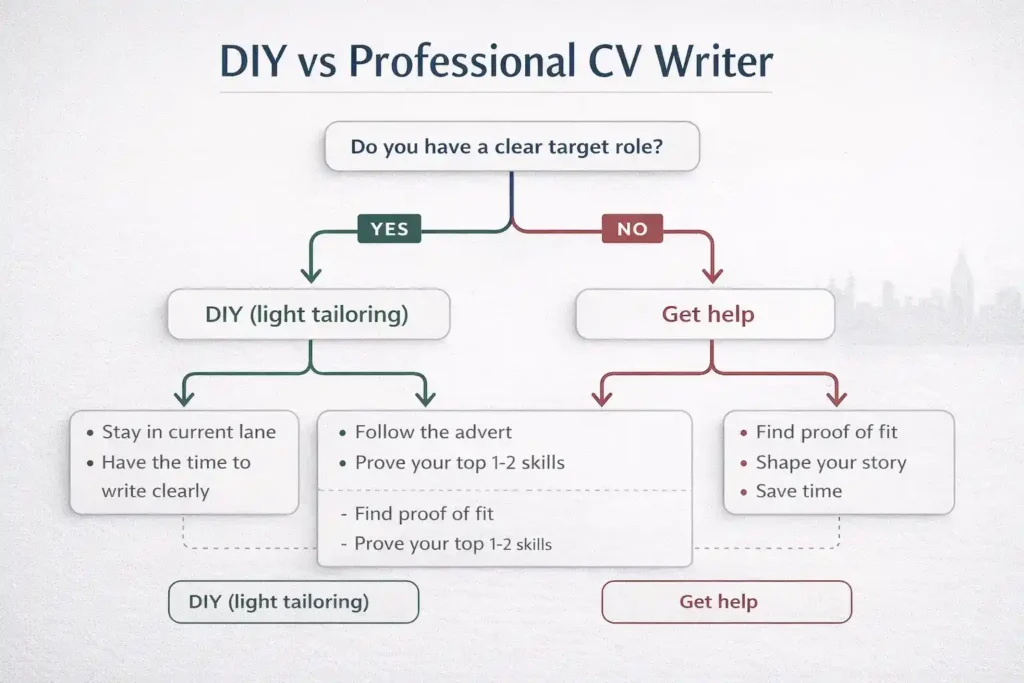
DIY works when you have time, clear direction, and decent writing habits. It also works when you’re staying in the same lane and your experience already matches the role.
Hiring help makes sense when the stakes are higher. For example, senior roles, career changes, long gaps, or competitive sectors. A good writer won’t invent content. They’ll pull out your best evidence, sharpen your message, and improve structure. If you want hands-on support, start with the right service level: a professional CV writing service or an executive CV writing service.
Next step
If you want a quick, honest steer, request a free CV review. You’ll get practical next steps you can action straight away.
If you’re early career, you may prefer the graduate CV writing service. It focuses on structure, clarity, and translating education into employer-ready proof.
FAQs About Curriculum Vitae Questions
Is a UK CV ever allowed to be one page?
Yes, sometimes. One page can work for graduates, entry-level roles, and internships. It can also work when your experience is limited but relevant. However, don’t force it if it makes your CV vague. Two pages is often clearer, because you can show proof. If you choose one page, tighten your profile, keep skills focused, and use achievement-led bullets. Remove filler lines and repeated duties. Clarity always beats “short”.
Should I include my full address on my CV?
Usually, no. A town or city is enough for most UK applications. Full addresses add clutter and don’t help hiring decisions. They can also create privacy issues. If a role is location-sensitive, show your location and availability instead. For example: “London (open to hybrid)” or “Nottingham (relocating)”. If the employer needs checks later, they will ask for your address at offer stage. Keep the CV clean and role-focused.
Do I need to include a cover letter as well?
Often, yes. Some employers still rely on cover letters to test motivation and fit. It’s especially useful for career changes, gaps, or when you’re applying slightly “up”. Keep it short. Use one clear reason for interest, then one or two proof examples. Avoid repeating your CV. Instead, add context that your CV can’t show. If the application portal includes a “supporting statement”, treat it like a structured cover letter.
How many bullet points should I use per job?
Aim for 4–6 strong bullets for recent, relevant roles. Use fewer bullets for older roles. Each bullet should show impact, not tasks. If a role needs more detail, add a short “Key achievements” sub-list, but keep it readable. Also, put your best bullets first. Recruiters skim. Therefore, lead with outcomes that match the advert. If your bullets feel repetitive, combine them and sharpen the result. Fewer, stronger bullets usually win.
What if I don’t have metrics for achievements?
Use other proof. Mention scope, complexity, pace, or risk. For example, “Handled a 60+ ticket daily queue” or “Supported a £2m budget line”. You can also show quality, such as fewer errors, smoother handovers, or improved compliance. If you can add one metric, start with time and volume. They’re often easiest to estimate accurately. Keep it honest. Recruiters value believable evidence more than inflated numbers.
What’s the best order for sections on a UK CV?
A common order is: contact details, profile, key skills, experience, education, then extras (certs, interests). However, you should adjust for your situation. Graduates may place education earlier. Career changers may use a “Relevant projects” section before experience. The goal is simple: show the most convincing proof first. Therefore, structure your CV for scanning. Put the strongest match signals on page one, above the fold.
Conclusion
These curriculum vitae questions matter because small choices change how recruiters read you. Keep your CV simple, evidence-led, and aligned to the role. Then tailor the top third so your fit is obvious fast.
If you want a clear next step, start with a free CV review.
Recent Comments